Dreams of Becoming an Economic Power—But at What Cost?
X: @vivekbhavsar
Mumbai is often described as the financial capital of India—a city that hosts multiple foreign consulates and where diplomats carefully monitor Maharashtra’s political climate before advising their governments and companies on investment decisions. Yet today, this very capital has been virtually paralysed by a section of the ongoing Maratha reservation agitation.
Mumbai’s Legacy of Protests
For over a century, Mumbai has been the epicentre of movements—whether during the British Raj, the post-independence Samyukta Maharashtra movement, in which 105 protestors laid down their lives as martyrs for the cause of a united Maharashtra or the countless farmer and tribal protests that followed. The city has seen orderly and disciplined demonstrations, most notably the historic Maratha Kranti Morcha, which mobilised lakhs with remarkable restraint.

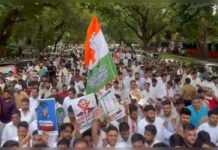
But the recent agitation led by Manoj Jarange-Patil stands in stark contrast. What Mumbai has witnessed over the last few days is unprecedented—protesters virtually holding the city hostage, disrupting its lifelines, and in some cases, treating public spaces like playgrounds.
A Different Kind of Protest
For four consecutive days, agitators occupied Chhatrapati Shivaji Maharaj Terminus, one of India’s busiest railway stations. At times they played kabaddi, at others they staged cultural games in areas critical to passenger movement. Soon, the demonstrations spilt over—local trains were halted, buses stopped, and even the state secretariat was surrounded.
This raises a fundamental question: what kind of protest justifies bringing a global financial hub to a standstill?

The Root of the Issue
It is undeniable that a large section of the Maratha community is economically distressed. But to blame the government alone would be simplistic. The truth is that the wealthy and politically powerful within the Maratha community itself have kept their poorer brethren on the margins.
Most educational institutions—medical colleges, engineering colleges, and universities—are owned by Maratha politicians or elites. Poor students, whether Maratha or OBC, rarely gain admission unless they can pay hefty donations. Parents from marginalised backgrounds are often told bluntly: “If you have the money, sit down. If not, leave.” Why does the agitation not question this entrenched system?
Several political leaders who today back Jarange-Patil have never ensured free or fair access to their own institutions. By contrast, leaders like Dr. Tanaji Sawant—despite being frequently criticised—have extended subsidised or even free education to needy students.

What the Government Has Already Done
To address economic distress, the state has already provided a 10% quota under the Economically Weaker Section (EWS) category, benefiting thousands of underprivileged Maratha youth. Institutions like the Annasaheb Patil Financial Development Corporation are actively supporting Maratha entrepreneurs. Hostels for students have been set up across districts.
And yet, the agitators remain fixated on one demand: inclusion of the entire Maratha community under the OBC quota. Such a move, however, would effectively endanger the rights of smaller OBC castes—hundreds of communities where many children still do not study beyond secondary school.

This demand, therefore, is not only socially unjust but constitutionally unsustainable.
The Wider Consequences
The government has shown remarkable restraint. Protesters were allowed to enter Mumbai. Despite having permission for only one day, they have continued for four. Roads were blocked, trains were stopped, yet the administration has held back its hand. This is not weakness—it is patience, meant to ensure justice within the constitutional framework.
But what about the larger consequences? How is Maharashtra being perceived globally? Can a state that cannot ensure normalcy in its financial capital truly hope to become a $1-trillion economy?
Foreign diplomats take such disturbances seriously. I recall, during the Bhima-Koregaon violence, officials from two European nations summoned me privately to ask: Is their investment in Pune safe? Should they continue expanding in Maharashtra? It took great effort to reassure them. Fortunately, that unrest did not spread statewide. Today, both countries remain among Maharashtra’s strongest investors.
But will they remain as confident if Mumbai itself continues to be held hostage?

Risk of Capital Flight
The risk is very real: investment could shift to Gujarat or other states perceived as more stable. If that happens, the very leaders and education barons supporting this agitation will blame the government, but the damage—lost jobs, lost opportunities—will fall squarely on the youth of the Maratha community itself.
Already, Marathwada is attracting significant new investments. If such protests derail the momentum, the region’s development will be reduced to a dream deferred.
The Way Forward
The solution lies in dialogue, not coercion. Manoj Jarange-Patil and his followers must give the government space to work within the boundaries of law and the constitution. Agitations that disrupt the life of Mumbai only weaken Maharashtra’s credibility at home and abroad.
Also Read: Pune Zilla Parishad’s Skill on Wheels Brings Hands-On Learning to Rural Classrooms
At the same time, Jarange-Patil’s political positioning cannot be ignored. His persistent criticism of Chief Minister Devendra Fadnavis, coupled with open praise for Deputy Chief Minister Eknath Shinde, reflects a partisan approach. Ironically, public sentiment across Maharashtra is increasingly shifting in favour of Fadnavis, while Shinde faces mounting negativity.
At a time when tough decisions must be made and the government needs resolute leadership, Shinde has chosen to remain absent from the frontlines. The people of Maharashtra will not easily forget this retreat. Jarange-Patil must recognise that his movement risks being remembered less for justice and more for political partiality.
If Maharashtra is to achieve its rightful place as a global investment destination, its social movements must also respect democratic discipline and its leadership must demonstrate political courage. Otherwise, the promise of prosperity will remain just that—a promise.
(The author, Vivek Bhavsar, is the Editor of Rajkaran and TheNews21, independent news platforms based in Mumbai)