A proposed Water Metro along the Ulhas River is triggering a larger debate about the future of mobility, infrastructure and urban expansion in eastern Mumbai Metropolitan Region.
By Vivek Bhavsar | Editor-in-Chief, TheNews21
THE ULHAS CORRIDOR SERIES | PART I OF III
Mumbai: For decades, the story of Mumbai Metropolitan Region’s (MMR) growth was written largely around the western corridor. Infrastructure investments, real-estate expansion, commercial activity and political attention flows steadily toward Mumbai, Thane, Navi Mumbai and the western suburban belt. But quietly, another geography is now beginning to change the future conversation around urban Maharashtra — the eastern MMR corridor stretching from Kalyan to Badlapur. What was once viewed as a distant suburban extension is now steadily evolving into a strategic growth belt shaped by highways, logistics networks, industrial expansion and proposed multimodal infrastructure projects. The transformation may still be unfolding gradually, but the direction is becoming increasingly visible.
It is within this changing landscape that an unusual proposal has now emerged from Badlapur — a proposed “Kalyan–Badlapur Water Metro” using the Ulhas River as a future mass transit corridor. The proposal, submitted through a Detailed Project Report (DPR) by former Kulgaon-Badlapur Municipal Council President Nandkishor alias Ram Patkar, seeks to position the Ulhas River not merely as a neglected water body, but as a long-term urban mobility and economic asset. The proposal itself may appear ambitious, even futuristic. But the larger question it raises deserves serious policy attention: Is eastern MMR entering a phase where conventional rail and road expansion alone may no longer be sufficient?
That question is no longer theoretical.
The Kalyan–Badlapur belt is already witnessing the cumulative impact of multiple infrastructure shifts. The influence zone of the Mumbai–Nagpur Samruddhi Mahamarg is steadily altering development patterns across eastern Maharashtra. The proposed Alibaug–Virar Multimodal Corridor is expected to improve regional freight and mobility integration across MMR. The Vadodara–Mumbai Expressway connectivity and logistics movement through the Badlapur-Ambernath belt are increasing the strategic importance of the region. Discussions around future metro connectivity and emerging industrial expansion are adding another layer to this transformation.
At the same time, Kalyan is rapidly emerging as one of the most critical transport junctions in the Mumbai region. The Central Railway corridor beyond Kalyan continues to operate under immense pressure, carrying lakhs of commuters daily under dangerously overcrowded conditions. Road congestion between Kalyan, Ambernath and Badlapur has also worsened sharply over the last decade, with daily commute times continuing to rise. Against this backdrop, the Water Metro proposal attempts to introduce a “third mobility axis” — one that does not depend entirely on acquiring new land for rail tracks or widening roads.
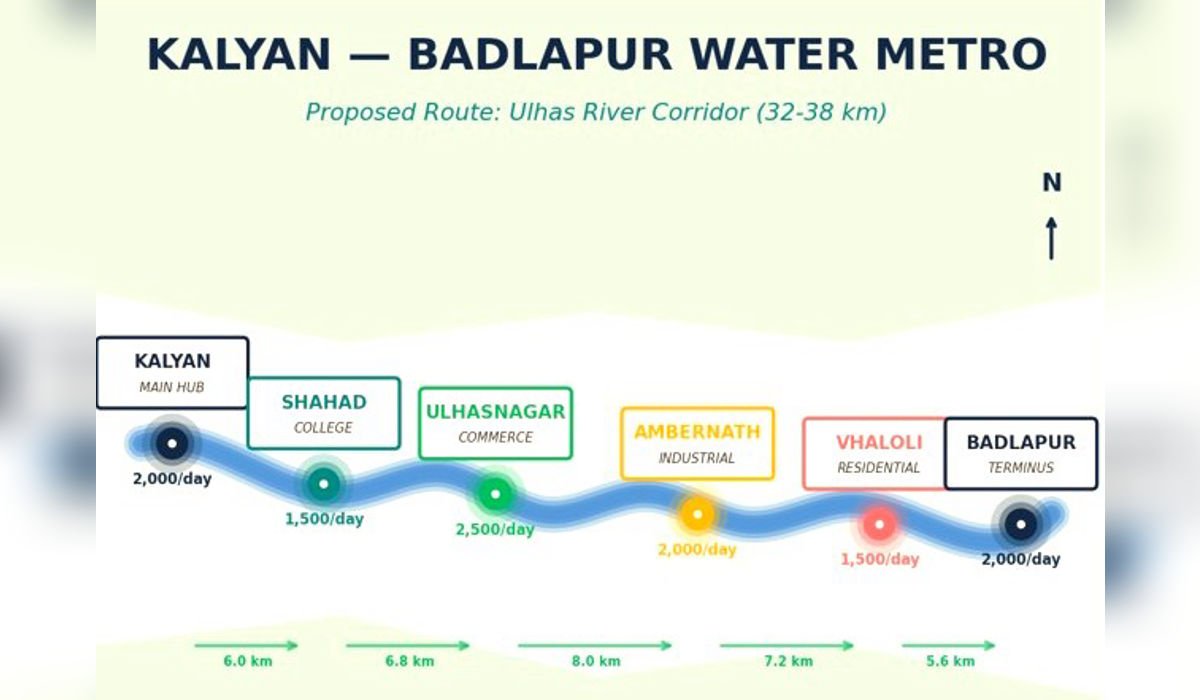
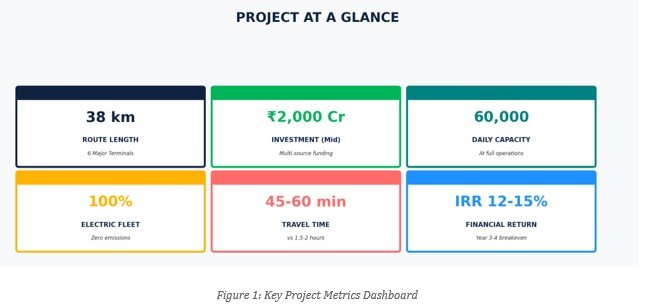
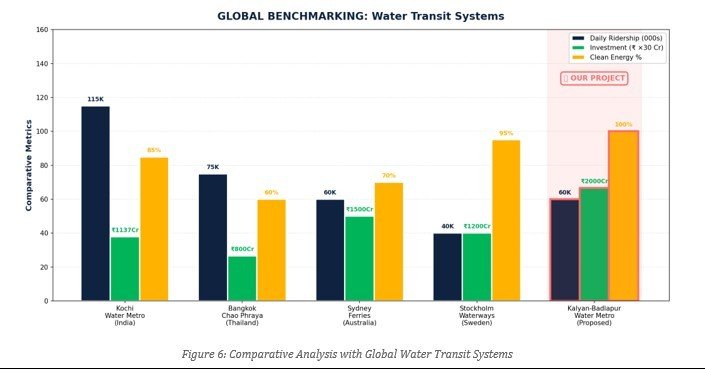
The DPR proposes a 32–38 km electric water transit corridor connecting Kalyan, Shahad, Ulhasnagar, Ambernath, Vhaloli and Badlapur through six terminals using electric catamaran vessels. The document claims the system could eventually support up to 60,000 passengers daily while reducing travel time significantly. The proposal draws heavily from the Kochi Water Metro model, which has increasingly become a reference point in India’s urban water mobility discussions. The DPR also frames the project not only as a transport solution, but as a wider riverfront development and economic integration initiative involving tourism, logistics, environmental restoration and future industrial cargo movement.
Importantly, the proposal emerges at a time when global cities are once again reconsidering waterways as part of urban transport planning. Across parts of Europe and Asia, governments are revisiting river systems because traditional infrastructure expansion is becoming financially and environmentally difficult. Metro rail systems require enormous capital investments. Urban land acquisition has become politically sensitive and economically expensive. Roads alone are no longer capable of solving congestion in rapidly expanding metropolitan regions. In that sense, the Ulhas River proposal reflects a larger shift in infrastructure thinking — whether practical or not.
Ram Patkar, who submitted the proposal to the Maharashtra government, argues that the Ulhas River should be viewed as a strategic regional asset rather than merely a neglected river channel. “True progress in public transportation lies not in laying more roads, but in using waterways sustainably and intelligently,” Patkar states in the proposal submitted to the state government.
Yet the proposal also raises equally serious questions.
Can the Ulhas River realistically support year-round passenger-grade navigation? Can dredging and river engineering be carried out without major environmental consequences? Will the financial estimates remain viable once actual implementation begins? Can a largely rail-dependent commuter population shift meaningfully toward water transport? And perhaps most importantly — is Maharashtra institutionally prepared to think about waterways as part of mainstream urban mobility planning?
Those questions cannot be brushed aside through political enthusiasm alone.
The Ulhas River today suffers from severe pollution, encroachments, siltation and ecological stress across multiple stretches. Monsoon water behaviour remains unpredictable in several areas. Environmental clearances for large-scale dredging could become highly complex. Even the financial estimates within the DPR show significant variability in potential project cost depending on engineering requirements.
Still, dismissing the proposal outright may also be shortsighted.
Large infrastructure transformations often begin first as unconventional ideas before eventually entering mainstream planning discussions. Mumbai’s Trans Harbour Link, Coastal Road, Metro expansion and Samruddhi Mahamarg all faced skepticism during their early conceptual phases. Not every proposal ultimately succeeds. But serious policy conversations often begin long before governments formally adopt them. That is perhaps where the Kalyan–Badlapur Water Metro proposal currently stands — not as a confirmed project, but as a provocative infrastructure question emerging from a rapidly changing region.
The real significance of the proposal may therefore lie beyond boats, terminals or river routes. It lies in what the proposal reveals about the future pressures building within eastern MMR.
The Badlapur of the future is unlikely to remain merely a distant railway suburb dependent on overcrowded trains and narrow roads. The region is steadily entering a larger economic and infrastructural transition. Whether policymakers are planning sufficiently for that transformation remains an open question and perhaps that is the larger debate this proposal has now triggered.
Because the real question may no longer be whether eastern MMR will expand. The real question is whether Maharashtra’s infrastructure imagination is expanding fast enough to keep pace with it.
Coming Next in Part II
“Kalyan–Badlapur Water Metro: Revolutionary Mobility Solution or Financial and Environmental Gamble?”
The next part will examine the project’s technical feasibility, financial viability, environmental concerns and the larger debate over whether waterways can realistically emerge as a future mobility solution for eastern MMR.