

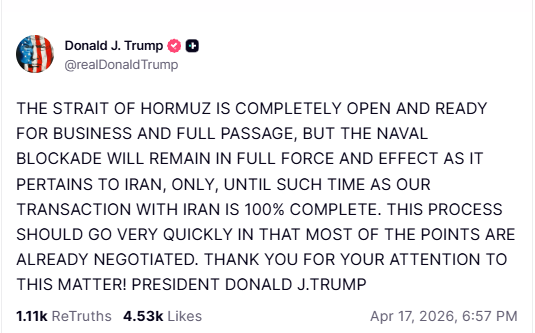
US President Donald Trump announced that the Strait of Hormuz is now fully open for commercial passage, but confirmed that the naval blockade on Iran will continue until Washington’s ongoing negotiations with Tehran are “100% complete.”
In a statement posted on social media, Trump said the crucial global shipping route was “completely open and ready for business,” signalling relief for global trade and energy markets after days of uncertainty in the Gulf.
However, he made it clear that the United States would continue to maintain strict naval restrictions specifically on Iran, even while allowing normal passage through one of the world’s most important maritime routes.
Trump Says Strait Open, But Pressure on Iran Remains
Trump said that while the Strait of Hormuz had reopened for “full passage,” the US naval blockade would remain in full force against Iran only until the ongoing diplomatic process was fully concluded.
The move suggests that while Washington is easing pressure on international shipping, it is still using maritime restrictions as leverage in negotiations with Tehran.
Major Relief for Global Trade and Oil Markets
The reopening of the Strait of Hormuz is significant because the narrow waterway handles a large share of the world’s oil and gas shipments.
Any disruption in the strait typically raises fears of oil supply shocks and spikes in global energy prices.
Trump’s announcement is likely to calm international markets, as the reopening ensures commercial vessels can once again move freely through the route without immediate concerns over wider regional disruptions.
At the same time, the continued blockade on Iran indicates that tensions between Washington and Tehran remain unresolved.
Naval Blockade Still Targets Iran
While commercial shipping has resumed, the US naval blockade against Iran remains active, meaning Iranian-linked maritime activity continues to face restrictions.
The strategy appears aimed at maintaining pressure on Iran during the final stages of negotiations while preventing broader disruption to international trade.
By separating global commercial passage from the Iran-specific blockade, Washington is attempting to stabilise shipping lanes without giving up strategic leverage.
Trump Signals Diplomatic Breakthrough Could Be Close
Trump’s statement suggests the US believes an agreement with Iran may be nearing completion.
By saying that “most of the points are already negotiated,” he indicated that only final terms remain before the broader “transaction” with Iran is finalised.
If negotiations succeed, it could mark a significant de-escalation in tensions in the Gulf region and reduce risks to global energy supplies.
However, until a final deal is reached, the US appears determined to keep economic and military pressure on Tehran.
Strategic Waterway Remains at Center of Global Focus
The Strait of Hormuz remains one of the most strategically important waterways in the world, connecting Gulf oil producers to global markets.
Any military or political developments affecting the strait have immediate global consequences, particularly for oil-importing economies.
Trump’s latest statement signals that while immediate fears of a wider maritime disruption may have eased, the geopolitical confrontation with Iran is far from over.
Q1. What did Donald Trump announce about the Strait of Hormuz?
Trump said the Strait of Hormuz is fully open for business and commercial passage.
Q2. Is the US naval blockade on Iran over?
No, Trump said the naval blockade on Iran remains in full force.
Q3. Why is the Strait of Hormuz important?
It is a key global shipping route for oil and gas exports.
Q4. What did Trump say about the Iran deal?
He said most negotiation points are already settled and the process should move quickly.
Q5. What does this mean for global markets?
It could ease fears of oil supply disruption while negotiations with Iran continue.


