X: @vivekbhavsar
Part VII – The Hidden Burden of Commitment Charges
Maharashtra has not only paid dearly for the loans it drew — it has also bled quietly for loans it never used. Over the last 25 years, the state has shelled out over ₹50 crore in “commitment charges”, a penalty levied by the World Bank simply because sanctioned funds remained undrawn.
This is money that built no schools, irrigated no farms, and saved no jobs. It is fiscal leakage at its worst: crores drained away only because governments borrowed more than they could spend.
The Early Years – A Few Crores Lost
In the 2000s, commitment charges seemed negligible. Maharashtra’s outgo ranged from just ₹1–5 crore annually. Projects like Bombay Sewage Disposal and Rural Water & Sanitation attracted modest charges when funds lay idle.
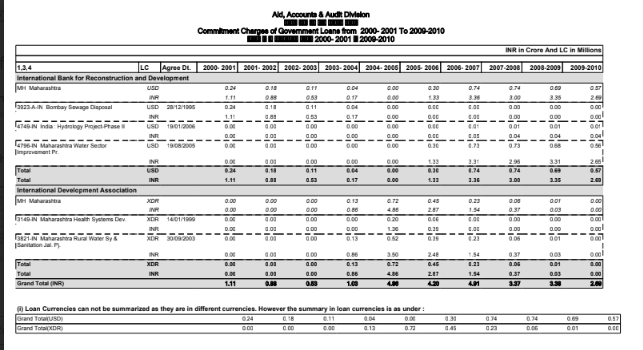
But the pattern was already there — money leaving the exchequer without any developmental return.
The 2010s – The Curve Rises
By the 2010s, the hidden cost began to grow. Annual charges climbed slowly, touching ₹7.43 crore by 2019–20.
The main culprit was the Climate Resilient Agriculture project, sanctioned in 2018 but poorly utilised in its initial years.
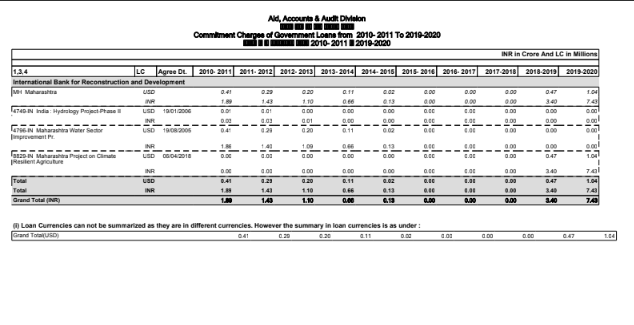
Older projects like Water Sector Improvement tapered off, but newer ones ensured the meter kept ticking.
The 2020s – A Silent Drain
The real drain emerged in the 2020s.
- 2020–21: ₹10.25 crore
- 2021–22: ₹10.13 crore
- 2022–23: ₹9.64 crore
- 2023–24: ₹6.69 crore
- 2024–25: ₹4.04 crore
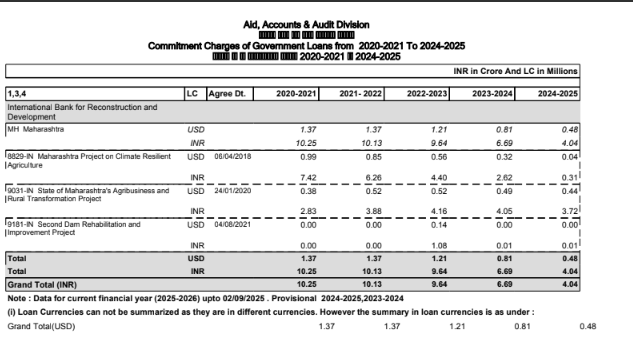
At its peak, Climate Resilient Agriculture alone absorbed ₹7.42 crore in 2020–21, while the Agribusiness Transformation Project rose steadily, from ₹2.83 crore in 2020–21 to ₹4.16 crore by 2022–23.
Even the Second Dam Rehabilitation Project added to the drain — not by building stronger dams, but by leaving undrawn funds on paper.
2025–26 – The Latest Snapshot
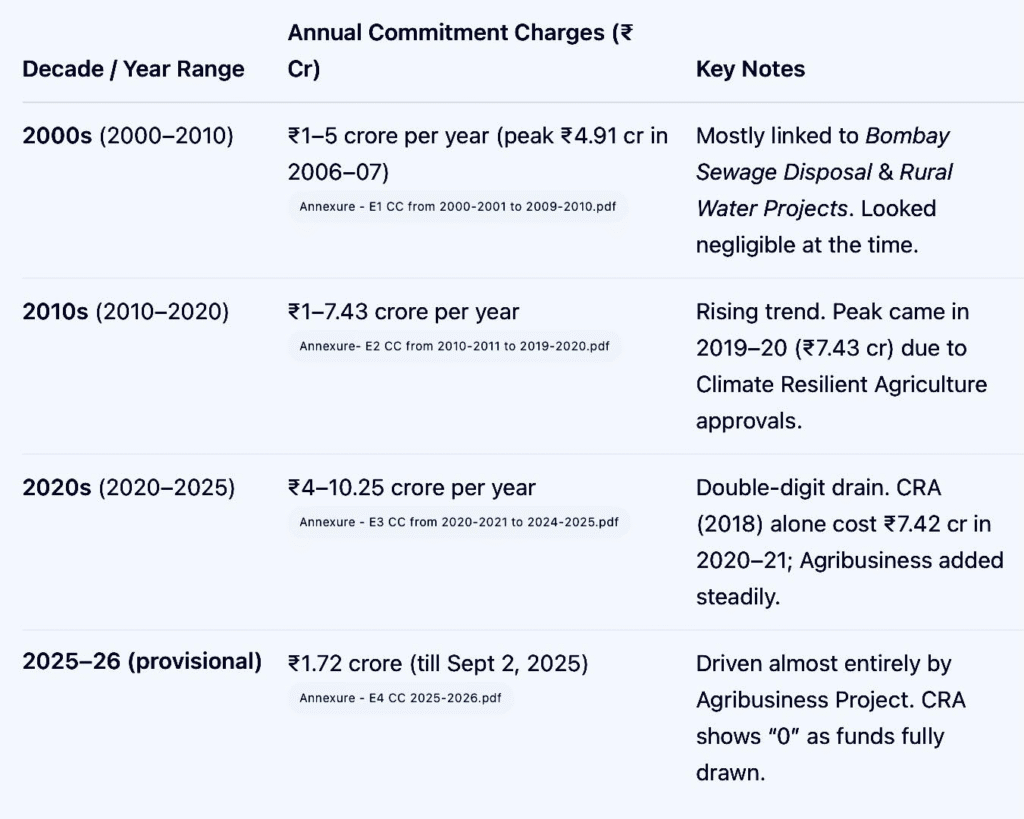
Provisional data for 2025–26 (up to Sept 2, 2025) shows ₹1.72 crore already lost . Almost the entire burden comes from the Agribusiness Transformation Project.

Notably, the Climate Resilient Agriculture project, once the costliest, now shows “zero” — only because funds have finally been drawn. The irony: Maharashtra paid crores for years just to “keep the loan open.”
The Bigger Picture
Commitment charges are often dismissed as minor. But over two decades, they have eaten into Maharashtra’s finances:
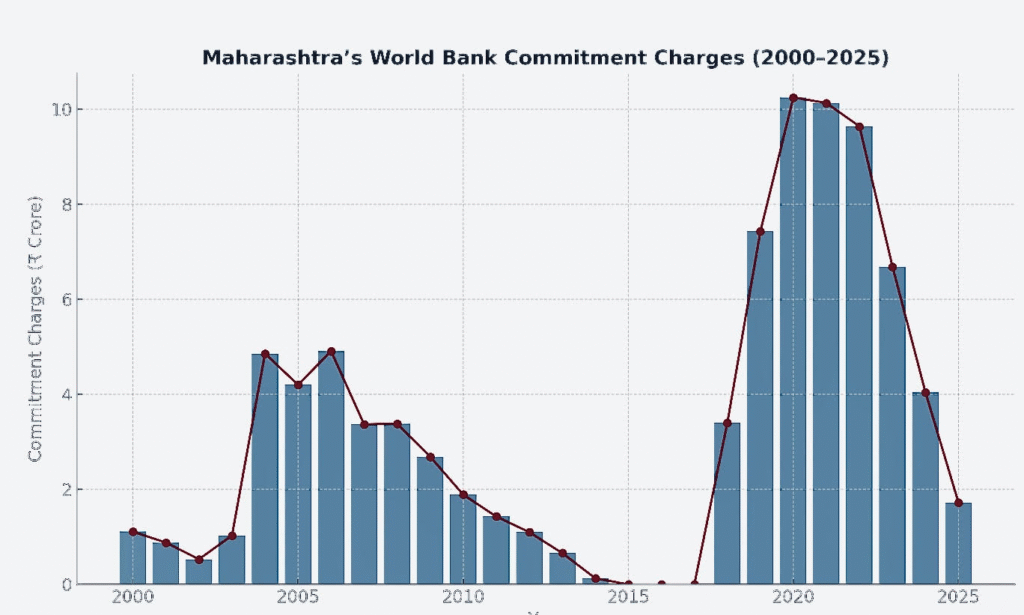
- 2000s: ₹1–5 crore a year
- 2010s: rising to ₹7 crore+
- 2020s: double-digit crores annually, peaking above ₹10 crore
What began as “loose change” has become a recurring annual tax for inaction.
Why This Matters
This is not just bad economics — it is bad governance. Every rupee paid as a commitment charge is a rupee denied to farmers, schools, or hospitals.
The lesson is stark: when governments borrow recklessly and fail to deploy funds, the World Bank still gets paid. Maharashtra, meanwhile, pays for nothing.
Also Read: Maharashtra’s World Bank Loan Trap: Hidden Costs Bleeding the State
Also Read: Maharashtra’s World Bank Loan Trap: The True Cost of Borrowing
Also Read: Maharashtra’s World Bank Loan Trap: Case Studies of Costly Projects
Also Read: Maharashtra’s World Bank Loan Trap: The Escalation Over Two Decades
Also Read: Maharashtra’s World Bank Loan Trap: Policy Questions & The Way Forward
Also Read: Maharashtra’s World Bank Loan Trap: “Climate Project or Cash Drain?”