X: @vivekbhavsar
Part 4 – Decade-wise Escalation & Hidden Costs
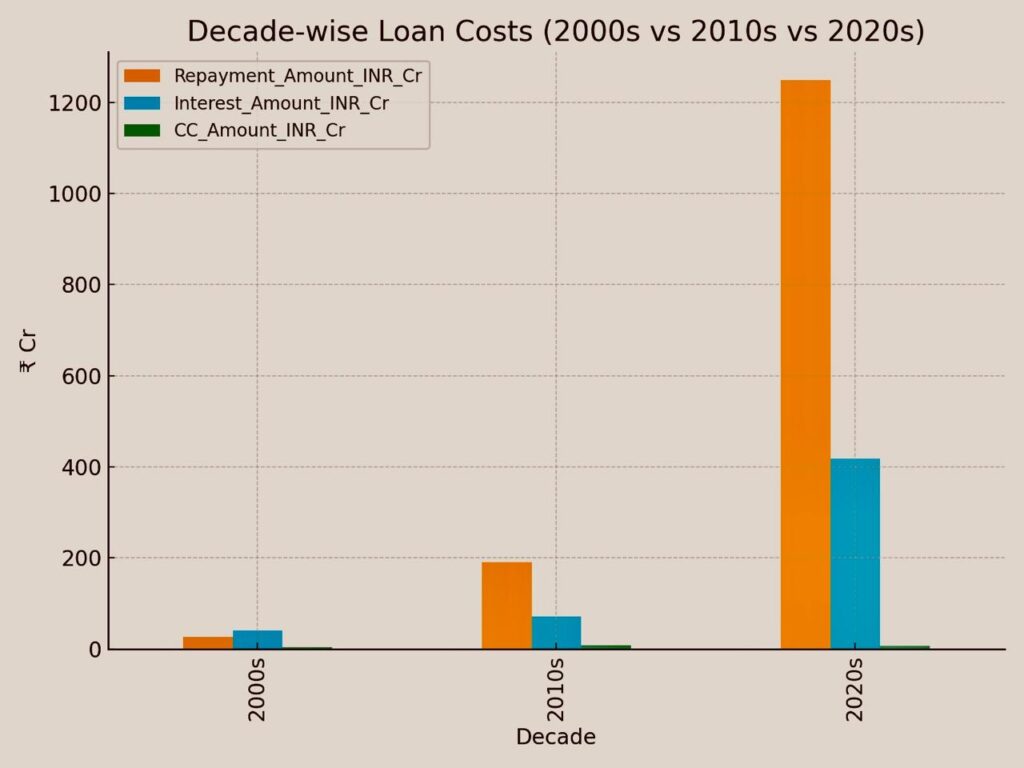
From just ₹100 crore a year in the 2000s to nearly ₹900 crore in 2024–25, Maharashtra’s World Bank loan burden has snowballed silently. Newly accessed RTI data shows how repayments, interest, and hidden charges rose decade after decade — yet remained largely absent from the public debate.
Also Read: Maharashtra’s World Bank Loan Trap: Case Studies of Costly Projects
The 2000s – A Modest Beginning
In the first decade (2000–2010), Maharashtra’s commitments under World Bank loans looked small. Annual repayments stayed within ₹50–100 crore, with interest averaging ₹10–15 crore. Key projects included the Earthquake Emergency Reconstruction and Jalswarajya Rural Water Supply.
At this stage, World Bank loans were marketed as “development partnerships” — a cheap and benign source of finance.
The 2010s – The Curve Turns Upward
By the 2010s, the tone changed. Massive projects like MUTP-2A (urban transport), Water Sector Improvement, and Agricultural Competitiveness pushed repayment bills sharply upward.
- By 2019–20, annual repayments crossed ₹400 crore.
- Interest ballooned — MUTP-2A alone cost over ₹27 crore annually.
- Commitment charges, once invisible, became routine drains — ₹3–4 crore per year on undisbursed agriculture-linked projects.
The 2020s – An Alarming Spike
The last five years reveal the true scale of the trap.
- 2022–23: Repayments touched ₹570 crore
- 2023–24: Rose further to ₹648 crore
- 2024–25: Exploded to ₹891 crore
Also Read: Maharashtra’s World Bank Loan Trap: The True Cost of Borrowing
Interest payments grew even faster:
- ₹226 crore on Climate Resilient Agriculture (2018) in 2024–25 alone
- ₹49 crore on MUTP-2A in the same year
- ₹18 crore on Agri-Business Transformation (2019)
Even unused loans cost dearly — e.g., ₹7.42 crore commitment charges on Climate Resilient Agriculture in 2020–21.
The Hidden Costs
These “extras” — interest and commitment charges — are not side notes. They are the crux. Maharashtra has often paid more in annual interest on one project than it originally borrowed for another.
Across two decades, the pattern is unmistakable: front-loaded optimism, back-loaded costs.
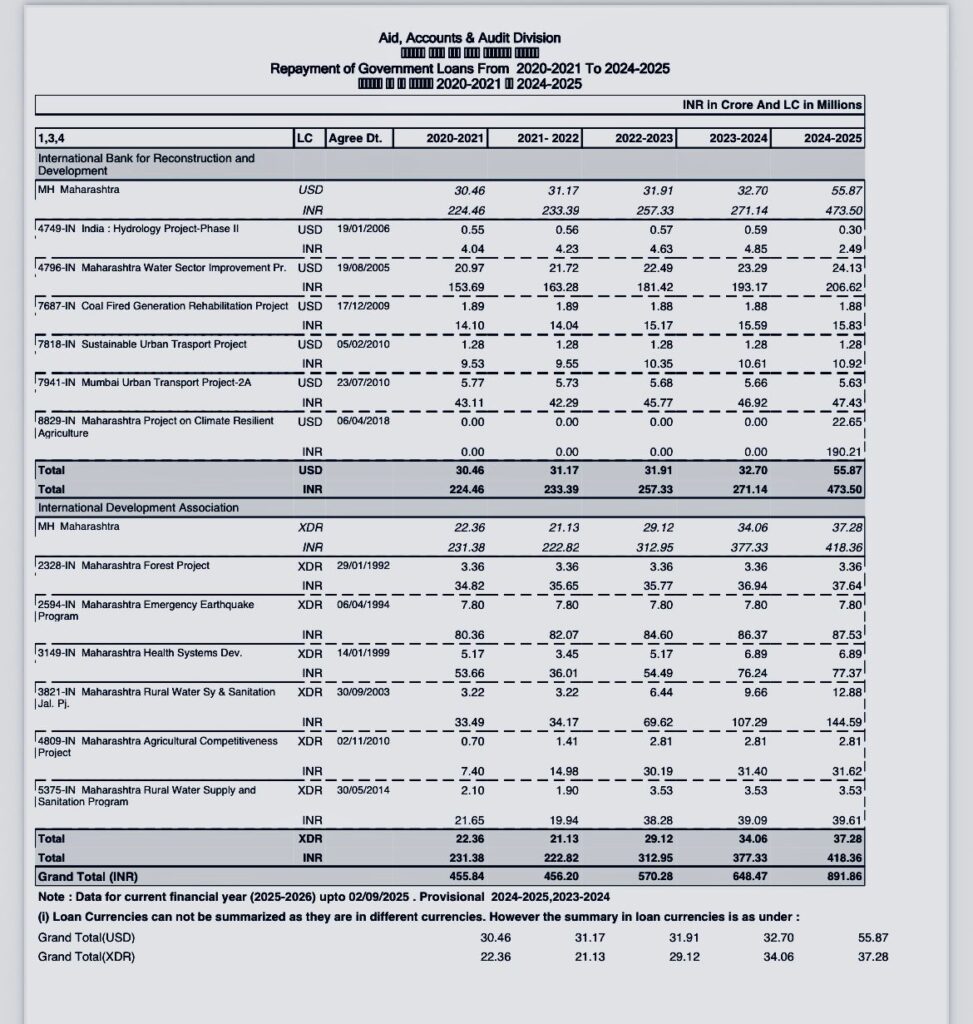
Analysis of Repayment Data (2020–21 to 2025–26)
Also Read: Maharashtra’s World Bank Loan Trap: Hidden Costs Bleeding the State
- Sharp Escalation:
- In 2020–21, Maharashtra’s World Bank repayment stood at ₹455.84 crore.
- By 2024–25, it had jumped to ₹891.86 crore — almost double in just five years .
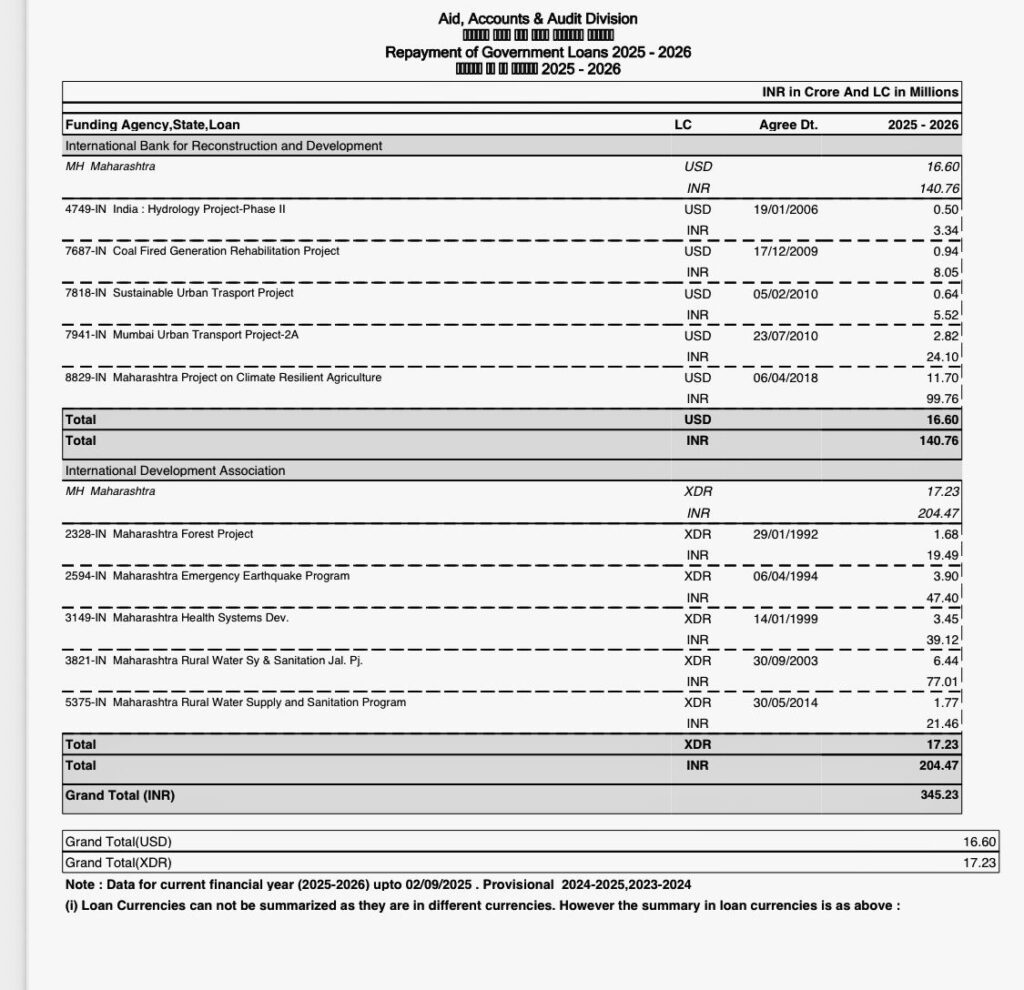
2025–26 Snapshot:
- Fresh data for 2025–26 (up to 2 Sept 2025) already shows repayments at ₹345.23 crore, with major outflows still pending.
- Key drains are Climate Resilient Agriculture (₹99.76 cr), MUTP-2A (₹24.10 cr), and Hydrology Project II (₹3.34 cr) .Hidden Costs:
- Interest and commitment charges aren’t separately broken out in these annexures, but earlier sections (Annexure C2/C3) show they run into hundreds of crores annually — especially for Climate Resilient Agriculture (₹226 cr interest in 2024–25) and MUTP-2A (~₹49 cr interest in 2024–25).
- The loan design ensures repayments spike heavily in later years, making the “cheap loan” claim misleading.
The Bigger Picture
This is not just fiscal arithmetic; it’s a structural trap. The very design of these loans ensures that by the time a project matures, Maharashtra has paid 30–60% more than the original sanction.
What began as a so-called “cheap source of finance” has, over 25 years, turned into a debt treadmill — spinning faster each year.
 Next in Part V: The policy questions no one wants to ask. Why does the state keep borrowing this way? Could Indian banks or NABARD have offered cheaper alternatives? And what urgent reforms can stop this spiral?