Inside Maharashtra’s Employment Guarantee Reality
By Vijay Shravan Gaikwad | Senior Journalist & Policy Analyst
Mumbai: A scheme that promised work as a right now struggles to deliver even as relief. In Maharashtra — the state that pioneered India’s Employment Guarantee model — a disturbing contradiction has emerged. Thousands of crores have been spent, yet the majority of eligible rural households remain without the work they were legally promised.
The question is no longer whether the scheme exists. The question is whether it works.
A Pioneering Legacy — Now Under Question
Maharashtra’s Employment Guarantee Scheme (EGS), launched in the early 1970s, was not just another welfare programme. It was a radical policy innovation — a recognition that the State has a responsibility to provide work to those who demand it.
Born out of drought, distress, and political will, the scheme became a global model. It prevented migration, supported rural incomes, and laid the foundation for what would later become the Mahatma Gandhi National Rural Employment Guarantee Act (MGNREGA) in 2005.
At its core, the idea was simple — and powerful. Work is not charity. Work is a right. That principle still exists on paper. What has changed is its delivery.
The CAG Indictment: When Spending Fails to Deliver
The latest audit by the Comptroller and Auditor General (CAG) of India presents a stark picture of that failure.
Between 2019 and 2024, Maharashtra had access to ₹13,957 crore under MGNREGS. Of this, over ₹13,500 crore was spent. Yet, of the 1.17 crore registered households, only 8.70% received the legally guaranteed 100 days of work. The numbers are not just disappointing — they are alarming.
Unemployment allowance worth ₹34.85 lakh was payable, but only a fraction was actually disbursed. Wages amounting to ₹35 crore remained unpaid. Compensation for delays was denied. Even the state’s own financial contribution was released with significant delays.
This is not a question of budget availability. It is a question of governance. ₹13,957 crore spent. 91% denied their legal right. This is not a financial gap — it is a systemic failure.
Work Sanctioned, But Not Delivered
The failure becomes deeper when one looks at execution. Out of over 25 lakh sanctioned works, nearly half either never began or remain incomplete. Projects exist on paper. Funds are allocated. But outcomes are missing.
A liability of over ₹500 crore continues to accumulate. Social audits — meant to ensure transparency — show massive gaps. Fraud cases have been identified, including manipulation of muster rolls and diversion of funds. The scheme is functioning. But not for those it was designed to serve.
Ground Reality: “It Is All on Paper”
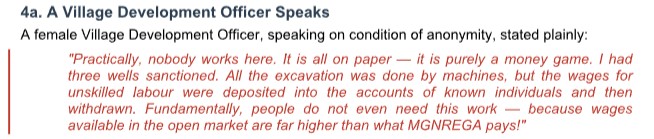
Beyond audit figures lies a more troubling reality — the voices of those who implement the scheme. A village-level officer, speaking anonymously, described the situation bluntly:
“Practically, nobody works. Everything is on paper. It is a money game.”
In several cases, work that should have generated rural employment is being executed using machines. Wages meant for labourers are routed through proxy accounts. At the same time, workers themselves are unwilling to participate — because wages under the scheme are lower than what the open market offers. This is not just leakage. It reflects a deeper structural irrelevance.
The Hiware Bazar Example: When the System Collapses
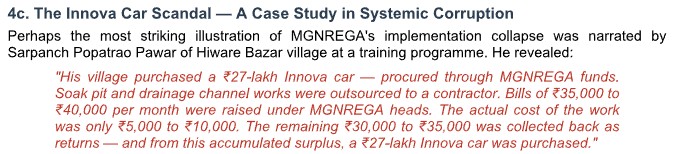
One example, narrated publicly by a village leader, illustrates the scale of distortion. In Hiware Bazar, funds under the scheme were used in a manner that led to the purchase of a ₹27 lakh vehicle. Works were shown under official records, bills were raised, and excess funds were siphoned off. What should have generated employment ended up financing assets unrelated to labour welfare. This is not an isolated case. It is a reflection of how a rights-based scheme can be hollowed out by weak implementation.
A Larger Policy Question
The debate, therefore, cannot be limited to whether such schemes should continue or not. The more important question is structural: Why does a legally guaranteed right fail to reach the majority of its intended beneficiaries?
If thousands of crores are spent and yet 91% of households do not receive their entitlement, the problem is not design alone. It is delivery. And delivery, ultimately, is governance.
Editor’s Note
At TheNews21, our ongoing “World Bank Loan Trap” investigation has repeatedly raised questions about large public spending without measurable outcomes on the ground. The findings in the CAG audit of MGNREGA Maharashtra reinforce this concern — pointing to a deeper structural failure in rural policy implementation.
Conclusion: A Right in Name, Not in Practice
Maharashtra once showed India how to guarantee the right to work. Today, the same state raises an uncomfortable question — what happens when that right exists only on paper?
For millions of rural households, the answer is already visible. Work is promised. Funds are spent. But employment does not arrive.
A scheme designed to provide dignity risks becoming another statistic.
(Part II will examine the restructuring of the scheme under the G RAM G Bill, the shifting policy direction, and what the future holds for the Right to Work in India.)