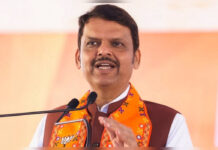
Mumbai: Chief Minister Devendra Fadnavis on Friday presented the Maharashtra Budget for 2026–27 in the Legislative Assembly, outlining the government’s development strategy centred on the long-term vision of “Viksit Maharashtra – 2047”. The Budget proposes a total expenditure of ₹7.69 lakh crore for the coming financial year. Revenue receipts are estimated at ₹6.16 lakh crore and revenue expenditure at ₹6.56 lakh crore, resulting in a revenue deficit of ₹40,552 crore. The fiscal deficit is projected at ₹1.50 lakh crore, remaining within the limits prescribed under the Fiscal Responsibility and Budget Management framework.
Presenting the Budget, Fadnavis said Maharashtra aims to achieve a $5 trillion state economy by 2047, positioning itself as a major contributor to the national goal of a developed India. The government has structured its development strategy around four broad pillars — Progressive Maharashtra, Sustainable Maharashtra, Inclusive Maharashtra and Good Governance — covering sectors ranging from agriculture and industry to urban development, energy, welfare and governance reforms.
In the agriculture sector, the government announced initiatives aimed at strengthening farm income and expanding technology use in farming. Programmes such as Agristack and digital advisory platforms are being expanded to improve access to services and market information for farmers. The state also plans to bring five lakh hectares under natural farming over the next two years.
A major political announcement in the Budget was a farm loan waiver of up to ₹2 lakh for eligible farmers with overdue crop loans, to be implemented under the Punyashlok Ahilyadevi Holkar Farmer Debt Waiver Scheme.
The government also announced new initiatives to strengthen allied sectors such as fisheries, animal husbandry and rural infrastructure. Under the Mukhyamantri Matsya Sampada Yojana, fisheries development programmes will be implemented with an annual outlay of ₹1,240 crore.
In the industrial sector, the state has announced a new Industry, Investment and Services Policy-2025 aimed at expanding Maharashtra’s industrial base and attracting investment. The policy aims to increase the share of the industrial sector in the state economy and generate about 50 lakh jobs.
The government also announced sector-specific policies including the Maharashtra Bamboo Industry Policy-2025 and the Maharashtra Gems and Jewellery Policy-2025, aimed at boosting manufacturing and exports.
Urban development and infrastructure remain central to the government’s growth strategy. The government has set a target of expanding metro networks, expressways and major transport corridors across the state. Several metro projects, coastal roads, tunnels and expressways are under implementation in cities such as Mumbai, Pune and Nagpur.
The government has also set an ambitious goal of increasing the economy of the Mumbai Metropolitan Region to $300 billion by 2030, while planning new urban development hubs and logistics corridors in surrounding regions.
In the energy sector, the government reiterated its commitment to expanding renewable energy capacity. Through solar and pumped hydro projects, the state aims to significantly increase its clean energy generation in the coming years.
The Budget also outlined several welfare initiatives targeting socially disadvantaged groups, women and tribal communities. Substantial allocations have been made under Scheduled Caste and Tribal Sub-Plans for development programmes and educational initiatives.
In education and skills, the government announced the development of an international “Educity” near Navi Mumbai International Airport and programmes to strengthen innovation and startup ecosystems.
The government has also proposed governance reforms including digitisation of public services, integration of government portals and new legislation aimed at reducing disputes in land ownership.
Fadnavis said the Budget reflects the state’s commitment to balanced regional development, economic expansion and social inclusion while maintaining fiscal discipline.
Also Read: Maharashtra Budget 2026–27: Free Power for Farmers, Solar Expansion and Green Energy Push