

Developments considered up to August 2026
The contemporary agri-food system depends heavily on the availability and affordability of synthetic mineral fertilisers. Nitrogen, phosphorus and potassium (N-P-K) underpin modern crop yields, but their production and distribution depend on geographically concentrated minerals, energy-intensive industrial processes and vulnerable shipping routes. For South Asia, geopolitical friction, maritime disruption and macroeconomic volatility therefore present risks not only to trade, but also to agricultural stability. This changes how food sovereignty should be understood. A country may produce much of its own rice or wheat and still remain exposed if the fertilisers, raw materials, energy and transport systems supporting those harvests depend on external suppliers. Agricultural resilience consequently requires attention to the upstream supply chains that sustain domestic production.
From Food Security to Input Security
The 1996 Rome Declaration on World Food Security defines food security in terms of people having physical and economic access to sufficient, safe and nutritious food. Food self-sufficiency, by contrast, concerns the share of consumption supplied through domestic production. Food sovereignty, articulated by La Via Campesina, places greater emphasis on the ability of people and states to shape their own food and agricultural systems. These concepts overlap but are not interchangeable. High domestic grain output does not by itself establish resilience. Modern cereal production relies on plant nutrients, fuel, machinery, storage, credit and transport. A disruption affecting imported fertiliser or its feedstock can raise cultivation costs, strain public subsidies and, if sustained, weaken farm productivity.
This article therefore treats input security as one component of food sovereignty. That does not mean eliminating imports. It means retaining sufficient policy space, supplier diversity, logistics capacity and financial resilience to prevent an external shock from destabilising domestic food production.
Three Nutrients, Three Supply Chains
The three principal plant nutrients have distinct production systems and geopolitical vulnerabilities. Nitrogenous fertilisers such as ammonia and urea are closely connected to energy markets. Ammonia synthesis commonly uses natural gas both as a source of hydrogen and as process energy. The International Energy Agency’s Ammonia Technology Roadmap states that just over 70% of global ammonia production uses natural-gas-based steam reforming. The price and availability of gas therefore influence where nitrogen fertiliser can be produced competitively. Phosphatic fertilisers operate through a different chain. Di-ammonium phosphate (DAP) requires phosphate rock, phosphoric acid, ammonia and sulphur-derived processing inputs. The US Geological Survey’s 2024 phosphate-rock summary records a high concentration of known reserves, particularly in Morocco and Western Sahara. Countries without comparable deposits must import either the mineral, intermediate chemicals or finished fertiliser.
Potash is mined rather than synthesised. The USGS 2024 potash summary identifies Canada, Russia and Belarus among the leading producers. This concentration exposes importing economies to geopolitical disputes, sanctions-related payment complications and disruptions in transport or insurance. The policy implication is important: “fertiliser dependence” is not a single condition. A country may possess urea plants but lack domestic gas; manufacture DAP while importing phosphoric acid; or have no geological access to potash. Resilience must therefore be assessed nutrient by nutrient and at every stage from raw material to farm delivery.
South Asia’s Uneven Exposure
India: Industrial Scale, Import Dependence
India possesses the region’s largest fertiliser-manufacturing system. According to the Department of Fertilisers’ Annual Report 2023–24, domestic urea production reached 31.4 million tonnes in 2023–24. This gives India a substantial industrial base, but it does not remove dependence on imported gas, phosphatic materials and potash. The state absorbs part of this external volatility through subsidies. In the Union government’s Expenditure Budget 2024–25, Demand No. 16, the Budget Estimates provided approximately ₹1.19 trillion for urea subsidy and ₹450 billion for nutrient-based subsidy support for phosphatic and potassic fertilisers. These protections insulate farmers from abrupt international price movements, but transfer a significant part of the risk to public finances. India’s scale offers procurement leverage and the ability to spread purchases across suppliers. Its underlying challenge is to balance domestic manufacturing, long-term imports and overseas investments without allowing fiscal protection to encourage inefficient nutrient use.
Bangladesh: Quantified Import Dependence
Bangladesh combines limited domestic production with large import requirements. Tanvir Ahmed’s USDA Foreign Agricultural Service report, Fertilizer Situation in Bangladesh, drawing on Bangladeshi government data, gives the following figures for 2024–25:
- Urea: production of 1.122 million tonnes, imports of 1.644 million tonnes and consumption of 2.644 million tonnes.
- Triple superphosphate: production of 72,000 tonnes, imports of 558,000 tonnes and consumption of 765,000 tonnes.
- DAP: production of 50,000 tonnes, imports of 1.399 million tonnes and consumption of 1.523 million tonnes.
- Muriate of potash: no domestic production, imports of 877,000 tonnes and consumption of 1.013 million tonnes.
The figures show why domestic factory capacity alone is an incomplete measure of security. Bangladesh must secure finished fertilisers as well as raw materials and energy for domestic plants. Its exposure therefore extends from international prices and shipping schedules to foreign-exchange availability and public procurement capacity.
Pakistan, Sri Lanka and Nepal
Pakistan has a substantial domestic urea industry linked to natural-gas availability. The Pakistan Economic Survey 2024–25 reports installed urea-manufacturing capacity of about 6.7 million tonnes a year. Capacity, however, is not identical to reliable output: domestic gas allocation and plant utilisation remain central to nitrogen security, while phosphatic and potassic requirements create continued import exposure. Sri Lanka illustrates a different vulnerability. Its dependence on imported mineral fertilisers became especially consequential during the economic crisis and foreign-exchange shortage described in the Central Bank of Sri Lanka’s 2022 Annual Report. The episode demonstrated how an external-payments crisis can become an agricultural-input crisis even without a physical interruption in global supply. Nepal’s exposure arises from the combination of import dependence and landlocked geography. Its fertiliser policy must therefore account not only for procurement, but also for transit arrangements, border procedures and timely inland distribution. In Nepal’s case, input security is inseparable from dependable regional connectivity.
Maritime Chokepoints as Agricultural Risks
Fertiliser supply chains cross some of the world’s most politically sensitive waterways. A disruption does not have to stop every shipment to create damage: longer voyages, higher insurance premiums, delayed deliveries and energy-price movements can all raise the landed cost of nutrients.
Hormuz and Gulf-Origin Fertilisers
The Strait of Hormuz is important because the Gulf is a major energy and fertiliser-producing region. UNCTAD’s March 2026 briefing, Implications of Strait of Hormuz Disruptions, recorded an approximately 95% fall in daily ship transits during the acute disruption it examined. UNCTAD also reported that urea constituted 67% of Gulf-region seaborne fertiliser trade, DAP 20% and mono-ammonium phosphate 9%. These percentages describe the composition of Gulf-region seaborne fertiliser trade, not corresponding shares of global trade. Even with that qualification, the concentration matters for South Asia: disruption in the Gulf can affect finished fertiliser shipments and the energy inputs used by manufacturing plants elsewhere.
Red Sea Diversions
Security threats in the Red Sea and Bab el-Mandeb have led some carriers to avoid the Suez route and sail around the Cape of Good Hope. UNCTAD’s 2024 report, Navigating Troubled Waters, explains how these diversions lengthen voyages, increase costs and reduce effective shipping capacity. For fertiliser importers, the relevant consequences are higher freight exposure and greater uncertainty over arrival schedules, particularly for cargo moving between Europe, North Africa and Asian markets.
The Black Sea
The Black Sea remains important to global agricultural trade. The formal Black Sea Grain Initiative was disrupted in July 2023, as recorded by the International Maritime Organization. Subsequent shipping has operated in an environment shaped by war, security warnings and commercial risk assessment. For South Asian policy, the lesson is broader than the status of any single corridor. Governments should avoid treating wartime shipping arrangements as permanently dependable and should incorporate route concentration, insurance availability and delivery delays into procurement planning.
Procurement Diplomacy and Overseas Investment
Long-term contracts, government-supported procurement and overseas investment can reduce exposure to volatile spot markets, but their value depends on enforceable delivery terms and functioning logistics. The Jordan India Fertiliser Company (JIFCO) illustrates this approach. IFFCO describes JIFCO as a joint venture involving IFFCO and the Jordan Phosphate Mines Company, established to supply phosphoric acid for Indian fertiliser production. The strategic value lies in linking overseas raw-material processing with demand in India. JIFCO should not be confused with Indo-Jordan Chemicals Company, a separate corporate entity. More generally, policy assessments must distinguish an operating asset from an announced memorandum, a framework agreement from a binding purchase contract and approved quantities from cargo actually delivered.
Soil Health and the Limits of Subsidy Protection
Subsidies can protect farmers from price shocks, but their design may also influence which nutrients farmers apply. When urea is substantially cheaper than phosphatic or potassic fertilisers, producers have an incentive to favour nitrogen even where soil and crop conditions require a different balance. The often-cited N-P-K ratio of 4:2:1 is best treated as a broad national reference, not a universal agronomic prescription. Appropriate application differs by crop, soil chemistry and agroclimatic zone. The policy objective should therefore be balanced, evidence-based nutrient use supported by soil testing, appropriate fertiliser blends and extension services—not the mechanical enforcement of a single national ratio.
The Case for Regional Coordination
South Asia’s countries do not share an identical fertiliser profile, but their vulnerabilities overlap. Several depend on imported potash and phosphatic materials; many procure nitrogen fertiliser or gas from a limited group of external producers; and seasonal demand can place simultaneous pressure on ports, foreign exchange and public budgets. These common exposures create a case for practical coordination without requiring a new regional bureaucracy. The first area is information. Agricultural and fertiliser agencies could exchange non-sensitive forecasts of seasonal demand, expected domestic output, import commitments and likely shortages. Earlier warning would give neighbouring countries and suppliers more time to adjust cargo schedules and transport capacity. The second area is logistics. Port authorities, railways and customs agencies could establish contingency procedures for fertiliser cargo during peak agricultural periods. This would be particularly valuable for landlocked economies and for smaller importers whose consignments may receive lower commercial priority during a global disruption.
The third area is research. Regional collaboration on soil testing, nutrient-use efficiency, biofertilisers and crop-specific application can reduce avoidable dependence without pretending that synthetic inputs can be eliminated immediately. Sharing agronomic evidence would also help governments redesign subsidies around soil and crop requirements rather than politically convenient national averages. Finally, emergency cooperation should remain modest and operational. A shared regional stockpile may be difficult to finance and govern, but countries could begin with common risk assessments, transparent inventory reporting and voluntary arrangements for cargo rescheduling during verified shortages. BIMSTEC, bilateral mechanisms and existing agricultural forums could provide administrative channels for such work. These are proposals for consideration, not descriptions of arrangements already in operation.
A Policy Framework for Managed Interdependence
The following recommendations are the author’s policy analysis rather than descriptions of mechanisms already operating across South Asia. First, governments should diversify suppliers by nutrient, raw material and shipping route. Diversification should be evaluated through actual delivery performance, not simply the number of memoranda signed. Second, countries should assess minimum reserve requirements for selected finished fertilisers and critical intermediate inputs. Reserve design must account for storage costs, shelf life, seasonal demand and the risk that excessive stockholding may itself distort markets. Third, states without domestic phosphate or potash resources should consider commercially sound overseas partnerships, long-term off-take contracts and equity participation in processing assets. Nitrogen strategies should similarly account for the security and price of gas or ammonia feedstock. Fourth, ports, bulk-handling systems, warehouses, rail links and customs procedures should be treated as part of agricultural policy. A fertiliser cargo secured abroad has little value if it cannot be unloaded and delivered before the relevant sowing season. Fifth, subsidy reform should protect small farmers while discouraging persistent nutrient imbalance. Abrupt market pricing would expose cultivators to unacceptable risk; gradual reform should instead support soil testing, customised nutrient recommendations and more efficient application. Finally, governments should publish regular supply-risk assessments containing verified inventories, import commitments, expected arrivals and identified route vulnerabilities. Public reporting should distinguish between memoranda, signed contracts, dispatched cargo and received stock.
The Limits of Self-Reliance
Complete self-sufficiency in every fertiliser category is neither commercially realistic nor geologically possible for most South Asian countries. Nitrogen production requires competitive energy or imported feedstock. Phosphate and potash production depends on mineral deposits that are not evenly distributed. Food sovereignty should therefore not be equated with isolation or the elimination of imports. A more realistic objective is managed interdependence: targeted domestic capacity, diversified external supply, resilient logistics, credible public stocks and policies that protect both farmers and soil health. Under this approach, strategic autonomy comes not from withdrawing from trade, but from ensuring that no single supplier, route or financial shock can destabilise the food system.
About the Author
Hridbina Chatterjee is a Gen Z researcher and contributor to TheNews21. She holds a master’s degree in Political Science with a specialisation in International Relations from Jadavpur University and writes on foreign policy, climate security, India’s Northeast and the Indo-Pacific.
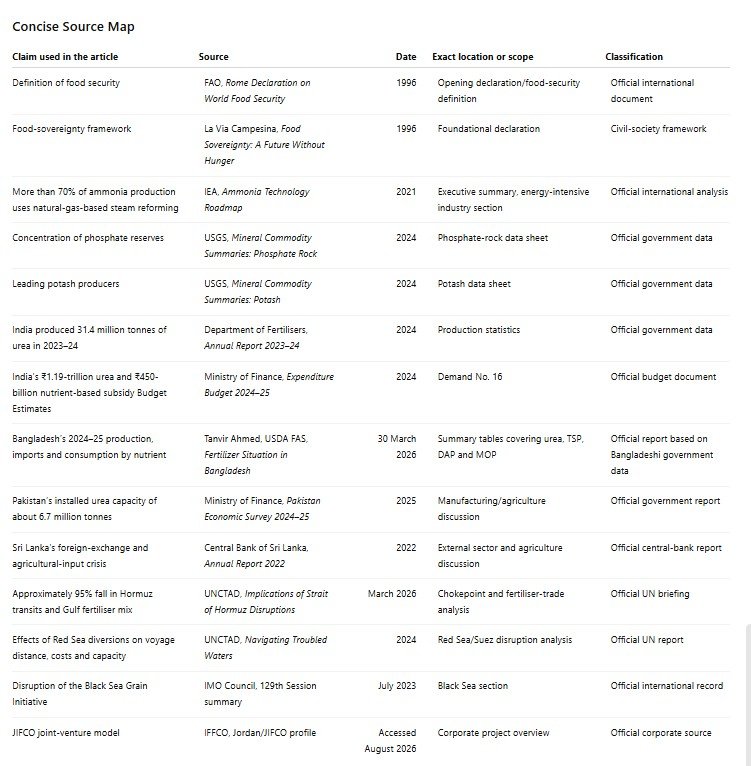
Methodological note: Interpretive statements and policy recommendations are the author’s analysis. Claims that could not be tied to an exact accessible document were removed or qualified during editing.


