

What began as a simple, intimate celebration in the early years of the Republic has evolved into an occasion connecting India’s highest constitutional office with children, nurses and citizens from across the country
New Delhi: When schoolchildren from across India arrived at Rashtrapati Bhavan on Friday to celebrate Raksha Bandhan with President Droupadi Murmu, an old tradition acquired a contemporary meaning. President Murmu urged the children to take the festival’s message of love, care and protection beyond human relationships and extend it to the environment. She asked them to think of trees and plants too as deserving protection and care. Students representing 17 states, one Union Territory, the Kendriya Vidyalaya Sangathan and Navodaya Vidyalaya Samiti participated in the programme. But the sight of children celebrating Raksha Bandhan with the occupant of Rashtrapati Bhavan is not new. Its roots stretch back to the early years of the Republic and India’s first President, Dr Rajendra Prasad, when the imposing presidential estate was also home to a much simpler tradition of personal interaction between the President and families living and working there.
When Rashtrapati Bhavan Became a Family Home
During Rajendra Prasad’s presidency from 1950 to 1962, Raksha Bandhan at Rashtrapati Bhavan was remembered less as an official function and more as a family occasion. Girls from families associated with the President’s Estate would visit and tie rakhis on the President’s wrist. Rajendra Babu, as he was affectionately known, would give them small gifts before returning to his official engagements. His wife Rajvanshi Devi played an important role in creating that atmosphere of informality. Remembered affectionately as “Maa ji”, she would spend time talking to children and their parents even when official duties called the President away. The celebration reflected something characteristic of Rajendra Prasad’s years at Rashtrapati Bhavan: an effort to make the enormous presidential estate feel less remote from the people who lived and worked within it. There were sweets, conversation and children moving through surroundings normally associated with state ceremony. There was little grandeur attached to the occasion. That simplicity became part of its charm.
A Presidential Estate of Many Faiths
The spirit extended beyond Raksha Bandhan. Rajendra Prasad and Rajvanshi Devi were remembered within the estate for participating in and acknowledging festivals belonging to different communities. Rashtrapati Bhavan was not simply the workplace of India’s first citizen; it was also a community populated by hundreds of employees and their families. For them, festivals offered opportunities to meet the presidential family beyond the rigid protocols of official functions. These memories are important because the early Republic was still defining what an Indian presidency should look like. The Constitution had created the office. The men and women who occupied Rashtrapati Bhavan gradually gave it its social traditions. Raksha Bandhan became one of them.
A Tradition Evolves
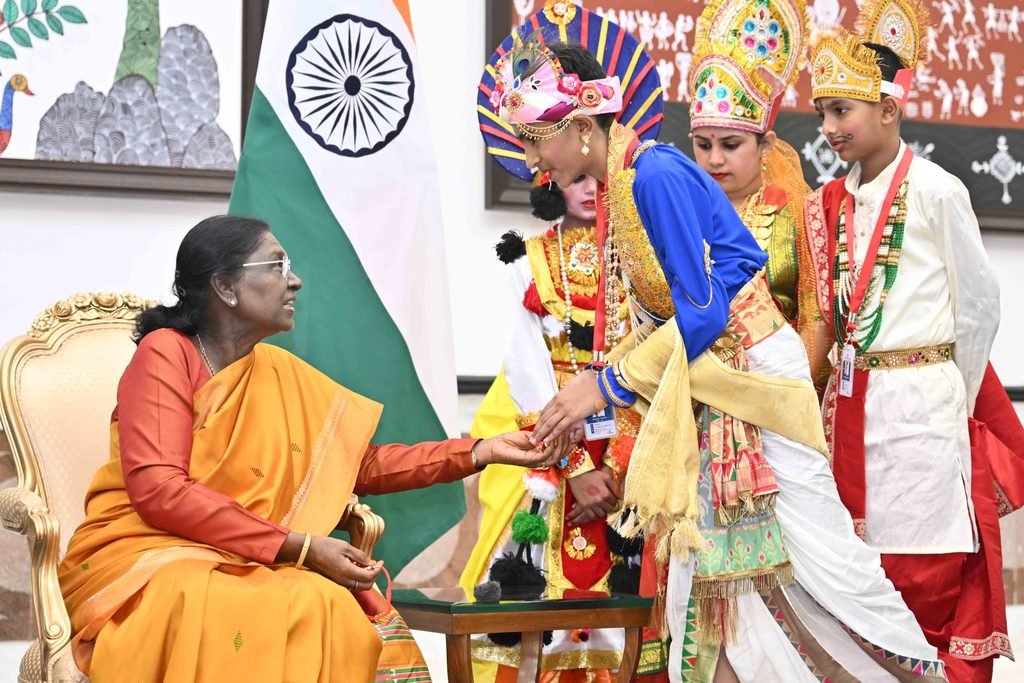
Successive Presidents gave such interactions their own character. The nature and scale of celebrations changed over the decades as Rashtrapati Bhavan itself became more accessible through organised programmes involving schoolchildren and citizens. For some Presidents, interactions with children became central to the occasion. That was especially natural during the presidency of Dr A.P.J. Abdul Kalam, whose enthusiasm for meeting students became one of the defining characteristics of his tenure. His conversations with young visitors frequently turned towards education, science and their ambitions for the future. The symbolism remained simple: children who would ordinarily see the President only in newspapers or on television suddenly found themselves sitting across from India’s head of state.
When Nurses Tied Rakhi During Covid
The tradition took on an unusual and powerful meaning during the Covid-19 pandemic. On August 3, 2020, President Ram Nath Kovind celebrated Raksha Bandhan at Rashtrapati Bhavan with members of the nursing community. Representatives of the Trained Nurses’ Association of India, Military Nursing Service and President’s Estate Clinic participated. They spoke to the President about their experiences treating Covid-19 patients and offered rakhis to him. Kovind turned the traditional symbolism of the festival around. Ordinarily, he observed, Raksha Bandhan represents a brother’s commitment to protect his sister. But during the pandemic, it was nurses who were protecting countless others while putting their own lives at risk. For that year at least, Raksha Bandhan at Rashtrapati Bhavan became as much a tribute to frontline healthcare workers as a festival.
Droupadi Murmu Gives the Tradition an Environmental Meaning
Under President Droupadi Murmu, children have again become central to the celebration. In 2025, students from government schools, Kendriya Vidyalayas, Jawahar Navodaya Vidyalayas and Kasturba Gandhi Balika Vidyalayas, along with children with special needs from different states and Union Territories, celebrated Raksha Bandhan at Rashtrapati Bhavan. Students presented eco-friendly rakhis and handmade greeting cards, while the President connected the festival’s idea of protection with responsibility towards nature. That message became even more explicit this year. At Friday’s celebration, Murmu told students that the bond represented by Raksha Bandhan need not be confined to brothers and sisters. Love, care and protection, she said, could extend to family, friends — and even trees. She encouraged students to tie rakhis to plants and trees and make their protection a continuing responsibility. Thus, a tradition associated with personal affection has gradually acquired another layer: environmental stewardship.
More Than a Presidential Ceremony
That evolution is perhaps what makes Raksha Bandhan at Rashtrapati Bhavan interesting. Presidents change. The country changes. The people invited to participate change too. Yet an essentially domestic festival continues to find a place inside India’s highest constitutional residence. The contrast is striking. Rashtrapati Bhavan is a building associated with state banquets, visiting heads of government, constitutional appointments, military ceremonies and the transfer of political power. But on Raksha Bandhan, its imagery becomes remarkably different: children carrying handmade cards, women tying threads around a President’s wrist, conversations about school and, more recently, appeals to protect trees. The ceremony temporarily narrows the distance between an institution and ordinary citizens.
A Thread Across Generations
More than seven decades after Rajendra Prasad became India’s first President, the Raksha Bandhan tradition offers a glimpse of the less formal side of the Indian presidency. The celebrations of the early Republic and those of 2026 are obviously not identical. Nor should they be. What began as intimate interactions involving families associated with the presidential estate has evolved into organised engagements with citizens from different parts of India. Ram Nath Kovind used the occasion during a pandemic to honour nurses who were protecting lives. Droupadi Murmu has expanded its symbolism towards environmental responsibility. And behind these changing forms survives a remarkably simple idea: India’s highest constitutional office need not always communicate with citizens through ceremony and protocol. Sometimes, the connection can be made with something as small as a thread tied around a wrist. That may ultimately explain why the tradition has endured — and why, decades after Rajendra Prasad’s years in Rashtrapati Bhavan, Raksha Bandhan there continues to tell a larger story about the relationship between the presidency and the people.


