

What began with ₹10,000 borrowed from a bank and ₹10,000 from her savings grew into a home-based enterprise that strengthened Amuli Devi’s family income—and eventually enabled her to train 170 other women in livelihood skills.
Banswara, Rajasthan: In Amlipada village, under the Tanda Mangla panchayat of Sajjangarh tehsil in Rajasthan’s Banswara district, lives Amuli Devi Dinesh Garasia, 44. For the past four years, she has been making handmade soap at home using ingredients such as neem, aloe vera, multani mitti, papaya, rose and lemon. What began as a modest household effort has gradually become an important source of income for her family. Amuli Devi’s journey is not simply about soap. It is about what can happen when skill, training and persistence come together in the right direction. She had always been interested in gardening, raising plants and preparing organic manure. Since childhood, she had carried a quiet ambition—to begin with something small and gradually build it into something meaningful. But circumstances rarely move at the pace of dreams. Her family’s financial condition did not allow her to think of a large beginning. Income opportunities were limited, and the pressure of household needs remained constant. Over time, that struggle created a conviction within her that she needed to build something of her own.
A Turning Point in 2021
That turning point came in 2021, when Amuli Devi joined VAAGDHARA as a Community Resource Person. Through the organisation, she received training related to village development, women’s participation in Panchayati Raj institutions, access to government schemes and the importance of self-reliance. The experience widened her understanding of how local institutions functioned and, more importantly, strengthened her confidence to take greater responsibility within the community.
Seeing her commitment, VAAGDHARA later associated her with the Krishi evam Adivasi Swaraj Sangathan at Bhilkua. For Amuli Devi, this exposure became more than organisational work. It gave her a closer view of how rights, resources, livelihoods and community participation were connected. The desire to move ahead economically became stronger.
Training That Opened a New Door
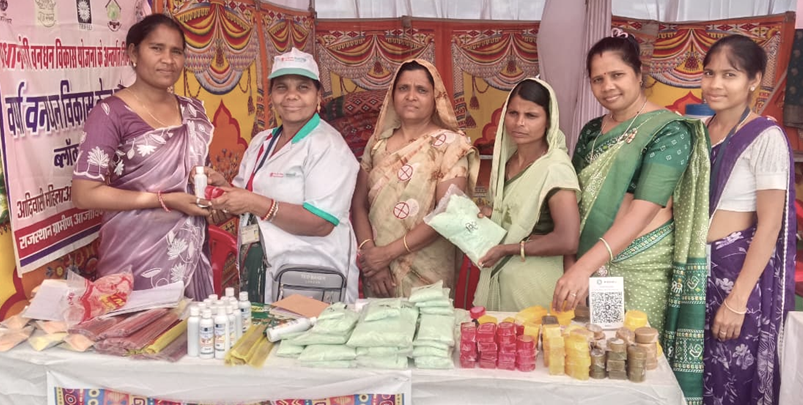
Amuli Devi then underwent formal training at the Rural Self Employment Training Institute (RSETI), Banswara, where she learnt to make soap, incense sticks, shampoo and washing powder. The training gave shape to an idea that had been forming within her for some time. Once the course ended, she decided to start. She did not have large capital. She borrowed ₹10,000 from a bank and added another ₹10,000 from her own savings. With a total of ₹20,000, and with support from her son, daughter and daughter-in-law, Amuli Devi began making soap at home. The first steps were simple: buying raw materials, arranging moulds and securing the basic equipment required for production. From that modest beginning, a home-based enterprise slowly took shape.
Soap Made at Home, Sold in the Village
Amuli Devi began preparing different varieties of soap using neem, aloe vera, multani mitti, papaya, rose and lemon. According to her account, one kilogram of raw material yields roughly ten bars of soap. Each bar is packed separately so that it can be sold as a finished product rather than as something made casually at home. In the early days, she says, a bar sold for around ₹10. As customers began returning and demand increased, she was able to raise the price. Today, depending on where and how it is sold, her soap fetches around ₹25 to ₹30 per bar, with some discount for buyers who purchase directly from her home. What matters most, however, is not the price alone. It is the fact that something she once learnt as a skill has become regular work.
From Doubt to Demand
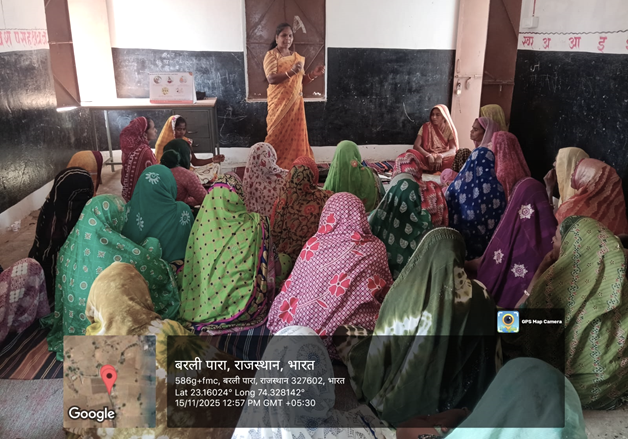
Like most first-time entrepreneurs, Amuli Devi began with uncertainty. Would people buy soap made at home? Would they trust the product? Would demand last beyond the first few customers? Those questions troubled her in the beginning. But gradually, orders started coming from households within the panchayat. Word spread from one family to another, and the demand began to grow. As the customer base expanded, Amuli Devi and her family increased production. She now uses larger quantities of raw material when demand is high and has begun supplying not only local households but also some nearby shops and buyers from the adjoining town. Families also continue to come directly to her home to purchase soap. The work that once began as an experiment had become a recognised source of household income.
More Than One Source of Earnings
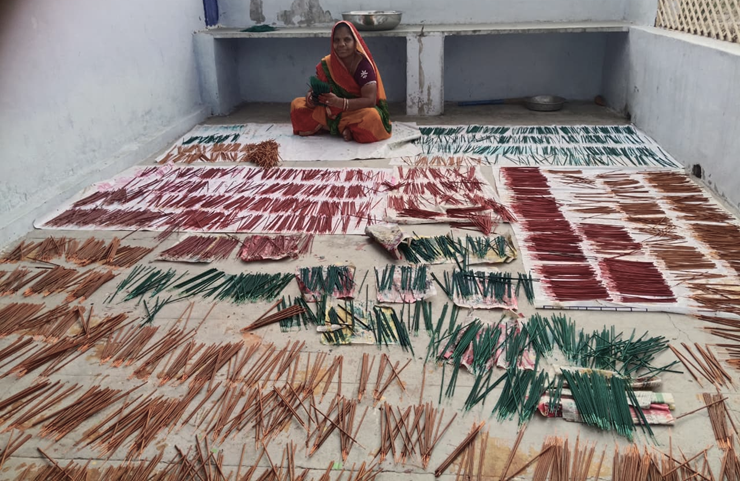
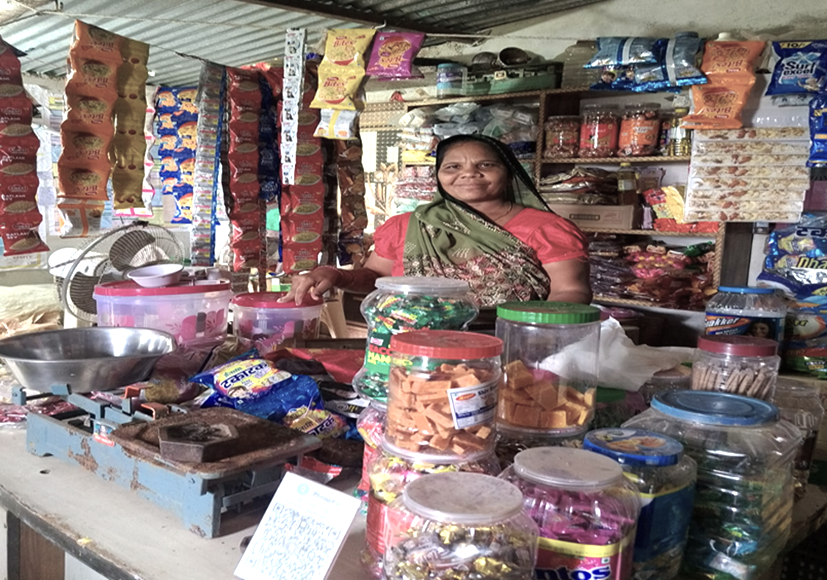
Amuli Devi did not stop with soap. The skills she acquired through training opened other possibilities as well. She began making incense sticks, and according to her account, this activity brings her an additional annual income of around ₹24,000. The family also runs a small grocery shop from home, and Amuli Devi has recently started a clothing shop as well. Taken together, these different activities have helped diversify the family’s earnings. According to Amuli Devi, her soap enterprise contributes around ₹2 lakh annually, while the family’s combined income from soap, incense sticks and other small businesses is now close to ₹2.5 lakh a year. These figures are not simply a measure of revenue. For a family that began with limited means and a ₹20,000 investment, they represent something more important: a gradual movement away from dependence and towards greater economic control.
A Family Begins to See a Different Future
The change in income has also begun shaping the next generation. Amuli Devi has sent her son for a teacher-training course, hoping that education will open another path for the family. This is perhaps one of the most meaningful outcomes of her enterprise. A small business begun at home did not remain confined to soap-making. It began influencing household choices, education and future planning. And this is where Amuli Devi’s story moves beyond a simple tale of entrepreneurship. The most important change was not merely that she learnt how to make soap. It was that she began to believe she could build something of her own—and sustain it.
From Enterprise to Empowerment — When One Woman’s Skill Begins to Change Many Lives
A Son Watches the Change at Home
The journey of Amuli Devi is perhaps best understood through the eyes of those who watched it unfold every day. Her son, Amit Garasia, remembers the early days clearly. When his mother began making soap, the family had very limited resources. There were no guarantees that the venture would succeed, and every rupee invested mattered. Yet, according to Amit, his mother’s determination never weakened. He remembers her preparing soap moulds late into the night and waking early the next morning to arrange raw materials and continue the work. For the family, those hours of labour were more than routine. They were the foundation of a new livelihood.
Amit believes his mother changed not only the financial condition of the household but also the way the family understood work itself. The lesson he draws from her journey is simple: No work is too small if it is done with conviction. Sometimes, the smallest beginning can one day become the identity of an entire family.
Success That Did Not Stop at Her Doorstep
What makes Amuli Devi’s journey more significant is that she did not keep what she had learnt to herself. Once her own enterprise became stable, she began sharing her skills with other women. She encouraged members of her self-help group to learn soap-making and other livelihood activities and gradually started helping women around her understand how a small skill could become a source of income. This was an important transition. Amuli Devi was no longer only an entrepreneur. She was becoming a trainer.
From Learner to Master Trainer
Over time, Amuli Devi became associated with the Rural Self Employment Training Institute (RSETI) as a master trainer. According to the information shared in her account, she has so far trained 170 women in activities such as soap-making, incense-stick production, shampoo-making and washing-powder preparation. The numbers are spread across different blocks of Banswara district:
- 30 women in Garhi
- 30 women in Anandpuri
- 90 women in Sajjangarh
- 20 women in Ghatol
Of these, Amuli Devi says around 40 women have gone on to start businesses of their own. That figure is perhaps more important than the number of training sessions conducted. Because behind every woman who starts earning from her own work stands a household in which economic decision-making begins to change.
When Income Becomes Confidence
For rural women, income is rarely just about money. It can influence mobility, confidence, participation in family decisions and the ability to imagine a future beyond dependence. Amuli Devi’s own journey reflects this shift. She began with a small amount of capital and a practical skill. Then came production. Then customers. Then income. And, gradually, recognition. The woman who once needed training herself now stands before other women as someone who can teach, guide and encourage them. This change is difficult to measure in rupees. But it may be the most enduring outcome of her journey.
What Self-Reliance Really Means
Amuli Devi often says that she wants the women around her to become self-reliant just as she did. That aspiration now appears in her actions. Whether she is training women in her own group or helping participants through RSETI, she continues to pass on the same practical knowledge that once helped her begin. Her story therefore raises a larger point about rural livelihoods. Self-reliance does not always begin with a large loan, a factory, expensive machinery or a complicated business plan. Sometimes it begins with a skill. A small amount of capital. Support from family. Access to training. And the confidence to start.
The Role of Institutions and Grassroots Support
Amuli Devi’s journey also shows why training institutions and community organisations matter. VAAGDHARA gave her early exposure to community work, women’s participation and local governance. RSETI provided technical training. Her family contributed labour and encouragement. But the enterprise itself took shape because Amuli Devi applied those opportunities with persistence. That balance is important. Institutions can create opportunities. Training can provide skills. But the transformation happens only when an individual decides to act on them.
More Than Soap
It would be easy to describe Amuli Devi’s story simply as the success of a natural-soap business. But that would miss the larger picture. Soap was only the beginning. From that beginning came incense sticks, a grocery shop, a clothing shop, greater household income, investment in her son’s education, and eventually the ability to train other women. A venture that started with ₹20,000 became a platform from which an entire family began thinking differently about its future. And then that experience started travelling beyond the family.
Forty Enterprises, Forty Different Journeys
The forty women who, according to Amuli Devi, have started livelihood activities after receiving training will each have a different story. Some may succeed more than others. Some may remain small. Some may grow. But the significance lies in the fact that they began. Because self-reliance in rural India is rarely built through one dramatic transformation. More often, it grows through many small decisions taken by ordinary people with limited resources. A woman learns a skill. She starts selling something. Another woman watches. Then she tries. And slowly, the economic landscape of a village begins to change.
The Fragrance of Self-Reliance
Amuli Devi’s journey began in a small home in Amlipada. There was no large investment. No sophisticated factory. No promise of instant success. There was only a modest amount of capital, some training, family support and a woman determined to make something of her own. Today, that effort has given her a stronger economic identity, a role as a trainer and the confidence to guide other women towards self-employment. Her story does not suggest that every woman must make soap. Its message is larger than that. It shows that when women receive the right opportunity, practical training and space to act on their own ideas, small beginnings can grow into meaningful livelihoods. And sometimes, the fragrance that begins with a bar of handmade soap can spread much farther than anyone imagined.


