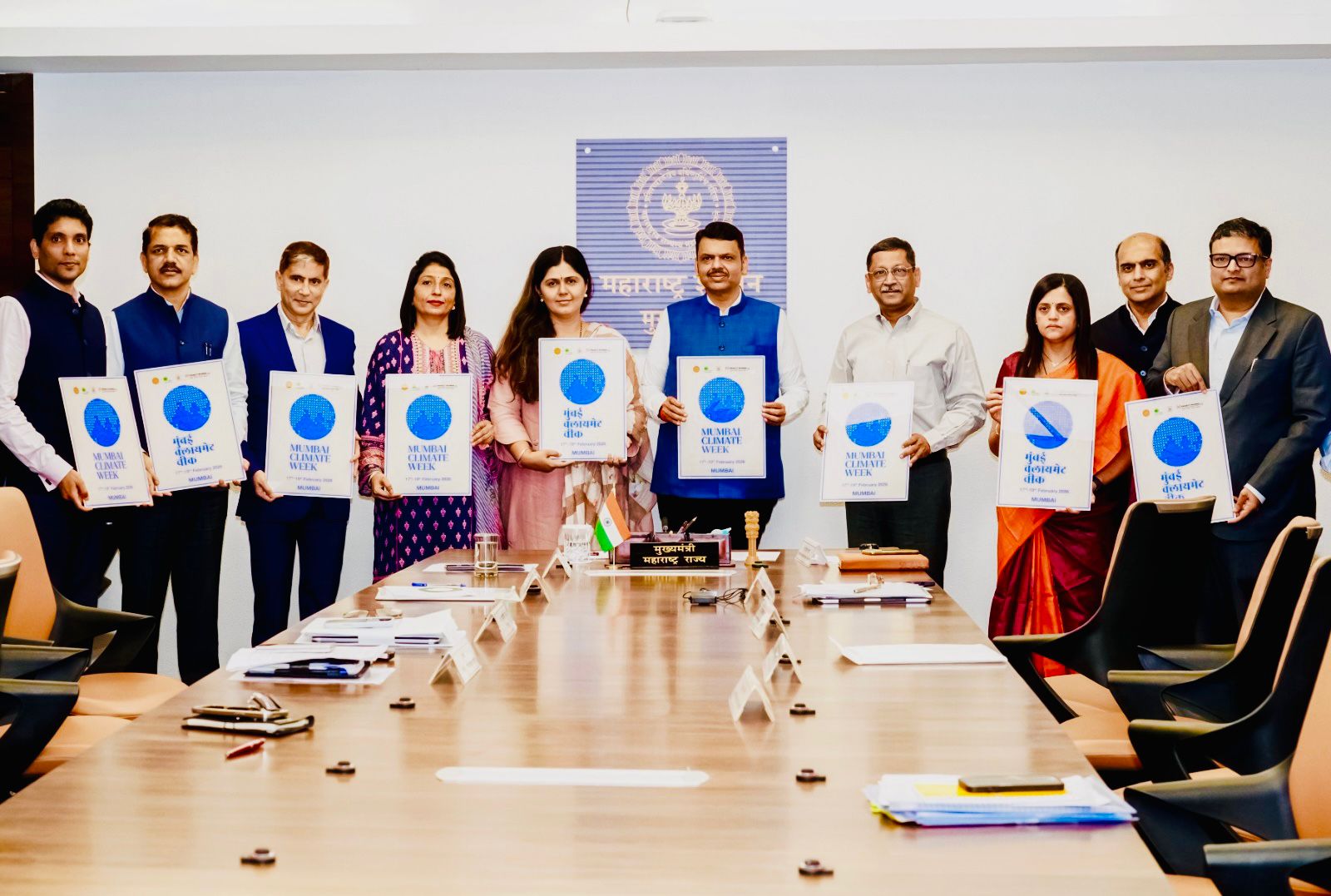
Mumbai: When Maharashtra Chief Minister Devendra Fadnavis announced that India will host the inaugural Mumbai Climate Week (MCW) in February 2026, it was more than an event reveal. It was a signal — that Mumbai intends to be the Global South’s climate capital, and that India is ready to move from dialogue to action on climate governance.
From Talk to Action
“It’s time to move from dialogue to action,” Fadnavis said, unveiling the state’s most ambitious climate platform yet. Mumbai Climate Week is being positioned not as a conference, but as a citizen-driven accelerator of solutions — linking government, business, and people.
Organised by Project Mumbai in partnership with the Department of Environment and Climate Change and supported by the BMC, the week will be India’s first dedicated public platform connecting climate justice, innovation, and finance.
Over 30 countries are expected to send delegates. The choice of Mumbai — India’s financial hub and a coastal megacity vulnerable to rising seas — is deliberate. The organisers call it a meeting point of urgency and optimism.
For developing nations constrained by debt and climate vulnerability, MCW aims to provide policy direction and financial pathways that balance economic growth with ecological responsibility.
As Shishir Joshi, Founder & CEO of Project Mumbai, put it, “MCW will amplify the voice of the Global South and empower climate-resilient communities through collaboration that transcends borders.”
The 2026 edition will revolve around three interlinked pillars:
• Food Systems – anchored by India Climate Collaborative, focusing on adaptation and equitable nutrition.
• Energy Transition – led by ISEG, Shakti Foundation, and Eversource, highlighting renewable financing and grid reform.
• Urban Resilience – driven by HT Parekh Foundation and WRI India, exploring design, infrastructure, and inclusive city planning.
Each theme will be analysed through lenses of justice, innovation, and funding — ensuring that climate action remains people-centric rather than policy-heavy.
Beyond policy sessions at the Jio World Convention Centre (Feb 17–19, 2026), MCW will adopt a hub-and-spoke model: art exhibitions, film screenings, hackathons, and community drives across Mumbai. The goal is to link grassroots initiatives with high-level decision-making, making the event a lived urban experience rather than a closed-door summit.
The initiative comes at a critical moment for emerging economies. In many developing countries, agriculture contributes 10–20 percent of GDP, compared with 5 percent in developed nations. With limited fiscal space to fund resilience projects, these nations are most exposed to climate shocks.
By positioning MCW as a forum for the Global South, India is asserting moral and strategic leadership — offering to turn its own developmental experience into a blueprint for others.
Mumbai Climate Week blends diplomacy, economics, and citizen activism. For the Fadnavis government, it reinforces Maharashtra’s reputation as a climate-forward state under Majhi Vasundhara Abhiyan and the State Climate Action Cell (SCAC).
For the Centre, it is a soft-power moment — framing India as a “bridge nation” between industrial economies and climate-vulnerable states. With the Prime Minister likely to inaugurate, the optics will position Mumbai alongside New York Climate Week and COP platforms, but rooted in southern pragmatism.
Preparatory activities — workshops, working groups, innovation maps — will precede February 2026. The success of MCW will hinge on whether its commitments turn into measurable outcomes: green financing models, policy pilots, and citizen-level adaptation.
If done right, Mumbai could evolve from a climate-risk symbol into a climate-leadership hub.
In essence, Mumbai Climate Week is not just about climate action — it’s about climate ownership.