

A memorable espresso at Kruti Coffee becomes the starting point for Subrat Ratho’s reflections on Koraput, tribal coffee growers, social entrepreneurship and the quiet joy of rediscovering Odisha.
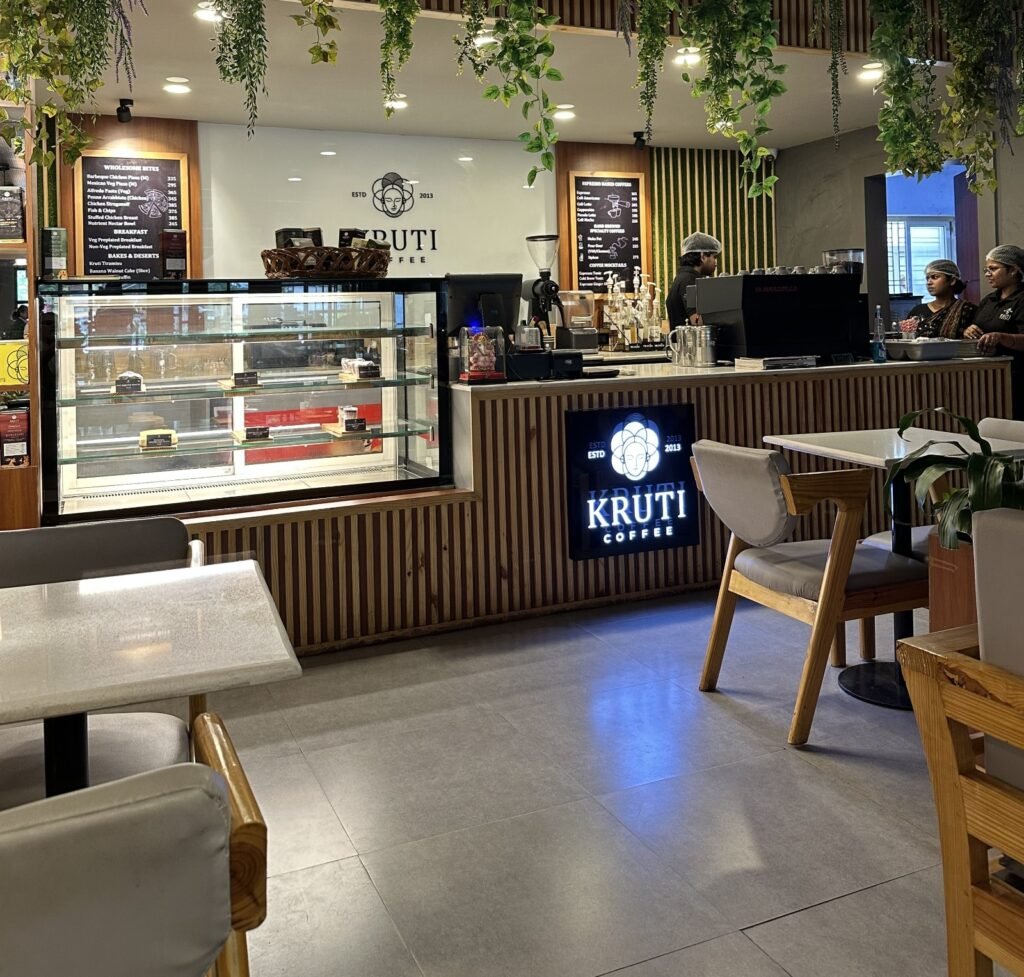
I wrote some time ago about falling in love with Kruti Coffee at first sip. This morning, I walked down again to its outlet in IRC Village, and I was delighted to find that the spell of the place remained intact. The espresso, brewed from a blend of Koraput beans, was just perfect.
As I was collecting my second cup, a young foreign couple walked in. The woman exchanged a few hesitant sentences in Odia with Adi, the young man behind the counter. She responded with an enthusiastic smile when I remarked that the coffee was excellent, and I asked where she was from.
“America,” she smiled.
Her accent sounded distinctly Latin American, but I decided to keep my curiosity in check and respect the couple’s privacy.
While lingering over my coffee, I picked up a magazine that told me more about the origins of Kruti Coffee. It began as a social enterprise incubated at the Tata Institute of Social Sciences in Mumbai by Amol Jadhav and Kamakhya Das, with the idea of creating sustainable livelihoods for tribal coffee growers in Koraput.
It feels good to get to know Kruti this way—espresso by espresso.
The story also reminded me that we perhaps underestimate social enterprises. We often think of them as worthy causes—earnest, well-intentioned and forever dependent on grants or philanthropy. The best social enterprises refuse to remain confined to that box. They become commercially successful businesses without losing sight of the social purpose that inspired them in the first place.
That, surely, is the ideal. A social enterprise should not aspire to remain a social enterprise forever. It should aspire to become a great enterprise—one whose commercial success amplifies its social impact. Profit, when earned by creating value for customers while creating dignity and opportunity for producers, is not a betrayal of purpose. It is what allows purpose to endure.
Kruti seems to have found that balance. It does not ask you to buy its coffee because it has a noble mission. It simply serves an excellent cup. The story behind the beans reveals itself only if you are curious enough to ask—or to linger over a second espresso.
Perhaps that is the highest compliment one can pay such an enterprise: people come for the coffee, return for the coffee, and only then discover that every cup has quietly been changing lives.
The experience has also left me with a growing desire to visit Koraput, a part of Odisha that I have somehow never seen despite having grown up in the state.
If you have been to Koraput—or even heard stories that have lingered with you—I would be grateful for your suggestions. I am not looking for a curated list of tourist attractions, but for personal, lived recommendations that help one feel Koraput rather than merely see it.
What, in your experience, should one not miss? A hilltop or a valley? A small, unassuming eatery where simple food stays with you far longer than expected? A forest trail, a waterfall, or a quiet village road?
I would love to hear your recommendations.


