
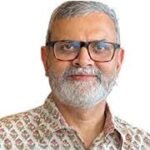
I still remember meeting Keshav Desiraju for the first time. I had just joined the civil services and arrived at the training academy in Mussoorie as a young probationer. Keshav was already an experienced officer in his mid-thirties and the Course Director of our Foundation Course. What struck me first was how unassuming he was. He was quiet, soft-spoken and almost shy. Some of the other officers who taught us were more flamboyant. They entertained us with stories of their careers and experiences. Keshav rarely spoke about himself.
At the time, I didn’t quite understand why I was drawn to him. I would understand it much later. Keshav did not teach by telling us what he had achieved. He taught by the way he conducted himself. I remained in touch with him after I completed my training. Over the years, I occasionally visited him at home and discovered a side of him that we had already glimpsed at the academy—his love of books, music and art. His home was filled with books and vinyl records, and our conversations ranged easily from public life to literature and music. Carnatic music was his passion, but when he discovered that I liked jazz, he made sure to play it whenever I visited.
There were sometimes long gaps between our meetings, but the friendship never seemed to require an explanation. Whenever we met, we simply picked up where we had left off. Keshav came from an illustrious family. His maternal grandfather, Dr Sarvepalli Radhakrishnan, was a philosopher, scholar and the second President of India. Keshav had studied at Cambridge. Yet none of this seemed to define the way he related to people.
During my career in the Indian Administrative Service, I sometimes found myself faced with difficult choices—situations in which what I believed to be in the larger public interest was not necessarily what those in political authority wanted. I rarely discussed these dilemmas with Keshav. Yet, when confronted with one, I would sometimes ask myself: What would Keshav have done? The question became a kind of moral compass. It was not because I imagined that Keshav would necessarily have had a ready answer. He rarely did that sort of thing. He had a way of making you examine the question more carefully, look beyond the immediate pressures and decide for yourself what was right. That, perhaps, was his way of teaching.
A few years before his death, after he had moved to Chennai, we spoke about my spending a few days with him there. I wanted to make the visit after his book on M. S. Subbulakshmi was published. Keshav was pleased by the idea, and we assumed there would be time enough to do it. There wasn’t. The visit remained one of those plans that seemed easy to postpone because there would always be another opportunity. By the time that opportunity came, Keshav was gone.
I sometimes regret that I did not make more time for him. Not because there was anything left to say that needed to be said, but because some friendships deserve more time than we give them. Perhaps that is what I feel most keenly about Keshav today. I did not know, when we were talking about that visit, that I was putting off something that would never happen. I was his student for only a few months in Mussoorie. I was fortunate to remain his friend for many years. What he left me was not a set of instructions, but a way of thinking—to pause, to question myself and to look beyond the immediate pressures before deciding what was right.


