

London: World Cups rarely reveal their true story in the opening week.
The early victories bring optimism. The defeats expose flaws. But eventually the tournament reaches a point where every calculation disappears and only one question remains.
Can you survive one more day?
India has arrived at that moment. When Harmanpreet Kaur leads her team onto the field against Australia at Lord’s on Sunday, it will not feel like a league match. It will feel like a knockout contest, with the tension of a final and perhaps the significance of an era-defining opportunity.
One victory could send India into the semi-finals of the ICC Women’s T20 World Cup 2026 and reaffirm their status as genuine contenders for a second ICC title in less than a year. One defeat could leave months of preparation hanging on mathematical permutations and net run rate.
There could hardly be a tougher opponent. Standing between India and the last four is Australia—the undisputed powerhouse of women’s cricket, six-time world champions and the team that has spent more than a decade setting the global standard. For years, almost every nation has measured its progress by one benchmark.
Can they beat Australia when everything is on the line? India now has the chance to answer that question.
A campaign built on resilience
India’s World Cup journey has been a challenging one. It began with one of the biggest fixtures in world cricket. Against Pakistan, the pressure was immense, but India looked remarkably composed. Smriti Mandhana played with the assurance expected from one of the world’s finest batters, while Deepti Sharma delivered a spell that immediately became one of the bowling performances of the tournament. Her five-wicket haul dismantled Pakistan’s chase and reminded everyone why she remains India’s most dependable all-rounder.
It was the perfect beginning. Then came an effortless win against the Netherlands. Confidence was high. After that, South Africa came. The defeat hurt for several reasons.
The match coincided with Harmanpreet Kaur becoming the first player—male or female—to complete 200 T20 Internationals. It should have been a celebration. Instead, Marizanne Kapp produced an all-round masterclass to spoil the occasion. The loss exposed areas India still needs to improve in.
Their top order laid an encouraging platform but could not fully capitalise on it. The middle overs were lacking in urgency. A promising total became merely competitive, while missed opportunities in the field allowed South Africa to seize control.
The defeat reminded us that the smallest mistakes can magnify at World Cups. Strong teams, however, define themselves by how quickly they recover. India responded exactly as they needed to. Against Bangladesh, Shafali Verma rediscovered the fearless batting that has made her one of the game’s most dangerous openers. The left-hander attacked from the outset, giving India the aggressive starts they had briefly lacked. Behind her, the emergence of young spinner Shree Charani has become one of the stories of the tournament.
Few expected the youngster to become India’s leading wicket-taker so quickly. Yet her ability to attack the stumps, vary her pace and remain calm under pressure has transformed India’s bowling attack. Alongside Deepti Sharma, she has provided Harmanpreet with an increasingly reliable spin partnership capable of controlling matches through the middle overs. With three victories from four matches, India are now just one win away from another World Cup semi-final. But the job remains unfinished.
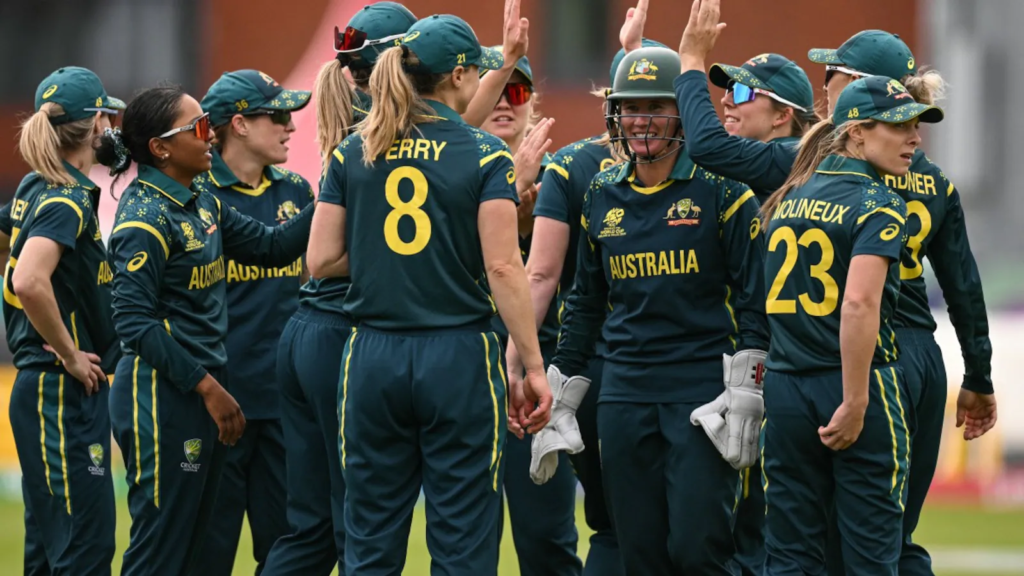
Australia still wear the crown
Every generation produces one team that everyone else is trying to catch. For women’s cricket, that team has been Australia. Six World Cup titles, years of sustained excellence, and a production line that somehow keeps replacing legends with new match-winners. Even when personnel change, the standards never seem to drop.
This tournament has followed a familiar pattern. Australia have navigated the group stage without defeat, combining disciplined bowling with batting depth that few teams can match. Their dominance, though, has not always been overwhelming.
There have been periods when opponents have challenged them. There have been moments when matches have remained evenly balanced. The difference is that Australia almost always finds a solution.
Beth Mooney remains a remarkably consistent performer at the top of the order. Ellyse Perry remains one of the finest all-round cricketers the sport has produced. Ashleigh Gardner’s influence extends across every department, while Annabel Sutherland has rapidly developed into one of the world’s premier pace-bowling all-rounders.
Captain Sophie Molineux has quietly overseen another unbeaten campaign, guiding a side that rarely allows pressure to dictate its cricket. Australia possesses something statistics cannot measure. They know how to win tournaments. That experience becomes invaluable when knockout cricket approaches.
The qualification puzzle
The points table tells an intriguing story. Australia sit comfortably at the top of Group A after winning all four of their matches and have virtually secured a place in the semi-finals. India occupies second place with three wins and one defeat, but South Africa remains close enough to keep the qualification race alive.
Bangladesh retains only a slim mathematical possibility, while Pakistan and the Netherlands have already been eliminated from contention.
The equation for India is both simple and complicated. A victory over Australia would guarantee qualification and could even present an opportunity to finish higher depending on other results. A defeat, however, would leave India vulnerable if South Africa completed the expected victory over Bangladesh. Net run rate could yet become decisive, although India’s healthy margin currently gives them an important advantage.
For Harmanpreet’s team, the ideal scenario is obvious. Avoid calculators, win the match, and control your own destiny!
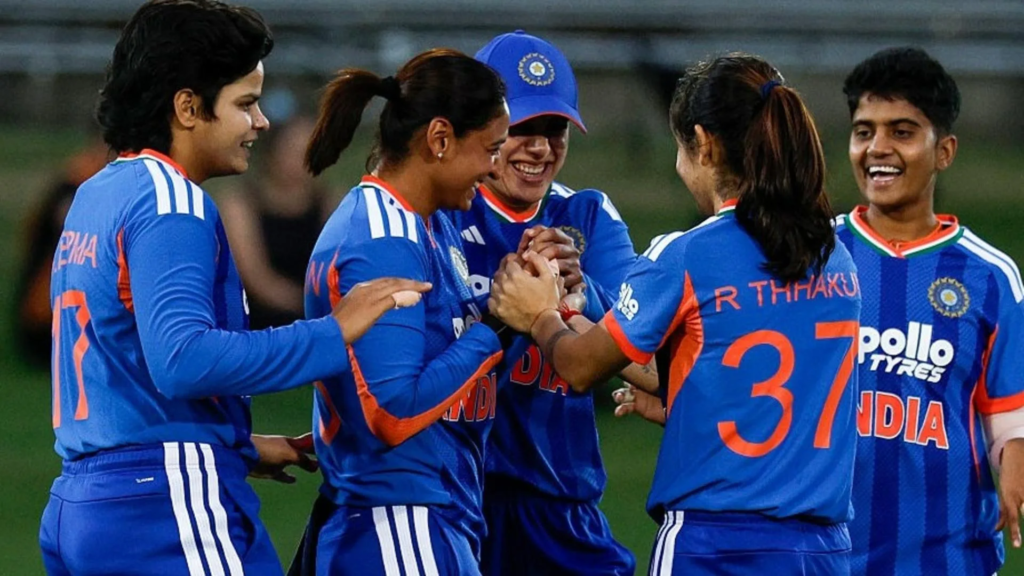
Why finishing first matters
Reaching the semi-finals is only part of the challenge. Where a team finishes in the group could shape its entire route to the title. Topping the group may avoid an immediate clash with another unbeaten heavyweight, while finishing second could produce a significantly tougher semi-final.
Momentum also matters. Defeating Australia immediately before the knockout stage would provide India with enormous belief. World Cups often swing on confidence as much as skill. If India can beat the tournament favourites, every remaining opponent suddenly looks beatable.
The contest within the contest
The scorecard will record only one winner. The game itself contains dozens of fascinating battles. Can Smriti Mandhana negotiate Australia’s new-ball attack and provide another solid platform? Will Shafali Verma continue her fearless approach against one of the world’s most disciplined bowling units? Can Harmanpreet finally produce the defining innings that has occasionally eluded her during this tournament? Richa Ghosh’s finishing ability could once again become decisive if India remains in the contest entering the final five overs. With the ball, much responsibility rests on Deepti Sharma and Shree Charani.
Australia traditionally dominates pace, but quality spin has occasionally slowed their scoring rate. If India’s spinners can control the middle overs, they will put Australia in a position they are not used to. At the other end, Australia will look towards Perry, Gardner, Mooney and Sutherland to once again demonstrate why they have remained world champions for so long.
Every overpromise has tactical significance. Every mistake could alter the course of the tournament.
Group B: Every possibility still alive
While India and Australia dominate the conversation in Group A, the race in Group B has become equally compelling.
Unlike the relatively clear picture in the other group, every remaining fixture continues to carry enormous significance. No team can yet afford to relax, and qualification remains a realistic possibility for more than two sides. England have looked increasingly dangerous as the tournament has progressed. Playing at home, they have gained momentum with each match and have one of the most balanced squads in the competition. Their batting has shown greater consistency, while their bowling attack, led by experienced campaigners, has repeatedly found breakthroughs at crucial moments.
Defending champions New Zealand remain in contention despite not always producing their best cricket. Amelia Kerr continues to influence matches with both bat and ball, while veterans Sophie Devine and Suzie Bates have once again demonstrated why experience becomes priceless in World Cups.
Sri Lanka has emerged as one of the surprise packages of the tournament. No longer dependent solely on Chamari Athapaththu, they have displayed greater depth in both batting and bowling, making them one of the most dangerous sides in the competition.
The West Indies, meanwhile, are still mathematically alive, but they require favourable results elsewhere. Ireland and the Czech Republic have already bowed out of the tournament after struggling to compete consistently against stronger opposition. With every remaining Group B match capable of altering the standings, the identity of the two semi-finalists could remain uncertain until the final league fixture.
Possible semi-final combinations
The final league matches could produce several intriguing knockout pairings. If Australia finish on top of Group A and India qualify in second place, Harmanpreet Kaur’s side could find themselves facing the Group B leaders in the semi-finals. Should India defeat Australia and leapfrog them in the standings, the equation changes entirely. India would likely avoid the strongest qualifier from Group B, which could create a more favourable route to the final. South Africa also remains capable of altering the picture. If they qualify ahead of India, Harmanpreet’s side could find their World Cup ending before the knockout stage even begins.
Such are the margins at global tournaments. Sometimes a dropped catch or a boundary saved on the rope can determine not just one match but an entire campaign.


