

When Diljit Dosanjh was asked in July what he thought about the student protest led by the Cockroach Janta Party (CJP) at Jantar Mantar, he initially kept his distance. “I am an artist. I am not a politician,” he said, adding that he would rather stay out of the issue and wishing well to those involved on both sides. The response did not sit well with everyone. Diljit was criticised online by people who argued that someone with his reach should have had more to say about a student protest that had already become a major public conversation. Now he has released a new music video, and some viewers think they may have found his answer after all.
What Diljit Dosanjh’s ‘Devil’ Video Actually Shows
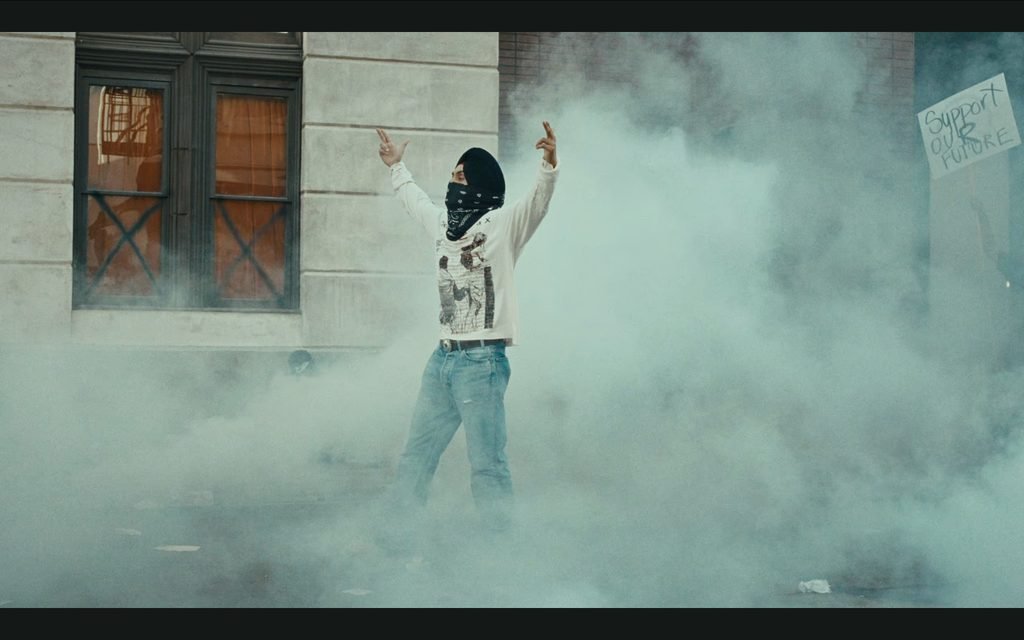
Devil, the lead track from Diljit’s new EP I’m an Artist Bro, opens with the singer standing at the head of a large crowd. Behind him, protesters carry placards bearing messages including “Save Our Future” and “Our Future, Our Fight.” Across from them stands a police line, with some officers on horseback and others carrying batons. The tension eventually develops into a confrontation between the two sides.
Then comes the video’s quieter moment. A young girl walks towards the police line holding a white rose. She pauses before an officer comes forward and embraces her, shifting the visual language from confrontation towards reconciliation. That, however, is as specific as the video gets. There is no title card naming the CJP, no reference to Jantar Mantar and no dialogue connecting the fictional protest directly to any particular real-world event. At the end comes the detail that has sparked much of the discussion: after the words “Don’t try this at home,” the screen flashes “I’m an Artist Bro.” The same phrase that followed Diljit after his comments on the student protest is now the title of his EP — and the closing message of a video built around protest imagery.
Watch the video here:
What Diljit Dosanjh Actually Said About the Protest
It is important to keep the timeline intact because the controversy is often reduced to the suggestion that Diljit simply refused to speak about the students. His initial response did distance him from the issue. During an Instagram Live in July, he said he was not even certain which protest was being referred to, asked people to leave him out of political matters and repeated that he was an artist rather than a politician. That was the moment from which “I’m an Artist Bro” emerged, and it drew considerable criticism online. But that was not his final word.
Diljit later returned to the issue through an Instagram Story and said the way the students had been treated was not right. He also said authorities should listen to their demands. “People’s voice is God’s voice,” he wrote. That later intervention matters because it complicates the simpler narrative that he remained entirely silent.
Why ‘I’m an Artist Bro’ Feels Different Now
None of this would necessarily have revived the July controversy if the phrase itself had not returned so prominently. But there it is at the end of Devil: “I’m an Artist Bro.” This time, it comes after images of young protesters, placards about the future, police barricades and confrontation. That connection is what viewers have picked up on. Comments beneath the video repeatedly link its imagery to student protest. One viewer wrote, “Student protest, Our Future our rights,” while another suggested that those familiar with the earlier controversy would understand what the video was referring to. Others are simply treating Devil as a music video with a broader protest message rather than decoding it as a response to one specific event. Both readings exist alongside each other.
Is ‘Devil’ Really About the CJP Protest?
This is where the story has to remain a question. Diljit has not said that Devil is based on the CJP-led protest. He has not named the organisation, referred to Jantar Mantar or publicly connected the music video to the events of July. Everything linking the two comes from interpretation: the protest placards, the police presence, the timing of the release and, most significantly, the return of “I’m an Artist Bro.” Given how recently the phrase became associated with his response to the student agitation, it is understandable that viewers are drawing that connection. But understandable is not the same as confirmed.
Perhaps Devil is Diljit responding through art to a controversy in which he was criticised for saying he was only an artist. Perhaps it is simply a broader song about protest, resistance and reconciliation. Until Diljit explains it himself, either conclusion would go further than the evidence allows. For now, what can be said with certainty is that a phrase once used to distance himself from a political controversy has returned at the end of a video filled with political-looking imagery. Whether that is coincidence or commentary is precisely what has got people talking.


