

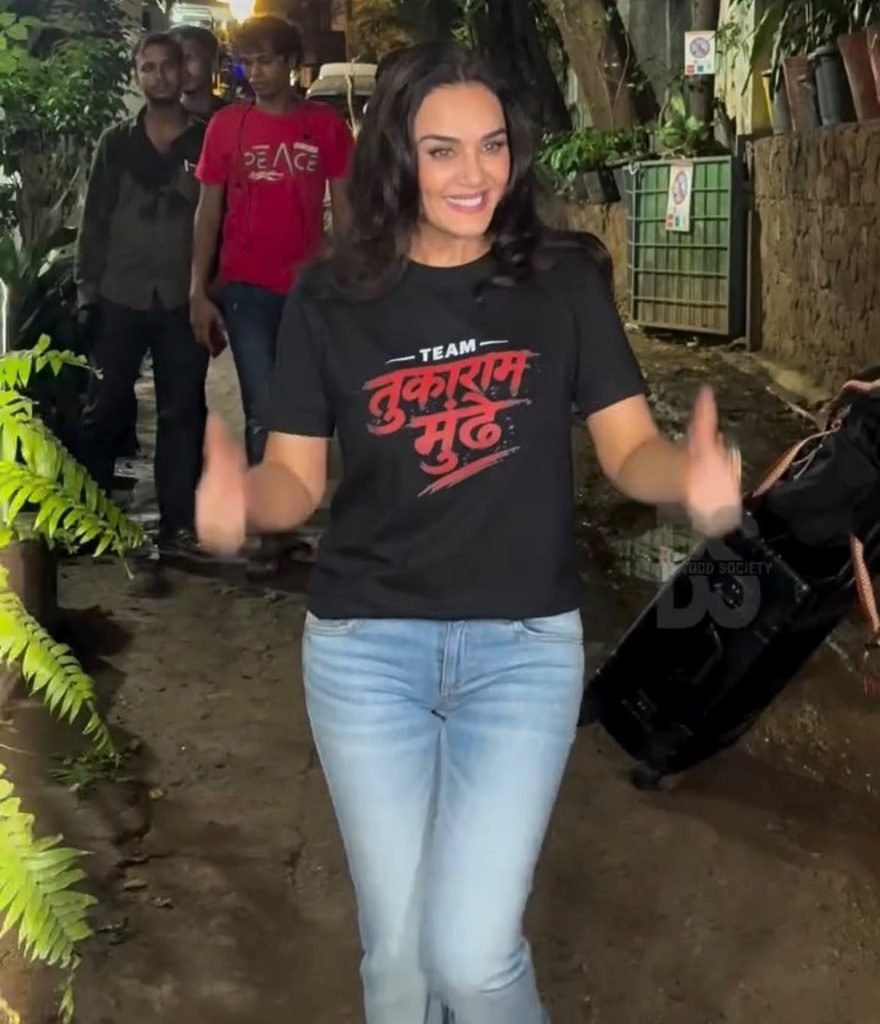
Preity Zinta stepped out in Mumbai in a fairly low-key look, but it was her T-shirt that quickly became the talking point. The actor was spotted wearing a black T-shirt emblazoned with the words “Team Tukaram Mundhe”, a rather direct show of support for the Maharashtra Food and Drug Administration Commissioner.
The message stood out because Mundhe has spent the past few months at the centre of Maharashtra’s increasingly visible food-safety crackdown. A video of Preity’s outing soon made its way online, with social media users focusing less on her casual jeans-and-trainers look and more on the name printed across her T-shirt.
Preity has not made a detailed public statement explaining the choice, but the message on the T-shirt was difficult to miss. And she is not the only Bollywood name to have taken notice of the bureaucrat.
Who Is Tukaram Mundhe?
Tukaram Mundhe is an IAS officer who currently serves as Commissioner of Maharashtra’s Food and Drug Administration.
Since taking charge, he has put food safety and enforcement firmly in the public spotlight, with inspections and action spanning restaurants, hotels, dairies, food outlets and other establishments.
His approach has also been unusually visible. Reports have documented thousands of food-safety inspections and raids under his tenure, targeting establishments ranging from street vendors and restaurants to larger food businesses.
The inspections have focused on issues including unhygienic kitchens, adulteration, expired products, improper storage and labelling, and other alleged violations of food-safety regulations.
The scale and visibility of the campaign have helped turn what would ordinarily remain a regulatory story into a much wider public conversation.
Why Mundhe’s FDA Crackdown Has Become Such a Big Deal
Part of the reason is straightforward: food safety is something people encounter every day. The FDA’s inspections have brought attention to practices consumers might otherwise never see, from poor kitchen hygiene and unsafe food handling to adulteration and improperly stored or labelled products.
In one recent operation in Navi Mumbai, the FDA uncovered a company allegedly altering expiry dates and nutritional labels on branded food products before repacking them for export.
The crackdown has also reached some of Mumbai’s better-known food establishments and government-linked premises. Restaurants, dairies, canteens and other food businesses have faced inspections, notices and, in some cases, licence suspensions.
Mundhe has defended the approach as enforcement of existing food-safety rules rather than a special campaign against particular businesses.
That visibility appears to have struck a chord with a section of the public. For many people, seeing a government department actively checking the places where they eat has made food safety feel less like an abstract regulation and more like an everyday concern.
Then Came the Bollywood Connection
Mundhe’s work crossed directly into Bollywood when the Maharashtra FDA issued show-cause notices to Shah Rukh Khan, Ajay Devgn and Tiger Shroff over their appearances in Vimal Elaichi advertisements.
The regulator alleged that the campaign could amount to surrogate or indirect promotion linked to prohibited pan masala or tobacco-related products. Mundhe later defended the notices, arguing that regulatory responsibility can extend beyond manufacturers and sellers to celebrity endorsers as well.
That move gave him an entirely different kind of visibility. His name was no longer appearing only in stories about restaurant raids and food-safety inspections; it had entered the Bollywood news cycle too.
Also Read: Why Maharashtra FDA Sent Notices to Shah Rukh Khan, Ajay Devgn and Tiger Shroff Over Vimal Elaichi
Preity Zinta Isn’t the Only Celebrity Backing Mundhe
Before Preity, Twinkle Khanna had already drawn attention to Mundhe’s inspections with a humorous post about checking her own kitchen.
Manoj Bajpayee also spoke positively about the idea of a government official doing his job with honesty and dedication.
More recently, Ramayan actor Sunil Lahri publicly praised Mundhe as well. Lahri shared a video message calling for more officers like him and applauding action against food-safety violations.
His remarks added another example of how Mundhe’s work has begun attracting support from people outside the usual political and bureaucratic circles.
Preity’s endorsement, however, may be the most instantly recognisable one yet because she chose to put the message directly on her clothes.
But Mundhe’s Crackdown Has Also Faced Criticism
The growing public support does not mean the FDA’s approach has gone unquestioned. The Bombay High Court has intervened in several matters involving FDA licence suspensions, raising concerns about the procedure followed in some enforcement actions.
In one recent case involving five eateries at the Mumbai Cricket Association’s BKC premises, the court allowed the restaurants to reopen after a fresh inspection found them substantially compliant with food-safety requirements. The court criticised what it considered an overly rigid approach, while the FDA agreed to withdraw the suspension.
Other cases have also seen courts question whether immediate suspension or closure was proportionate where violations could potentially be rectified or where an immediate health risk had not been clearly established.
That provides an important counterpoint to the growing public enthusiasm around Mundhe. Visible enforcement may win applause, but regulatory action still has to meet standards of procedure, proportionality and fairness.
When a Bureaucrat Becomes a Public Symbol
For now, Mundhe has become something unusual for a bureaucrat: a recognisable public figure whose name has moved beyond government offices and into celebrity conversations.
Preity Zinta’s T-shirt may be the clearest example yet. What began as a series of inspections, raids and regulatory actions has become a wider cultural talking point, with actors, public figures and ordinary citizens weighing in on the officer behind the crackdown.
Watch the viral clip:
https://x.com/PreityZintaPeru/
And perhaps that leaves the more interesting question: when a bureaucrat becomes a public symbol, is it because of personality, or because people are responding to visible enforcement in an area that directly affects their everyday lives?


