

Growing up on Kashmir’s iconic houseboats is no longer the idyllic life many imagine. Through the voices of children and their families, Parsa Tariq explores life on Dal Lake amid environmental decline, health challenges, economic uncertainty and dreams that stretch far beyond the water.
SRINAGAR: Eleven-year-old Insha sits on the wooden porch of her home, swinging her legs over the dark, still waters of Dal Lake. Her family’s houseboat, The Golden Willow, is moored directly against the concrete embankment. To reach school each morning, she runs across a narrow, squeaky wooden plank connecting the porch to the bridge stairs leading to the main road.
Growing up on Dal Lake’s houseboats once sounded like a dream. Today, it is a complex daily reality.
For the children who live on these wooden boats throughout the year, childhood is shaped by a unique combination of challenges: polluted summer water that causes skin rashes, sudden rainstorms that bring an unexpected chill even in midsummer, limited access to emergency healthcare, and the quiet pressure on parents who increasingly depend on second jobs on land to keep their families afloat.
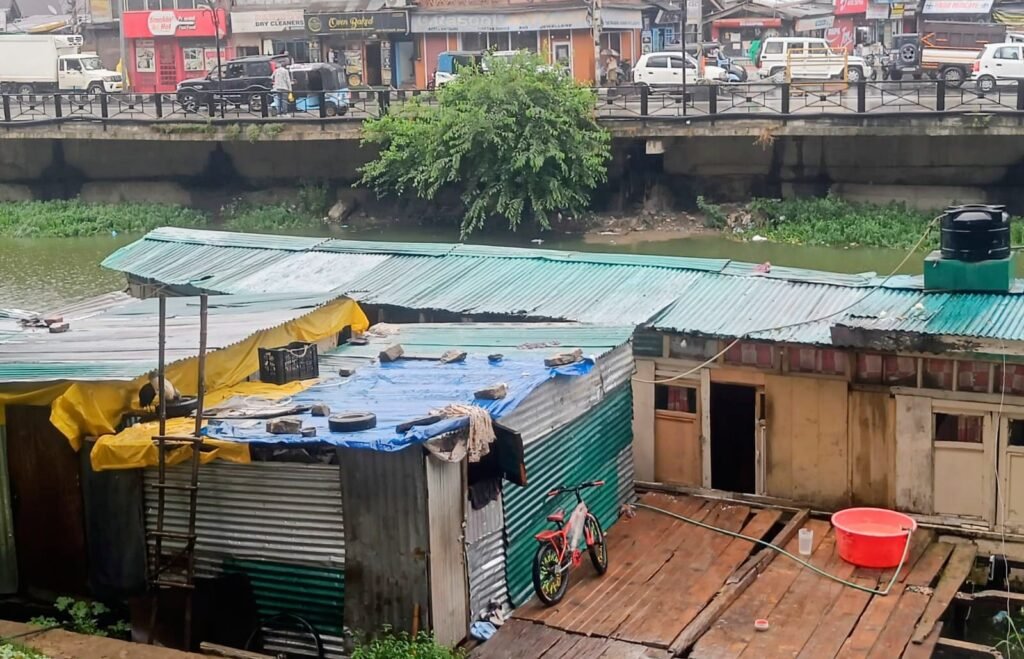
Planks, Bridge Stairs and Unpredictable Weather
Reporting on Dal Lake over three days reveals how dramatically Kashmir’s summer weather can change.
The first morning was bright and sunny, casting a warm golden light across the water. By the following two days, however, relentless rain had settled over the Valley as part of a week-long downpour. Even in the middle of summer, continuous rainfall brings a sharp chill, transforming the lake into a grey, shivering expanse.
For 11-year-old Insha, leaving home means taking three quick steps across a thick wooden plank. But when rain makes the timber slippery, her mother calls out from the kitchen window, reminding her to slow down.
“I like running up to the bridge stairs to meet my friends after school,” says Insha, holding a small plastic doll under her arm. “When the sun is out, tourists walk on the bridge and take photos of our boat. But when it gets super hot in July, the water turns green and smells really yucky. My legs get itchy spots if I drop my ball and reach down to grab it. Papa tells us, ‘Don’t put your hands in there!’ But sometimes toys just fall in.”
A little further along the embankment, nine-year-old Falak sits near her boat’s entrance, watching plastic wrappers float beneath the wooden walkway. Her family’s houseboat is positioned in a corner where floating waste often gathers beneath the bridge.
“My school friends think it’s like a playground,” says Falak, shrugging against the damp air. “They say, ‘Oh, you live on a boat, you can swim all day!’ But I tell them, no way, it’s not like that. In winter, it gets so cold my toes go numb and we sit with kangris under heavy blankets just to stay warm. But even now in summer, when it rains for a whole week like this, my chest starts hurting. I begin coughing and my mum gets worried.”
The Ecological Shift Beneath the Hull
The pollution that Insha and Falak encounter every day is no mystery. It is the result of decades of environmental degradation.
According to the Comptroller and Auditor General (CAG), rapid urbanisation, encroachment, siltation and the discharge of untreated sewage have steadily damaged Dal Lake’s fragile ecosystem.
The CAG reported that the lake’s open-water area declined from 15.40 square kilometres in 2007 to 12.91 square kilometres in 2020, while increasing nutrient pollution has fuelled excessive weed growth and algal blooms, further degrading water quality.
The ecological decline has been accompanied by a gradual reduction in the number of traditional houseboats.
Peer-reviewed research estimates that more than 900 registered houseboats remain across Dal Lake and its adjoining water bodies—a fraction of the numbers that existed several decades ago.
Houseboat owners say rising maintenance costs, ageing wooden structures and restrictions on new construction aimed at protecting the lake’s fragile ecosystem have made sustaining this centuries-old way of life increasingly difficult.
Daily Hardships and Medical Realities
Inside the houseboats, families have learned to adapt to changing environmental conditions. While fathers seek economic stability, mothers shoulder the everyday responsibility of protecting their children from the physical dangers and health risks of life on the lake.
Even beneath grey skies and relentless summer rain, household chores cannot wait.
Falak’s mother, Naseema, kneels on the rain-soaked wooden deck, filling a bucket with icy water pumped from the motor to wash the family’s clothes. Her hands are red and raw from repeated exposure to the freezing water.
“When they were small toddlers, I was scared to death every minute,” Naseema says, watching Falak balance carefully on the slippery plank leading to the bridge. “There are no railing bars on these walkway planks. One wrong step and a small child falls into the water. Now that they are older, the danger is what’s in the water and how fast the weather turns. The lake isn’t clean like when I came here twenty-five years ago. The kids get stomach aches, skin rashes, and bad coughs every time a rainy cold spell hits us.”
Naseema’s everyday experiences reflect what doctors routinely observe in local clinics.
Dr Altaf Shah, a senior medical officer in Pulwama, says these recurring illnesses are consistent with prolonged exposure to poor water quality and damp living conditions.
When asked about the primary health concerns affecting houseboat residents, Dr Shah points to skin diseases, respiratory illnesses and waterborne infections. Explaining the particular risks faced by children, he says:
“They face waterborne and skin disorders related to hygienic water and sanitation.”
Dr Shah notes that stagnant, polluted water in parts of Dal Lake creates conditions that allow infectious diseases to spread more easily. When children retrieve toys from algae-covered water or come into direct contact with contaminated areas, skin infections and rashes can develop quickly. At the same time, dampness rising through unheated wooden structures during winter and prolonged rainy spells contributes to respiratory illnesses.
“In winter, such children may get respiratory infections, allergies, and frostbites,” Dr Shah explains.
Medical accessibility presents another challenge during emergencies or severe weather.
While dedicated healthcare facilities are available, Dr Shah believes greater intervention is needed to reach families living on the lake. He says the government should “increase mobile water ambulances and hospitals on such lakes” to ensure timely medical care for every household.
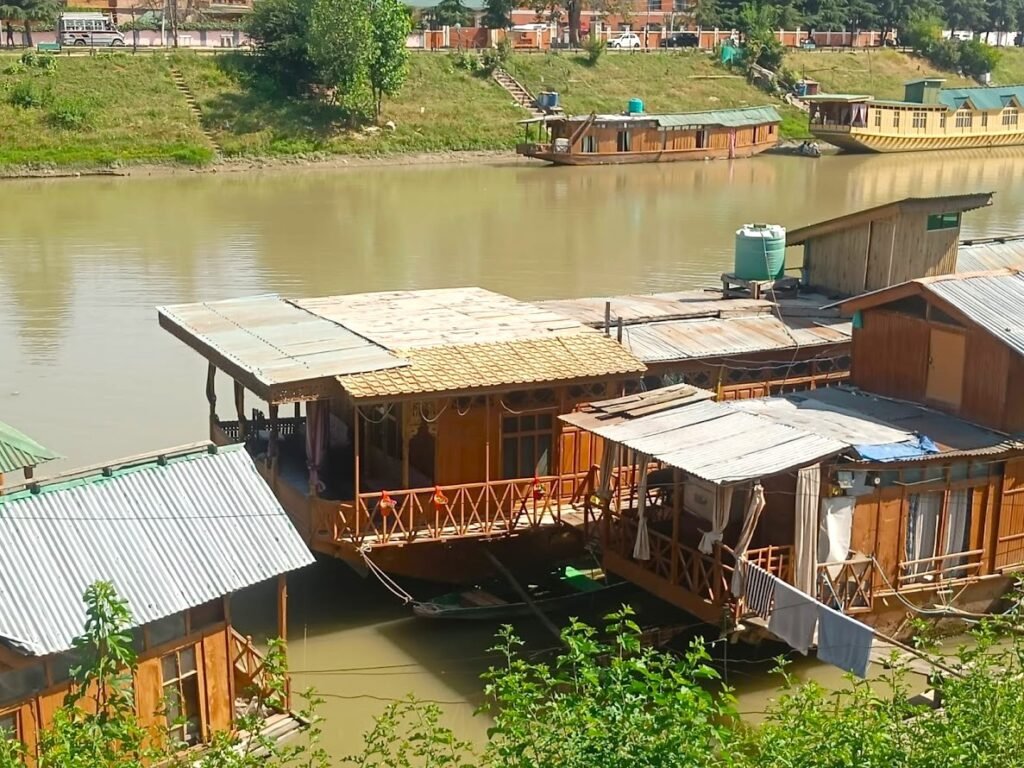
Houseboats anchored on Dal Lake reflect a centuries-old way of life that continues to adapt to changing environmental and economic realities. Photo Credit: Parsa Tariq / TheNews21
Balancing Livelihoods on Land
Beyond managing health concerns, families also face the economic challenge of preserving a traditional way of life.
For many, seasonal tourism alone is no longer enough to support a household or maintain an ageing wooden houseboat.
Falak’s father, Farooq, works as a school van driver. Before dawn each morning, he leaves the lake to navigate city traffic before returning home in the evening.
Standing near the bridge stairs in his driver’s jacket, he pulls a light shawl around his shoulders as rain drums steadily on the wooden roof.
“Relying on tourists alone doesn’t pay for school books or daily groceries anymore,” Farooq says. “I drive the school bus from six in the morning, and every month it feels like everything on land costs more, while life on the water gets harder. When you are balancing a full-time job on land with living on a boat, you are constantly exhausted, but we need that fixed monthly income just to survive.”
For families like Farooq’s, earning a livelihood now depends on balancing two very different worlds—one anchored in the centuries-old traditions of Dal Lake, the other shaped by the economic realities of modern Kashmir.
Dreams Beyond the Bridge
Despite the environmental and financial challenges surrounding them, conversations with the children often drift away from illness or the lake itself. Instead, they turn to school, personal interests and dreams of the future.
On Dal Lake, young girls and boys navigate a social world of their own. They watch children on land walk across the bridge carrying tuition bags, heading to private classes, while they study on cramped wooden stools beneath the glow of flickering battery lamps.
Twelve-year-old Meeram sits on a wooden stool near the bridge stairs, carefully colouring a science diagram in her school notebook.
“In school, whenever we have science or drawing projects, my friends ask if I only draw lake flowers and fish,” Meeram says, resting her pencil against her cheek. “They think we don’t have internet or TV on the boats, or that we don’t study the same subjects as them. But I love space, science and math. My teacher told us about computers, and that’s what I want to learn.”
She pauses for a moment before speaking again, her voice calm and thoughtful.
“Living here makes people think your whole story is just about the lake,” Meeram says softly. “I like my home, but I want to build a life where I’m known for my own mind, not just because I live on a wooden boat. I’m studying hard so I can become an engineer and use a computer. I want to travel, work in a proper office, and show my parents that we can build a life on land too.”
For Meeram and many children growing up on Dal Lake, the houseboat is both home and inheritance. Yet their ambitions stretch well beyond the wooden decks on which they were raised. They dream not of leaving their identity behind, but of expanding the possibilities that lie ahead.
Epilogue
For now, the old wooden houseboats remain tied beside the bridge stairs, gently swaying as rain ripples across the lake and vehicles pass overhead.
Within these ageing homes, a new generation is growing up—crossing narrow wooden planks each day, negotiating environmental uncertainty, challenging long-held assumptions and imagining futures that extend far beyond the water’s edge.
Their childhood is shaped by a landscape unlike any other, where beauty and hardship exist side by side. The lake continues to define their daily lives, but it does not define the limits of their aspirations.
As Dal Lake itself changes, so too do the lives of the children who call it home. Whether they remain on the water or build lives elsewhere, they carry with them the resilience, adaptability and quiet determination forged on Kashmir’s fading houseboats.


