

Anjana Sasi | Reporting from Nagoya, Japan
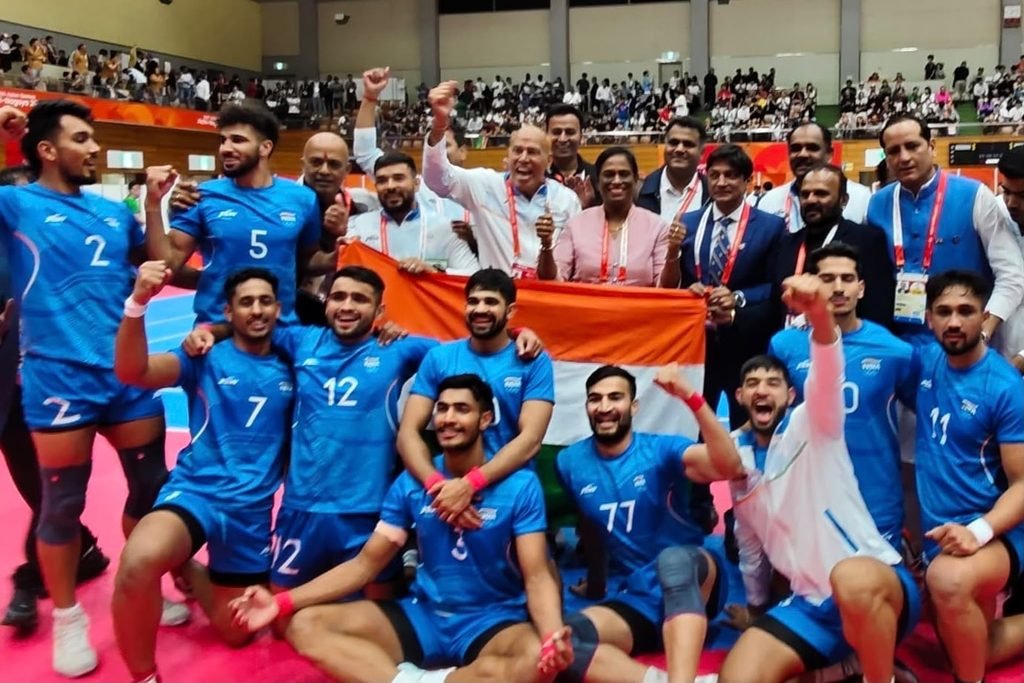
Nagoya: The roar from the kabaddi court finally gave India something to celebrate. Two gold medals in a single day and a jump into the top 10 of the Asian Games standings. But behind the celebrations in Nagoya is a more complicated Indian campaign — one in which some expected medals have slipped away while unexpected heroes have stepped forward to keep the tally moving.
India ended Saturday in 10th position with 30 medals — four gold, 12 silver and 14 bronze. The men’s and women’s kabaddi teams provided the golden lift, both defeating Iran in their finals. India had begun the day in 12th place, so the climb into the top 10 was encouraging. But the country is still searching for the kind of broad-based medal surge that made the previous Asian Games such a landmark campaign.
The two kabaddi golds were among the medals India would have expected. The men’s team defeated Iran 40-34 to win its ninth Asian Games gold across 10 editions of the event. The women also defended their title, beating Iran 37-34 in a much tighter final. Two finals, two golds — exactly the kind of return India needed.
Athletics added more to the tally. Tajinderpal Singh Toor won silver in the men’s shot put with a best throw of 20.64m, while Manpreet Kaur added bronze in the women’s shot put and Prachi took bronze in the women’s 400m. But some of the most compelling stories have come from athletes who were not necessarily carrying the biggest expectations.
Sawan Barwal’s silver in the marathon was one of the campaign’s major breakthroughs. Long-distance running rarely receives the same attention in India as cricket, shooting or badminton, yet Barwal produced a performance that put him among the country’s standout athletes in Nagoya. His medal ended a 44-year wait for India in the men’s marathon at the Asian Games. He clocked 2:11:36, finishing behind Japan’s Ichitaka Yamashita and becoming the first Indian marathon medallist at the Games since 1982.
Then came Baranica Elangovan. Her bronze in the women’s pole vault was historic — India’s first-ever Asian Games medal in the event, across either men or women. She cleared 4.15m and shared bronze with Kazakhstan’s Polina Ivanova. Her medal was not simply a successful clearance. It represented the kind of breakthrough Indian athletics has often struggled to produce in technical events where the country has traditionally lacked depth.
These are the performances that have given India’s campaign its emotional edge. They are not merely medals added to a spreadsheet. They come from athletes who have spent years waiting for their moment. At the same time, India cannot ignore where things have gone wrong.
Badminton is one of the clearest examples. India arrived with considerable expectations after its strong showing at the previous Asian Games and with a generation capable of challenging the best in the world. The men’s team did secure bronze earlier in the competition, but the individual events have not produced the returns India might have hoped for.
Satwiksairaj Rankireddy and Chirag Shetty had already shown their quality in the team competition, while Lakshya Sen also contributed to India’s progression there. But when the individual events arrived, India’s medal possibilities narrowed quickly. The concern is not simply that leading players lost. Every major competition produces defeats. The larger issue is depth.
Also Read: India’s Asian Games Test: The Medals Are Coming, But the Golds Must Follow
A sport with India’s recent badminton record should ideally be able to absorb the early exit of one or two leading names without seeing its medal prospects shrink dramatically. There have been similar frustrations in other disciplines. Swimming has yet to produce the breakthrough India has been waiting for, while fencing has struggled to turn participation into medals.
These are not failures of individual athletes. But they underline a larger issue for Indian sport: participation is expanding faster than medal-winning depth in several Olympic disciplines. Shooting remains one of India’s strongest medal-producing sports, but even there the story has not been completely straightforward.
India has won medals consistently, but there have also been occasions when shooters who appeared capable of challenging for gold have either slipped out of podium contention or settled for lower medals. For a country that now enters major multi-sport events expecting shooting to deliver regularly, the standard of success has changed. That is why the comparison with Hangzhou 2022, held in 2023, is unavoidable. India returned from Hangzhou with a record 107 medals — 28 gold, 38 silver and 41 bronze — and finished fourth.
What stood out there was not only the total but the spread. India was winning medals across a wide range of disciplines and producing breakthroughs from athletes who had not always been household names before the Games. Nagoya has not yet reached that level of depth. The comparison, however, needs to be made carefully.
The Games are still underway, and India’s tally could still change substantially in the remaining days. Hangzhou itself showed how quickly a campaign can gather momentum once several medal events arrive together and there are reasons for India to remain hopeful.
Tejaswin Shankar has completed the opening day of the decathlon and will finish the remaining events on Sunday. A strong second day could add another important medal to India’s athletics tally. Gulveer Singh is another reason for optimism. After winning silver in the 10,000m, he has qualified for the 1500m final.
There are also opportunities remaining in cricket, shooting, archery, boxing, squash and hockey. Some of India’s most experienced medal contenders are still to have their final say in Nagoya. The hockey competitions, in particular, carry significance beyond the medal itself because the Asian Games champions secure direct qualification for the 2028 Olympic Games.
The biggest challenge for India now is the gold count. Thirty medals may look healthy, but only four are gold. Twelve silvers and 14 bronzes show that Indian athletes are repeatedly reaching the podium. The next step is converting more of those performances into victories. So India’s position in 10th is both encouraging and revealing.
The kabaddi teams have done their job. Shooting has contributed strongly. Athletics has produced both expected performances and delightful surprises. But badminton and several other disciplines have exposed gaps that cannot be hidden by the medal table. For the Indian contingent, the remaining days are therefore not simply about adding numbers. They are about discovering whether the country has enough depth to turn individual successes into a sustained campaign. Nagoya has already produced heroes India did not necessarily expect. Now it needs the athletes it expected to deliver to join them.


