

Nagoya: The opening ceremony of the Aichi-Nagoya Asian Games was designed to leave an impression. It did — but perhaps not only through the spectacular stage, lasers, giant screens and carefully choreographed performances.
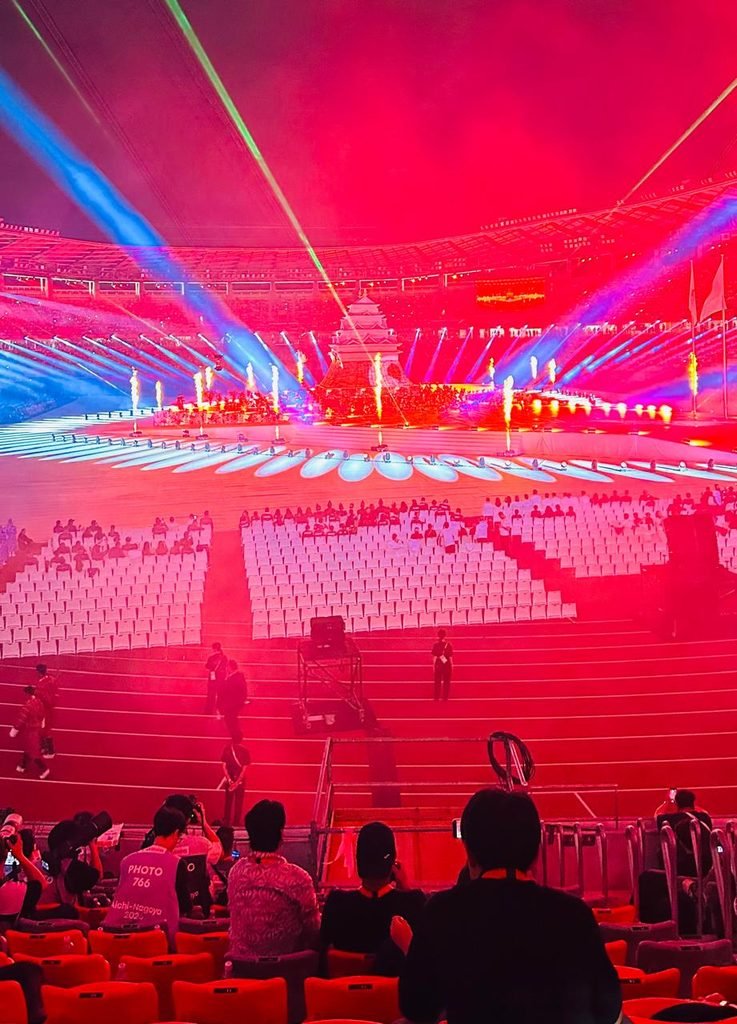
Inside the stands, away from the centre of the production, the evening offered another view of the Games — one shaped by ordinary spectators, long hours of waiting, crowded seating and the practical realities of staging a major continental sporting event. That contrast is worth noticing.
By the time the formal ceremony began at 6 p.m. on September 19, many spectators had already been inside the stadium for several hours. The cultural warm-up programme had begun at 4 p.m., while people had started arriving much earlier.
Some carried small battery-operated fans. Others used traditional hand fans. It was not a crisis, nor was the weather exceptionally severe by official standards. But it was a reminder that the experience of a mega event is measured differently from the experience of watching it on television.
For the organisers, the ceremony was about creating a seamless spectacle. For the people in the stands, it was a long evening spent physically inside that spectacle. And that difference is increasingly important as sporting events become larger, more technologically ambitious and more environmentally conscious.
Aichi-Nagoya represents a very different Asian Games from the one inaugurated in New Delhi in 1951. The first edition brought together 489 athletes from 11 countries competing in six sports. Today, the Games have grown into a vast continental sporting ecosystem, bringing athletes and officials from 45 countries and regions, as well as the Olympic Council of Asia (OCA) Refugee Team, together across 43 sports. The numbers tell one part of the story. The opening ceremony showed the other.
Where Japan’s Past Met Its Technological Present
The heart-shaped stage became the centre of an elaborate production that moved effortlessly between Japan’s past and present. Traditional martial arts gave way to contemporary music. Japanese cultural imagery shared the stage with sophisticated lighting, LED displays and laser effects.
The ceremony was technologically polished without abandoning the cultural identity of the host country. That balance was one of the evening’s most striking features. But the larger question for modern mega events is no longer simply how spectacular they can become. It is how intelligently that spectacle can be delivered.
A stadium can look extraordinary on camera while presenting very different challenges to the people sitting inside it. Waiting time, access, seating, movement, shade and the ability to take a break can matter just as much to spectators as the quality of the performance happening on stage. These are not glamorous details. They are operational details. Yet they increasingly define whether a major event feels welcoming or merely impressive.
Sustainability Has a Human Dimension Too
That is especially relevant to Aichi-Nagoya’s sustainability ambitions. The Games have placed considerable emphasis on reducing their environmental impact, including through the use of existing venues and measures intended to limit unnecessary construction and resource consumption.
That approach is significant because the modern sporting world is under increasing pressure to reduce the environmental cost of mega events. But sustainability cannot stop at construction materials, transport or energy consumption. It also has a human dimension.
A genuinely sustainable sporting event has to consider how people experience the venue — spectators, athletes, volunteers, officials and workers. Climate conditions, crowd movement, access to water, rest areas and basic comfort are part of that equation. The small fans appearing throughout the stands were therefore more than just an amusing visual detail.
They were a reminder that even the most advanced sporting infrastructure ultimately has to serve the people sitting inside it. And there was plenty to celebrate on that front too.
Also Read: Aichi-Nagoya Awaits: Asia’s Sporting Power Struggle Begins
Beyond the Spectacle, the People
The volunteers were visible and helpful. The organisation around the stadium was disciplined. The movement of thousands of people into the venue was largely orderly. Delegations from across Asia transformed the stadium into a visual map of the continent, while the athletes’ parade provided perhaps the most powerful reminder of what the Games are actually about.
When India entered, led by Manu Bhaker and Pawan Sehrawat, the response from the Japanese crowd was warm and unmistakable. The Chinese, Korean and Japanese contingents also generated strong reactions, reflecting the diversity of the audience itself. That moment mattered more than the lasers.
Because behind all the technology, the Asian Games remain fundamentally a gathering of people. The temptation with modern opening ceremonies is to judge them through the scale of the production — bigger screens, more elaborate choreography, more spectacular lighting and greater technological sophistication.
Aichi-Nagoya showed that Japan can deliver that level of production. But the more meaningful test may lie elsewhere. Is the same level of attention that goes into the stage also possible for the person sitting in the highest row?
Is sustainability only about the number of tonnes of material saved or venues reused, or is it also about how comfortably and efficiently thousands of people experience an evening? Can technology improve an event without allowing the technology itself to become the event?
Aichi-Nagoya’s opening ceremony provided no easy answers. It did, however, pose those questions from the stands. And perhaps that is where the next generation of Asian Games needs to be judged — not only by what the world sees on screen, but also by what the people inside the stadium actually experience.
Disclosure: Anjana Sasi’s travel for TheNews21’s Aichi-Nagoya Asian Games coverage has been supported by a private individual who has requested anonymity. The supporter has no role in TheNews21’s editorial decisions or coverage.


