

Bharat Pavilion and Bharat Parv put production, VFX, gaming and distribution at the centre as New Delhi seeks to convert an existing audiovisual treaty—and the wider India-Canada reset—into working commercial partnerships
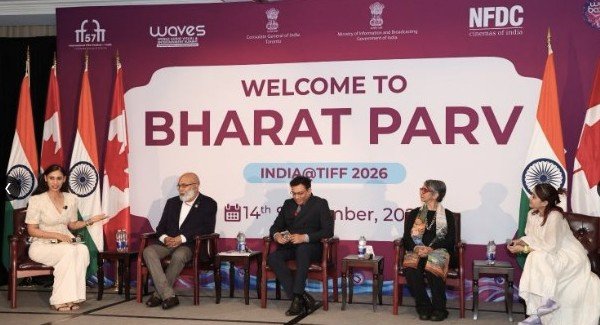
Toronto: India’s presence at the Toronto International Film Festival (TIFF) this year carried a noticeably different message. The pitch was no longer limited to taking Indian cinema abroad or attracting audiences to Indian films. It was about persuading international producers to use India as part of their production chain. At the 51st Toronto International Film Festival, the Bharat Pavilion and a separate Bharat Parv gathering brought together filmmakers, producers and representatives of the Indian and Canadian creative industries, with discussions extending from co-productions and shooting locations to post-production, visual effects (VFX), animation, gaming and global distribution.
The approach coincides with an important change at TIFF itself. The 2026 edition, being held from September 10 to 20, marks the launch of TIFF’s formal content marketplace, TIFF: The Market, aimed at connecting producers, buyers, financiers, distributors and technology companies alongside the festival programme. India appears to be using that shift to reposition its presence in Toronto from primarily cultural visibility to commercial matchmaking.

From Film Showcase to Production Partner
The Bharat Pavilion at TIFF highlighted the World Audio Visual and Entertainment Summit (WAVES) 2027 and WAVES Bazaar, India’s platform intended to connect film, television, streaming, animation, gaming and other audiovisual businesses with international buyers and collaborators. The Consulate General of India in Toronto described discussions at the Pavilion as focusing on partnerships, international markets and opportunities for Indian creative talent. That positioning was carried further at the Bharat Parv reception organised by the Consulate General of India in Toronto in association with the Ministry of Information and Broadcasting and the National Film Development Corporation (NFDC). India’s High Commissioner to Canada Dinesh Patnaik used the gathering to underline India’s ambition to become a larger centre for content creation, production and investment, while Consul General Mahaveer Singhvi urged Canadian filmmakers, studios, producers and creative entrepreneurs to explore India not only as a consumer market but as a production partner.
That distinction is significant. India has for decades provided locations and production services to foreign filmmakers. The emerging pitch is broader: international productions can potentially tap Indian writers, technicians, studios, VFX and animation companies, post-production facilities and increasingly digital and gaming businesses within the same creative ecosystem. At the TIFF Pavilion, the emphasis similarly extended across pre-production, production and post-production rather than being confined to finished films seeking international exposure.
The Treaty Already Exists
The India-Canada co-production proposition is also not starting from zero. An Audiovisual Co-production Treaty between Canada and India came into force on July 1, 2014, allowing producers from the two countries to combine creative, technical and financial resources for eligible audiovisual projects. India’s Ministry of External Affairs continued to list the film co-production agreement as part of the bilateral relationship in its January 2026 India-Canada brief. The important question, therefore, is no longer whether a bilateral framework exists. It is whether producers on both sides can convert that framework into projects, financing, distribution arrangements and sustained business relationships.
India has been trying to close that gap for several years. Even at TIFF in 2022, officials discussed ways of expanding and popularising the India-Canada co-production arrangement. Similar outreach continued through subsequent editions of the festival. Seen in that context, Bharat Parv 2026 represents continuity—but with a potentially stronger commercial platform around it because TIFF now has a dedicated market.
Why WAVES 2027 Matters
The Toronto outreach also fits into a larger attempt by the Ministry of Information and Broadcasting to develop WAVES into an international marketplace for India’s media and entertainment economy rather than merely another government-supported summit. Preparations are already underway for the second edition of WAVES, scheduled to be held in Mumbai in 2027. Government planning has included expansion of WAVES Bazaar and market access as well as initiatives covering artificial intelligence, animation, VFX, gaming, digital media and other technology-driven creative industries. The invitation to Canadian industry players at TIFF therefore has a follow-through point: bring potential partners from Toronto to Mumbai, where projects, technology partnerships and co-production discussions could move beyond introductory meetings. Whether that happens will be more important than the number of delegations attending the events.
A Creative-Economy Track in the India-Canada Reset
There is another layer to the timing. The film-industry engagement comes amid a broader rebuilding of India-Canada relations. Canadian Prime Minister Mark Carney visited India from February 27 to March 2 this year, the first bilateral visit by a Canadian prime minister since 2018. Both governments subsequently described the relationship as moving forward across trade, investment, technology, energy, talent and other sectors. Prime Ministers Narendra Modi and Carney again met during the Group of Seven Summit in France in June, where they noted what both governments termed “positive momentum” in bilateral relations. Annual Foreign Office Consultations in New Delhi on September 2 also recorded continuing high-level engagement. The creative industries are consequently becoming one of several commercial tracks through which that renewed engagement is being tested. Unlike politically sensitive areas of the bilateral relationship, film production, animation, VFX, gaming and content distribution offer a relatively established institutional base: an existing co-production treaty, large creative workforces in both countries, a substantial Indian-origin audience in Canada and now two emerging industry marketplaces—TIFF: The Market in Toronto and WAVES in Mumbai.
The Test Comes After Toronto
Bharat Parv ended with the familiar elements of a cultural engagement—an industry discussion followed by performances. But the substantive measure of the initiative will lie elsewhere. The test will be whether conversations in Toronto result in identifiable co-productions, Canadian productions being undertaken in India, Indian studios securing international post-production or VFX assignments, distribution deals, technology collaborations or Canadian participation at WAVES 2027. For India, TIFF 2026 therefore represents more than another international cinema showcase. The effort underway is to move from showing Indian content to selling India’s capacity to create, finance, produce, process and distribute content with the world. And in the India-Canada relationship, that would shift cinema from cultural diplomacy to measurable creative-economy business.


