

“When the village made up its mind, even a dry pond smiled again.”
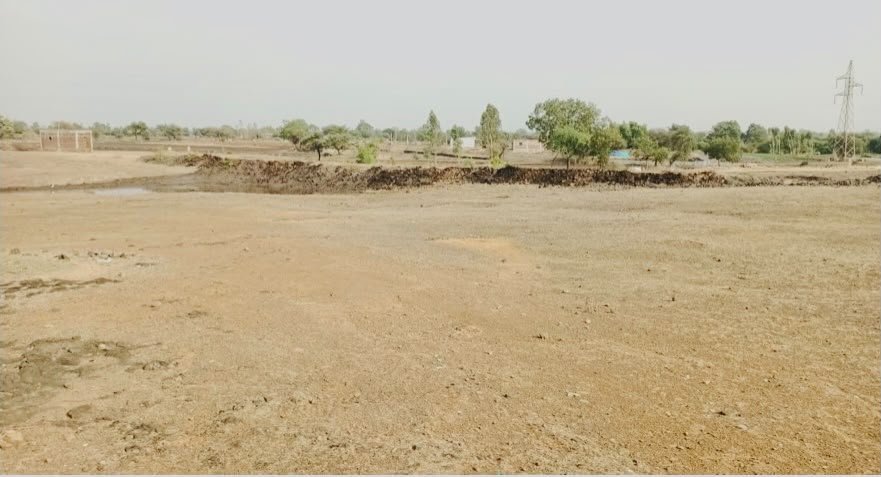
KESARPURA, JHABUA: Three months earlier, villagers had stood on the dry bed of this pond with pickaxes, spades and metal pans in their hands. By August, they were standing beside water. On May 19, 2026, around 150 residents of Kesarpura came together for Halma, the traditional Bhil practice of collective voluntary labour. They removed weeds and accumulated silt, strengthened a leaking embankment and worked to restore a water body on which farming and livestock in the village depend.
What happened afterwards gave the village reason to believe that the solution it had long looked for outside had, at least in part, been within the community itself. Nearly three months after the Halma, villagers found the pond filled to the brim. More importantly, they said, the seepage through the embankment had stopped. The water that arrived had stayed.
A Tradition Built Around the Words: ‘You Are Not Alone’
Kesarpura lies about 22 kilometres from the Petlawad block headquarters in Madhya Pradesh’s Jhabua district. Its story is not merely about restoring a pond. It is about rediscovering the confidence of an entire community. Halma is a word from the Bhili dialect referring to collective voluntary labour. When a family in the Bhil community is weighed down by a burden—whether raising a house, bringing in a harvest or facing a calamity—the community comes together voluntarily and without payment to stand beside it. The message is simple: you are not alone.
Kesarpura’s pond had been waiting for exactly this tradition. Years of neglect had left it choked with silt and unwanted weeds. Its depth was shrinking, and with it the pond’s capacity to hold water. Seepage through one stretch of the embankment quietly drained away part of the rainwater it collected. In this tribal region of rocky and sloping land, where retaining rainwater is critical, a failing pond directly affects farming and the availability of water for livestock. As summer set in, cracks appeared across the pond bed, and the village’s hopes seemed to slip into those cracks along with the water.
When the Dhol Sounded, the Village Came Out
The village knew the problem was large, but it also began to believe that part of the solution lay in its own hands. With support from the Gram Swaraj Samuh, or village self-governance group, formed with facilitation from VAAGDHARA, villagers decided to hold a Halma at the pond.
On the morning of May 19, Kesarpura showed what that decision meant. It began not with speeches or formal announcements, but with the beat of the dhol, kundi and thali.
A rally wound through the village. Children ran ahead carrying a banner announcing the “Traditional Halma Method”, with a message urging people to conserve water for the future. Behind them came elders, young people and women. People arrived carrying pickaxes, spades and metal pans.
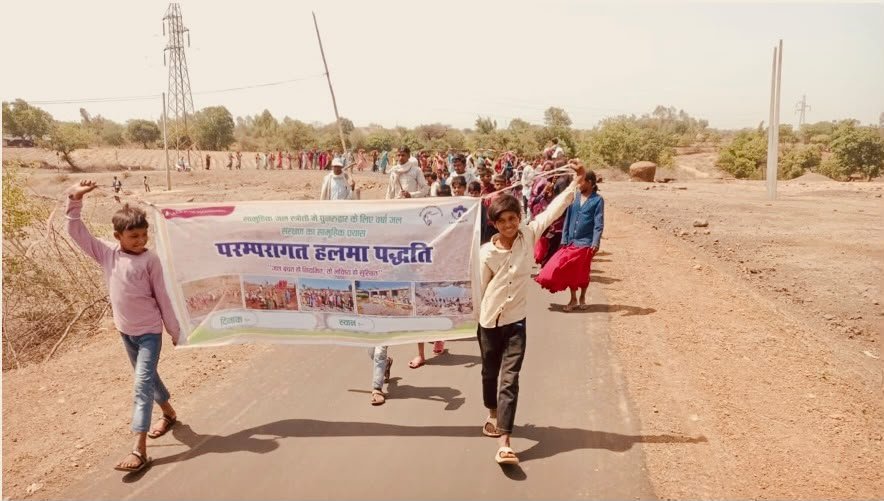
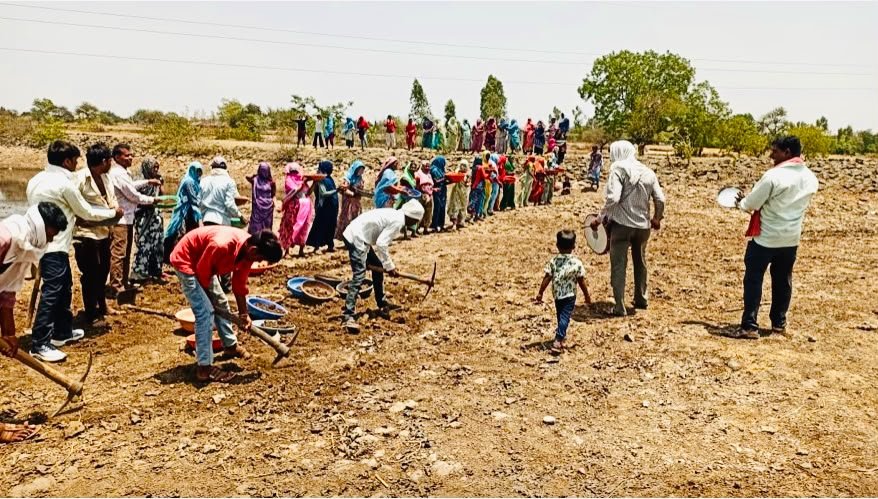
Around 150 people gathered at the pond. There was no attendance register. There was no wage sheet. People had come of their own accord. Under the blazing sun, heads were covered with gamchas and dupattas, and the work divided itself almost naturally.
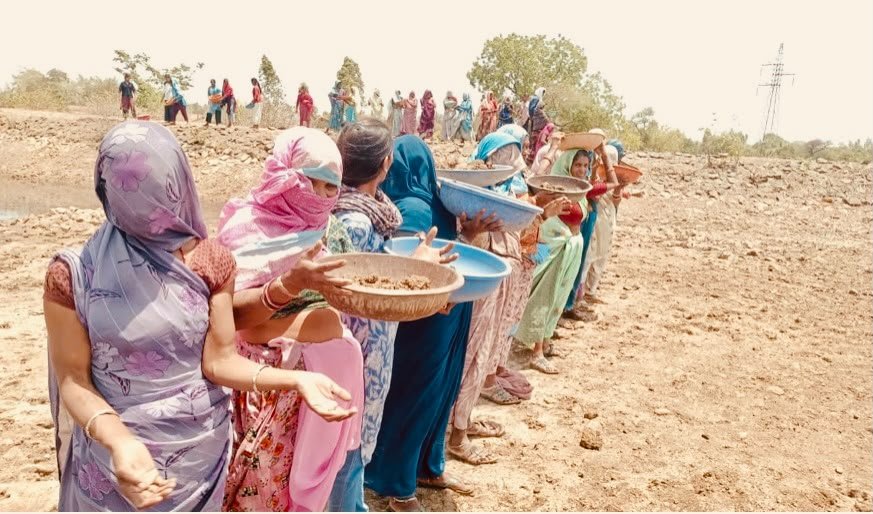
Some entered the pond bed to cut weeds. Others loosened and dug out the accumulated silt with pickaxes and spades. The excavated earth was loaded into pans and basins and passed along a line of villagers. Pan by pan, hand by hand, the silt made its way out of the pond.
Women at the Heart of the Halma
Among the most striking features of the day was the participation of women. Despite their responsibilities at home, women remained at the pond, carrying pans of earth under the summer sun and working alongside the men. Basanti Ninama still remembers the sound of the dhol.
“When the dhol sounded, I could not sit at home. Standing in the line with a pan on my head, it felt like I was working in my own courtyard. I was tired, but my heart felt light. I felt I was doing something for my village.”
The villagers also concentrated on the section of the embankment where water had been seeping out. Soil was piled onto the weak stretch, pressed down and strengthened collectively. The work was physical, but Halma was never only about labour. By noon, the tools were put aside for a while. Yet the collective spirit continued.
A Meal That Explained Halma Without Words
Lunch was prepared collectively on the bank of the pond. Women made plates from tree leaves. People then sat in rows on colourful mats to share the meal. An elderly woman and a small child ate from the same kind of leaf plate, seated in the same gathering. There was little distinction between those who had organised, those who had dug, those who had carried earth and those who had cooked.
The meaning of Halma could be seen there without needing an explanation. Here, trust takes the place of accounts, and labour and celebration blend into one another.
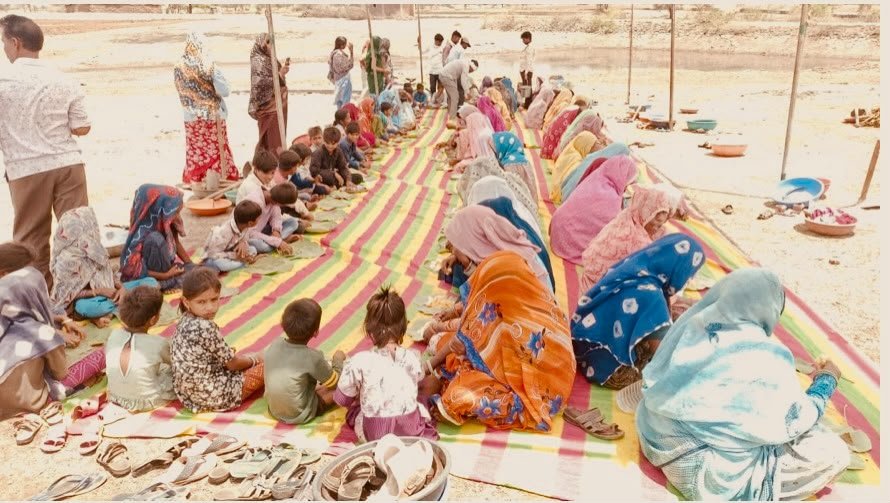
The leaf plates carried another quiet message. They created no plastic waste and required no water for washing afterwards. At an event centred on conserving water and restoring a natural resource, the practice fitted naturally with the purpose. Traditions sometimes carry such environmentally sensitive solutions without needing to announce them as such. A communal meal during the Kesarpura Halma brings children, women and elders together after hours of voluntary labour. (Photo: Mukesh Porwal, Block Facilitator, VAAGDHARA)
‘We Had Repaid Our Debt’
Among those who participated in restoring the pond were Basanti Ninama, Ganga Ninama, Surta Ninama, Sundar Mavi, Anadu Maida, Devli Mori, Phula Katara, Seema Maida, Anita Katara, Kala Ninama, Sukhram Maida, Ukarlal Maida, Mansingh Ninama, Ukar Ninama, Laxman Ninama, Dilip Vasuniya, Gendu Mori, Khima Mori, Anil Maida and Sunil Katara.
They differ in age and family circumstances, but their recollections of that day share a common thread. For Ganga Ninama, the work carried an emotional meaning. Generations of her family had depended on the pond, and seeing it buried under silt had troubled her. “The day the pond was cleaned, I felt we had repaid our debt.”
Devli Mori remembers the heat, but also the absence of complaints. “It was very hot, but nobody complained. We want our children to see how work for the village is done.” For some villagers, the experience also changed their understanding of responsibility for community assets.
Anil Maida recalled that people had previously expected work on the pond to be undertaken by the government. “Before the Halma, we thought the government would do this work. This time we understood that when the village becomes one, we don’t have to wait for anyone.”
That does not remove the responsibility of public institutions for water infrastructure. What the Halma demonstrated was something different: communities can also play an active role in maintaining and protecting the natural resources on which they depend.
Facilitation, But Community at the Centre
During the Halma, Paramesh Patidar, Implementation Leader at VAAGDHARA, interacted with villagers and discussed the traditional idea behind Halma—standing beside one another in times of need and accepting collective responsibility. Block Facilitator Mukesh Porwal and his team assisted with community mobilisation and planning, while Team Leader Dharmendrasingh Chunawat provided guidance to the initiative.
But the labour belonged to Kesarpura. The villagers brought the tools, removed the silt, carried the earth, strengthened the embankment, prepared the food and, most importantly, took responsibility for the pond. That distinction matters. The organisation facilitated. The community acted.
Three Months Later, the Water Stayed
After the Halma, Kesarpura returned to its routine. The monsoon did not bring as much rain as villagers had hoped, according to local accounts, and there were concerns that the pond might once again remain only partly filled. Then came the transformation.
Around August 2026, roughly three months after the Halma, villagers found the pond filled to the brim. Where dust had once risen from the dry bed, calm water now stretched across the pond. Green grass began appearing along its edges.
For the villagers, an equally important development was that the seepage through the repaired section of the embankment appeared to have stopped. The water that came had stayed. For farmers such as Sunil Katara and Mansingh Ninama, the significance is practical. Stored water can support irrigation needs and provide drinking water for livestock.
The pond may also contribute to local groundwater recharge, although the extent of any improvement in nearby wells or handpumps would require monitoring over time.
The Invisible Achievement: Ownership
There is another result that cannot be measured simply by looking at the amount of water in the pond. It is ownership. When villagers remove silt with their own hands, carry soil on their own heads and repair an embankment together, the pond is no longer seen merely as a structure located near their village. It becomes something in which they have invested their own labour.
That emotional investment can become a powerful incentive for maintenance. This may be Halma’s greatest invisible achievement: along with restoring a water body, it can help create its guardians. The work does not end with one day of voluntary labour. Silt will return. Vegetation will grow. Embankments will require watching. Rainfall will vary from year to year.
Whether Kesarpura’s pond remains healthy will ultimately depend on whether the collective responsibility demonstrated on May 19 continues in the years ahead.
Greenery emerges along the strengthened embankment as water remains in Kesarpura’s pond after the monsoon. (Photo: Mukesh Porwal, Block Facilitator, VAAGDHARA)
When Tradition Meets a Present-Day Need
Kesarpura today brings together several strands of rural life: the tradition of elders, the labour of younger villagers, the participation of women and families, and a collective determination to protect a shared resource. Its experience does not suggest that community labour can replace government investment or public responsibility for rural water security. Nor can one restored pond overcome the larger challenge of drought.
What Kesarpura demonstrates is narrower, but important. Local knowledge can complement public programmes. Community participation can strengthen the maintenance of shared resources. And institutions can sometimes achieve more by facilitating local action than by displacing it.
In Kesarpura, three elements came together: an indigenous tradition adapted to a present-day need, institutions remaining facilitators rather than replacing community initiative, and villagers treating a shared natural resource as their own responsibility.
Halma removed silt and weeds from Kesarpura’s pond. But its deeper achievement may be what it restored outside the pond—the belief that a village acting together can protect the resources on which its future depends.
Three months later, the water standing in the pond had become the most visible evidence of that belief.
About the Author: Vikas Parashram Meshram is a journalist, social-development professional and field documentation specialist with over 15 years of experience in rural livelihoods, tribal communities and development communication. His writing focuses on community-led development, sustainable agriculture, climate resilience, natural-resource management and grassroots change.


