

London: There are defeats that hurt, and then there are defeats that linger. As the shadows lengthened over Lord’s on Sunday evening, the sea of blue that had transformed the Home of Cricket into a miniature Indian fortress slowly fell silent. The cheers that had echoed through the famous old ground for much of the afternoon faded into quiet disbelief. Thousands had arrived believing they were about to witness India take another decisive step towards a historic Women’s T20 World Cup triumph. Instead, they watched an old story unfold once more.
Australia had done it again. For the second consecutive Women’s T20 World Cup, India’s journey ended in the group stage at the hands of the six-time champions. The names may have changed, the venue may have been different, but the outcome remained painfully familiar. When the pressure reached its highest point, Australia once again found another gear, another partnership and another way to remind the cricketing world why they remain the benchmark in women’s cricket.
For India, the dream of adding the T20 crown to last year’s ODI World Cup title disappeared in the very place where so many cricketing dreams have been fulfilled. Lord’s, a ground that has witnessed countless triumphs, became the setting for another lesson in championship cricket.
Australia reached the semi-finals without losing a match. India were left wondering how it had let another promising campaign slip away.
A match that felt like a knockout
The final Group A fixture had all the intensity of an elimination contest long before the first ball was bowled. Earlier in the day, South Africa had survived a scare against Bangladesh to move level with India on points, leaving Harmanpreet Kaur’s side with only one route to the semi-finals — beat Australia. Nothing less would do.
Australia, meanwhile, entered the contest in a far more comfortable position. Four victories from four matches had already underlined their authority throughout the tournament. Even defeat would almost certainly have been enough for qualification. Yet teams built on sustained success rarely play for calculations.
They play to win. The atmosphere reflected the significance of the occasion. A record crowd of 27,163 packed Lord’s, the highest attendance ever recorded for a Women’s T20 World Cup group-stage match. Indian supporters dominated the stands, creating an atmosphere more reminiscent of Mumbai or Bengaluru than North London. Even Virat Kohli was among those watching from the Pavilion, adding another layer of significance to an already unforgettable evening.
It felt less like a league fixture and more like a World Cup final played two rounds too early.
India Build, Then Explode
Winning the toss, Harmanpreet chose to bat first on a surface expected to improve under lights. India’s approach was noticeably more measured than in previous outings. Shafali Verma resisted the temptation to attack every delivery, while Smriti Mandhana balanced caution with elegant strokeplay. Their opening partnership of 66 provided exactly the platform India had hoped for. It was not breathtaking, but it was controlled, ensuring wickets remained intact against one of the world’s most disciplined bowling attacks.
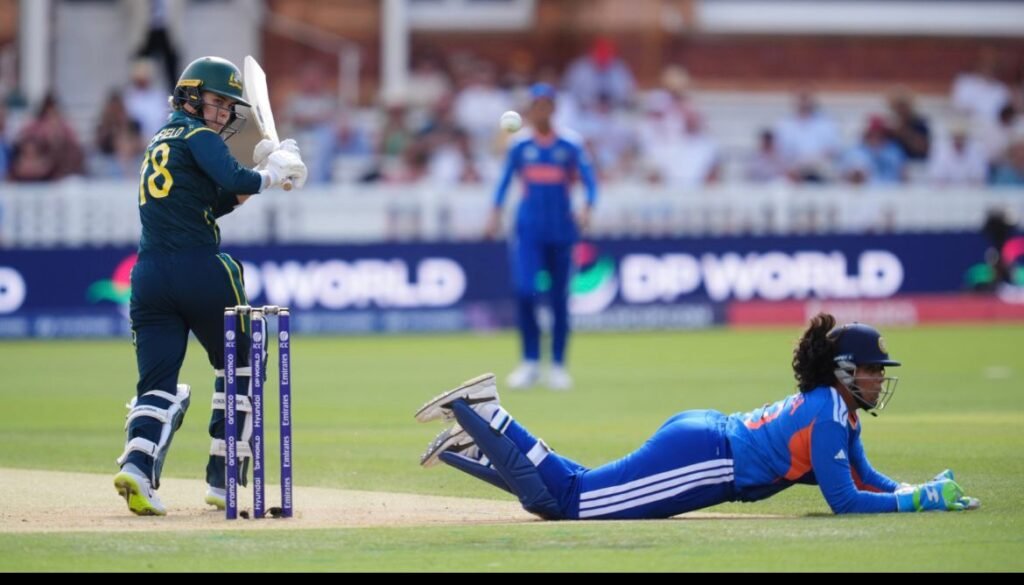
Australia rarely panicked during the Powerplay, and they remained patient again. Captain Sophie Molineux sensed the shorter boundary might tempt Shafali into taking risks. Introducing herself into the attack immediately paid off when the opener lost her footing attempting an ambitious drive, leaving her stumps exposed. It was a classic Australian breakthrough—not spectacular, but perfectly timed.
The bigger setback arrived soon afterwards. Mandhana looked well set for another substantial contribution before confusion between the wickets led to an avoidable run-out. It was one of those moments that rarely appears decisive when it happens but often proves costly in hindsight. Instead of building towards a century of partnership, India suddenly found themselves having to rebuild.
Harmanpreet’s Captain’s Innings
If India needed someone to seize the moment, Harmanpreet Kaur answered the call. Her innings was everything her team required. She began cautiously, recognising that Australia had tightened the screws in the middle overs. Then, almost imperceptibly, the tempo shifted. Boundaries began arriving through extra cover. Sweep shots found gaps. Singles became twos. Partnered first by Jemimah Rodrigues, Harmanpreet slowly wrestled momentum back from Australia. Even after Rodrigues retired hurt late in the innings, India’s captain refused to allow the scoring rate to stall.
The final over became one of the defining passages of the innings. Facing Australian captain Sophie Molineux, Harmanpreet launched three successive sixes with the authority of a batter determined to leave nothing behind. Her unbeaten 56 from just 27 deliveries became the fastest half-century by an Indian in Women’s T20 World Cup history and continued an extraordinary sequence of scores against Australia in global tournaments.
Those late blows transformed India’s innings. From a total that looked likely to finish around 150, India surged to 170 for 4, collecting 36 runs in the final two overs. By the innings break, momentum appeared to belong to India. Or so it seemed.
Australia Blinked — But Never Broke
India could hardly have asked for a better start with the ball. Renuka Singh trapped Georgia Voll lbw in the opening over, sending the massive Indian contingent into a celebration. The early breakthrough reinforced India’s belief that the target was indeed a defendable one.
Although Beth Mooney and Phoebe Litchfield attempted to steady the chase, India’s bowlers maintained relentless discipline. Deepti Sharma varied her pace intelligently, while young left-arm spinner Shree Charani continued the impressive form that has made her one of the discoveries of the tournament.
By the tenth over, Australia had slipped to 68 for three wickets. For the first time all evening, uncertainty filled the Australian dressing room. India had exactly what they wanted. Australia were under pressure. The required rate was climbing. One more wicket could have exposed the middle order. Instead, two of the game’s greatest competitors calmly reminded everyone why Australia continues to dominate global tournaments.
Perry and Gardner Turn the Match
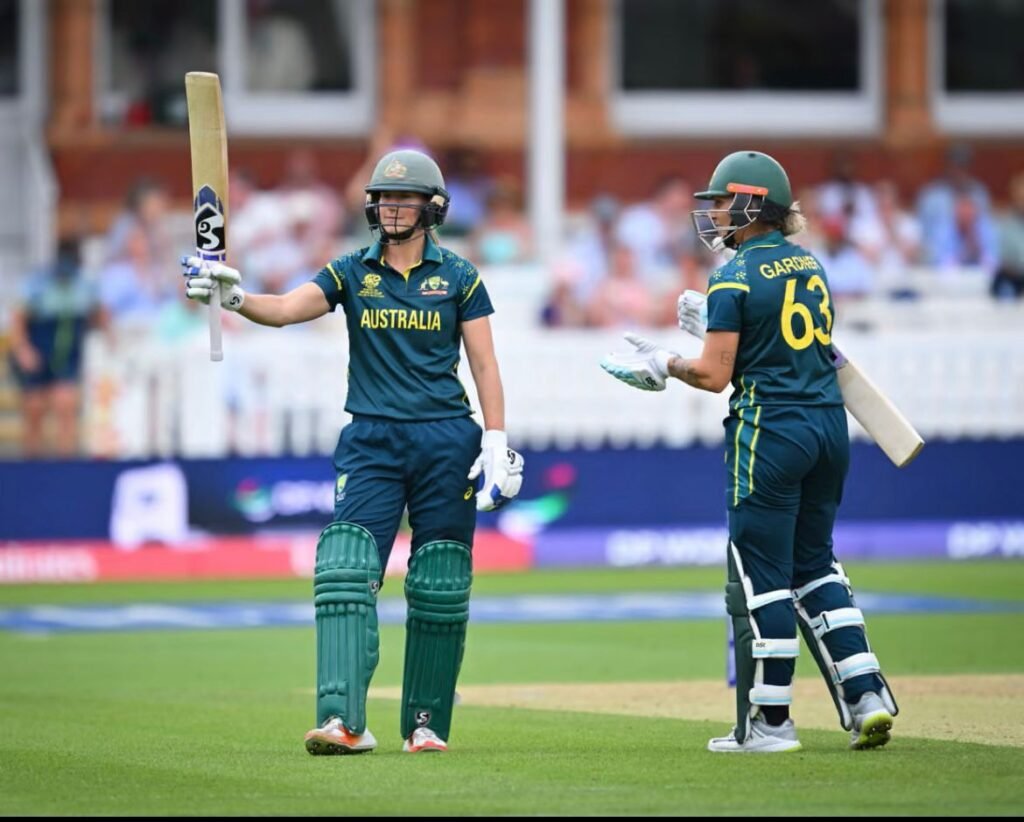
Great teams rarely need many invitations. Australia accepted the one India offered. With the chase delicately poised, Ellyse Perry and Ashleigh Gardner walked into the middle carrying vastly different roles but a shared understanding of what the situation demanded. There was no rush. No unnecessary risks. They knew that if they stayed together long enough, the pressure would gradually shift back onto India. That is precisely what happened.
Perry was the stabiliser. She absorbed the pressure from India’s disciplined bowling and kept the required run rate under control. There were no extravagant strokes, only calculated aggression and impeccable placement. Singles became doubles, loose deliveries were sent to the boundary, and every over steadily reduced India’s advantage. At the other end, Gardner sensed precisely when to change gears.
Initially content to rotate the strike, she gradually became more assertive as India’s bowlers searched for breakthroughs. Her clean hitting against both pace and spin altered the complexion of the chase. What had looked like a demanding target suddenly appeared comfortably within Australia’s reach. Together, they added 100 runs in just 59 deliveries – a partnership built not merely on powerful stroke play but also on experience, composure and exceptional game awareness. It was the defining passage of the contest.
Where India Lost Control
The scoreboard may suggest Australia won comfortably, but the contest turned on a handful of crucial moments rather than one dramatic collapse. India’s bowlers executed their plans impressively during the first half of the chase. Renuka Singh found movement with the new ball, Deepti Sharma varied her pace intelligently, and Shree Charani once again demonstrated remarkable maturity for a young spinner.
Yet once Perry and Gardner settled, India struggled to find another breakthrough. Harmanpreet rotated her bowlers in search of inspiration, altered the field repeatedly and attempted to disrupt the partnership with changes in pace and angles. Australia simply refused to be rushed.
Instead of chasing boundaries everywhere, Perry and Gardner trusted the dimensions of the ground, worked the gaps and ran with relentless intensity. Their running between the wickets placed constant pressure on India’s fielders, turning comfortable singles into hurried twos and forcing small errors that gradually tilted the momentum.
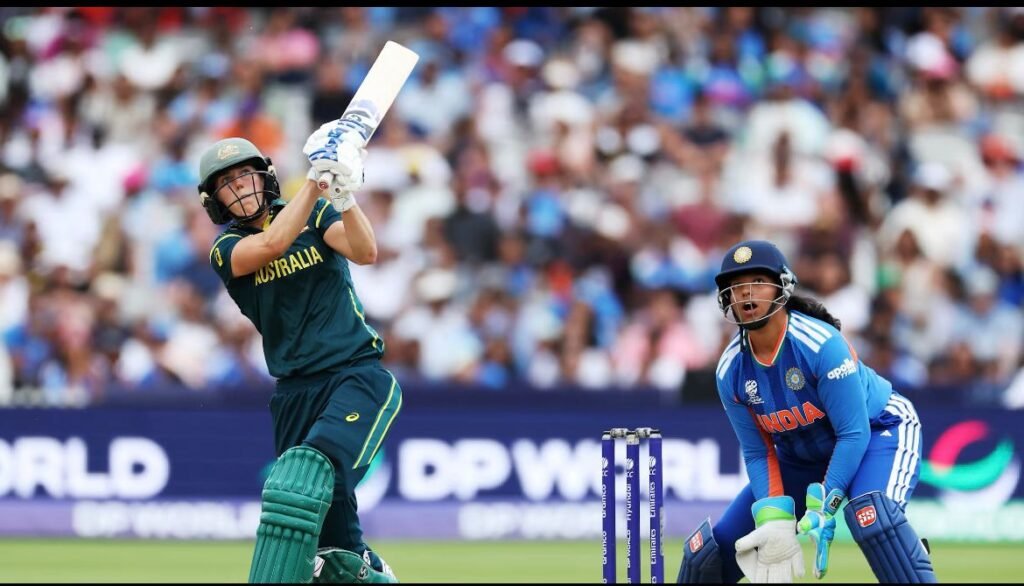
India’s spinners, so effective throughout the tournament, suddenly found themselves unable to control the game. Australia consistently targeted the shorter boundary while respecting the quality deliveries, refusing to allow either Deepti or Charani to build sustained pressure. By the time Perry reached her half-century, India appeared to be waiting for a mistake that never came.
Did India Leave Runs Behind?
Looking back, India’s total of 170 for 4 was competitive—but perhaps not intimidating enough against a batting line-up of Australia’s calibre. The opening partnership between Smriti Mandhana and Shafali Verma laid an excellent foundation, yet the scoring rate dipped during the middle overs following Mandhana’s unfortunate run-out. Australia tightened the field, slowed the pace and forced India into a rebuilding phase.
Harmanpreet’s extraordinary finish, including three successive sixes in the final over, transformed the innings and gave India genuine hope. Without that late assault, the target would have looked well short. Even so, there remained a feeling that India had left another 10 to 15 runs on the field.
Against most teams, 170 at Lord’s would have been enough. Against Australia, it proved just short.
The Difference Between Good Teams and Great Teams
Statistics explain Australia’s success. Mentality defines it. For nearly two decades, Australia has developed an extraordinary ability to remain composed when matches become tense. They rarely allow early setbacks to dictate the remainder of an innings. Instead, they trust their processes, their depth and their experience. That confidence was evident throughout the chase.
At 68 for 3, lesser teams might have panicked. Australia simply recalibrated. Perry and Gardner understood that there was no need to force the issue. Their patience gradually transferred pressure back onto India, a hallmark of champion teams. It is this calmness under pressure, more than individual brilliance, that continues to separate Australia from the rest of the world.
Lessons for India
India’s campaign should not be judged solely by the result at Lord’s. There were plenty of positives. Deepti Sharma reaffirmed her status as one of the world’s finest all-rounders. Young left-arm spinner Shree Charani emerged as one of the discoveries of the tournament. Shafali Verma rediscovered her attacking instincts, while Harmanpreet Kaur led from the front when her team needed her most.
Yet the tournament also highlighted familiar shortcomings. India occasionally struggled to make the most of promising starts. Fielding standards, though improved, still lacked the consistency required at the highest level. Most importantly, when Australia applied sustained pressure, India could not produce the decisive breakthrough that would have changed the contest.
Those are small margins. Unfortunately for India, World Cups are often decided by exactly those margins.
The Road Ahead
Australia’s victory ensured they finished at the top of Group A and marched into the semi-finals with an unbeaten record. They will face the West Indies at The Oval, carrying the momentum of another commanding campaign.
South Africa’s victory over Bangladesh earlier in the day secured the second semi-final place from the group, ending India’s hopes despite three wins from five matches.
England and South Africa will contest the second semi-final, completing a last four that features four teams with vastly different journeys but one common ambition.
Australia, however, remains the team everyone must beat.
Another Lord’s Lesson
The Home of Cricket has witnessed countless stories of triumph and heartbreak across generations. On Sunday, it added another. For India, Lord’s became the place where a promising World Cup campaign ended one step short of the semi-finals. The disappointment will sting because the team showed enough quality throughout the tournament to dream of lifting the trophy.
For Australia, it was another reminder that greatness is rarely about spectacular moments alone. It is built on composure, adaptability and an unwavering belief that no situation is beyond recovery.
India arrived at Lord’s believing the match could be the day they finally broke through the Australian barrier. Instead, they discovered that the champions still stand exactly where they always have—at the summit of women’s cricket. The celebrations belonged to Australia once again. And as the Women’s T20 World Cup moves into its final week, one message has become unmistakably clear.
If anyone wants to lift the trophy, they will almost certainly have to dethrone the team that has ruled this stage for more than a decade.


