

Beyond Statistics, Towards Solutions
Part I: One Crore Citizens, Beyond the Last Mile
Maharashtra is home to more than one crore tribal citizens. Yet healthcare access, poverty, literacy gaps and geographical barriers continue to shape outcomes in many remote communities. Part I of TheNews21’s special series examines the findings of the Maharashtra State Tribal Health Committee Report.
A pregnant woman in Nawad Uttamnagar, a remote tribal settlement in Jalgaon district, went into labour. The nearest ambulance was unavailable. The terrain was difficult. Time was running out.
What followed was a remarkable display of determination by frontline workers. An ASHA worker, an Auxiliary Nurse Midwife (ANM), counsellors and local officials coordinated transport, first by motorcycle and then through a privately arranged vehicle, ensuring that the woman reached a health facility in time. The delivery was successful.
For many urban readers, this may sound like an extraordinary incident. For those working in tribal Maharashtra, it is part of everyday reality.
This story, documented in the Maharashtra State Tribal Health Committee Report, captures the central challenge facing tribal healthcare in the state: distance. Not merely physical distance, but the distance between policy and implementation, between infrastructure and access, and between development indicators and lived realities.
Maharashtra is often celebrated for its industrial growth, urban centres and public health achievements. Yet hidden behind these success stories is another Maharashtra—one inhabited by more than one crore tribal citizens whose health outcomes continue to lag behind state averages despite decades of welfare programmes.
The recently released report of the Maharashtra State Tribal Health Committee, chaired by Dr. Mittali Sethi, IAS, offers one of the most comprehensive assessments of tribal health undertaken in recent years. Based on field visits, consultations and extensive data analysis, the report provides not merely a diagnosis of problems but a roadmap for solutions.
This series seeks to examine those findings and ask a simple question:
Has progress reached the last hamlet?
One Crore Citizens
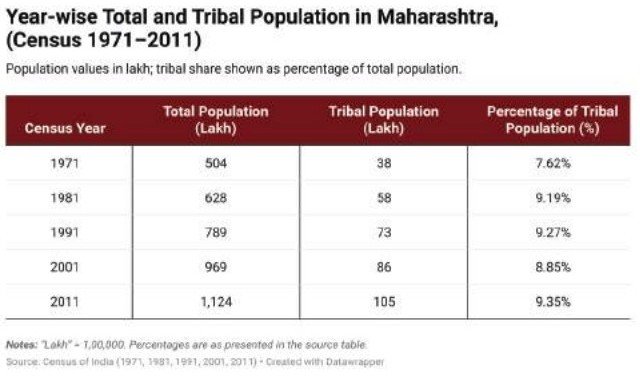
According to Census data, Maharashtra’s tribal population has grown from approximately 38 lakh in 1971 to over 1.05 crore in 2011. Today, Scheduled Tribes constitute around 9.35 per cent of the state’s population. This is not a marginal demographic group.
The tribal population of Maharashtra exceeds the population of several Indian states and is spread across diverse regions—from the Bhil-dominated districts of Nandurbar and Dhule to the Gond communities of Gadchiroli and Gondia, and the Warli settlements of Palghar and Thane.
Yet tribal communities are often discussed as a single category.
The report cautions against such simplification. Different tribal groups face different challenges, shaped by geography, culture, livelihoods and access to public services.
Progress Must Be Acknowledged
The easiest story to write about tribal health is one of failure. The more accurate story is more complicated. Over the past two decades, Maharashtra has achieved substantial improvements in several health indicators.
Maternal mortality has declined dramatically. Infant mortality and under-five mortality have also fallen. Institutional deliveries have increased significantly across social groups. These achievements deserve recognition.
They reflect years of investment by public health systems, frontline workers and local administrations. However, progress has not been uniform.
Tribal communities continue to remain behind state averages on many indicators.
The challenge facing Maharashtra today is no longer merely reducing mortality. It is ensuring that the benefits of development reach every community and every settlement.
The Geography of Healthcare
One of the report’s most powerful observations is that tribal health cannot be understood without understanding geography.
Remote settlements in Nandurbar, Gadchiroli, Palghar and other districts often face challenges that urban policymakers rarely encounter.
In some locations, health workers travel long distances on foot. Rivers must be crossed. Roads become inaccessible during monsoons. Emergency transportation remains difficult.
The report includes striking examples of bamboo-lance transport systems used to carry patients across difficult terrain and photographs of healthcare workers undertaking arduous journeys to provide basic services.
These images remind us that healthcare is not merely about hospitals and budgets. It is also about access.
A health facility may exist on paper. The real question is whether a pregnant woman, a sick child or an elderly patient can reach it in time.
Beyond Health
One of the report’s most important contributions is its recognition that tribal health is not simply a medical issue.
Health outcomes are closely linked to Education, Nutrition, Poverty, Water and sanitation, Livelihoods and Women’s empowerment.
The literacy gap illustrates this challenge.
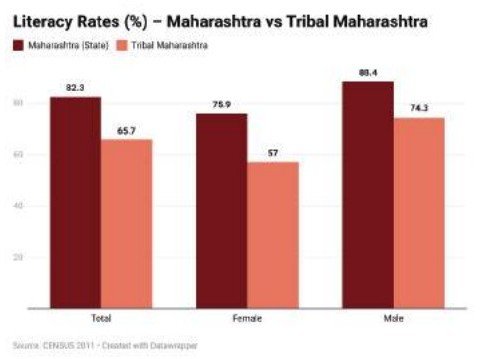
While Maharashtra’s overall literacy rate stands above 82 per cent, literacy among tribal communities remains significantly lower. The gap is even wider for women.
These disparities matter because maternal education is closely linked to health-seeking behaviour, nutrition, immunisation and child survival.
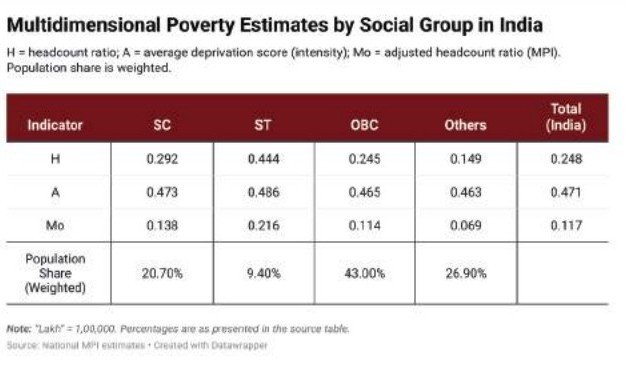
Similarly, multidimensional poverty remains disproportionately high among tribal communities. Poverty influences diet, housing, sanitation and access to healthcare.
Hospitals alone cannot solve these problems.
The Invisible Gap
Perhaps the most important insight emerging from the committee’s work is that tribal deprivation often becomes invisible within aggregate statistics.
A district may perform well overall while specific tribal blocks continue to face severe challenges. State averages may improve while remote settlements remain underserved.
The report repeatedly argues for more granular data and tribal-specific monitoring mechanisms. This is a crucial point.
Public policy can only address problems that it can see. When tribal realities disappear into broader averages, targeted interventions become difficult.
Why This Matters Before the Monsoon Session
As Maharashtra prepares for the Monsoon Session of the Legislature, the Tribal Health Committee Report arrives at an important moment. The report does not merely highlight problems. It provides a roadmap.
It identifies gaps in healthcare access. It documents the challenges faced by frontline workers. It examines social determinants of health. And it proposes reforms aimed at improving outcomes for tribal communities. The question now is whether those recommendations will translate into action.
Policy reports often receive attention when they are released and are forgotten soon afterwards.
This report deserves a different fate. Because behind every statistic lies a family, a settlement and a community seeking the same opportunities and services that many citizens take for granted.
Beyond the Last Mile
For decades, tribal health has been discussed primarily through the lens of tragedy—malnutrition deaths, disease outbreaks and healthcare shortages. Those issues remain important. But Maharashtra now faces a different challenge.
The state has demonstrated that progress is possible.
The next step is ensuring that progress reaches everyone. More than one crore tribal citizens live in Maharashtra.
The success of the state’s development story will increasingly be measured not by conditions in its cities, but by conditions in its most remote hamlets.
The journey from a government report to meaningful change begins with recognising a simple truth:
No development model is complete if it leaves the last mile behind.
Part II: Born Behind — The Maternal and Child Health Gap in Tribal Maharashtra
Coming next in the Tribal Maharashtra: Beyond Statistics, Towards Solutions series.


