

Mumbai/New Delhi: India’s economic engagement with Latin America and the Caribbean (LAC) is entering a new strategic phase, according to a new study released by the Export-Import Bank of India during the ALIDE 2026 General Assembly in Paraguay.
The study, titled “India’s Economic Footprint in LAC: Trade and Investment Patterns and Opportunities”, examines the growing trade, investment and strategic complementarities between India and the LAC region, which collectively accounts for nearly US$ 2.9 trillion in merchandise trade and a GDP of around US$ 6.5 trillion.
Released by Banco Nacional de Fomento (BNF) President Manuel Ochipintti and ALIDE Secretary General Edgardo Alvarez in the presence of Exim Bank Resident Representative Biswajit Garg, the report argues that India and LAC are increasingly positioned as natural economic partners amid shifting global supply chains and the energy transition.
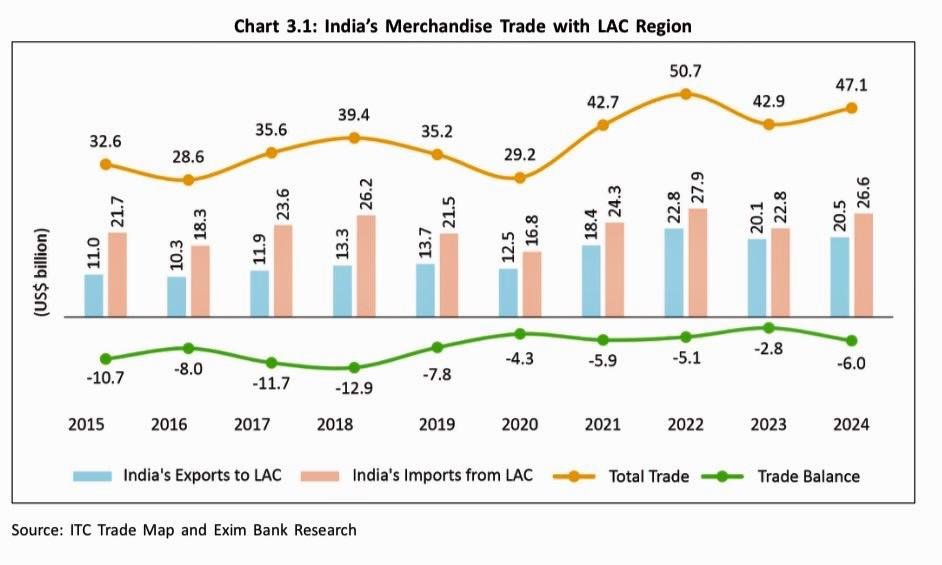
According to the study, total trade between India and the LAC region rose from US$ 32.6 billion in 2015 to more than US$ 47 billion in 2024, growing at a CAGR of 4.2%. India’s trade deficit with the region also narrowed significantly during the period.
The report identifies strong complementarities between India’s industrial priorities and LAC’s strengths in mining, agriculture, energy, automotive manufacturing and critical minerals. Countries such as Argentina, Chile and Peru are emerging as globally important suppliers of lithium, copper and rare earth elements — resources increasingly critical for electric vehicles, batteries and renewable energy technologies.
Brazil and Mexico remain India’s largest export destinations within the region, accounting for nearly 60% of India’s exports to LAC in 2024. Indian exports are dominated by automobiles, pharmaceuticals, engineering goods and machinery, while imports from the region are led by crude oil, copper, gold and agricultural commodities.
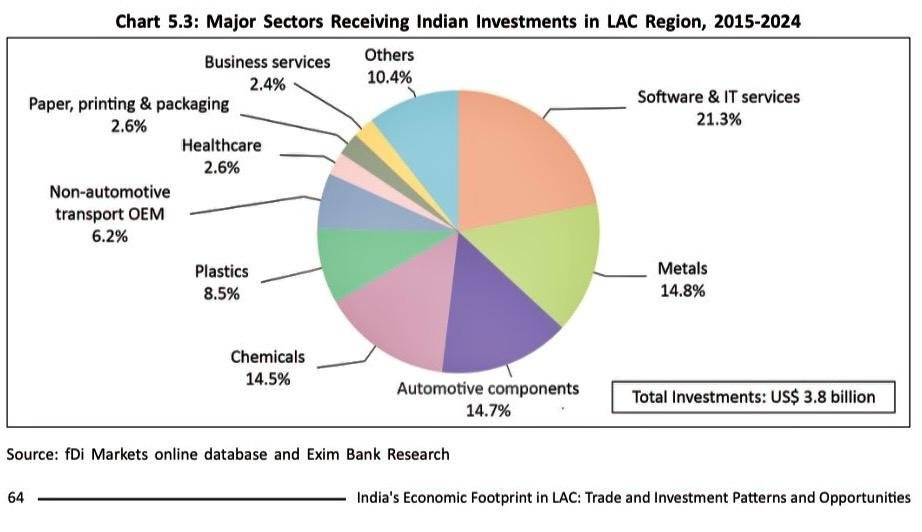
The study also highlights the strategic importance of nearshoring and supply-chain diversification, particularly as geopolitical tensions and protectionist trade policies reshape global commerce. Mexico’s manufacturing integration with North America and Brazil’s growing role in renewable energy and automotive production are seen as major opportunities for Indian investors and exporters.
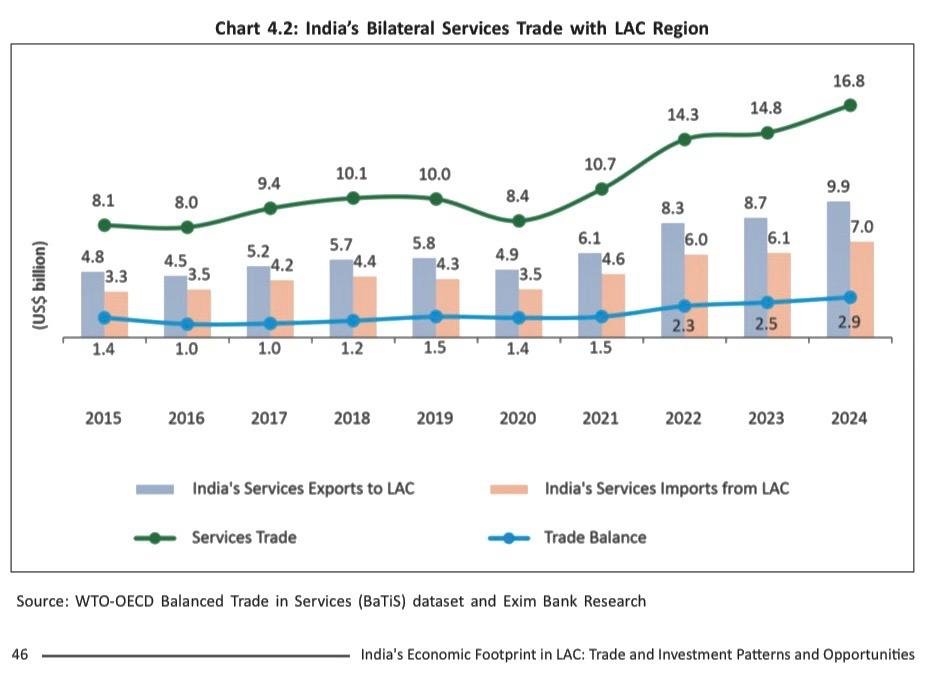
In services trade, India’s exports to LAC more than doubled between 2015 and 2024, driven largely by IT, software, consulting and business services. Bilateral services trade reached US$ 16.8 billion in 2024.
However, the report notes that India-LAC economic engagement still faces major barriers, including weak shipping and air connectivity, high logistics costs, language barriers, fragmented trade agreements and China’s deep economic footprint in the region.
The Exim Bank study recommends deeper trade agreements, mutual recognition arrangements, development finance partnerships, stronger logistics integration and institutional cooperation to unlock long-term growth opportunities between India and the LAC region.


