What the G RAM G Bill Means for India’s Right to Work
By Vijay Shravan Gaikwad | Senior Journalist & Policy Analyst
Mumbai:
If Part I exposed how the scheme is failing on the ground, Part II must confront something more serious — where the policy itself is heading. This is no longer just about poor implementation. It is about a shift in direction.
From April 1, 2026, MGNREGS, in its present form, will cease to exist. It is being restructured under what is being projected as reform. The question is simple — is this reform or a retreat?
From Right to Work to Managed Scheme
MGNREGS was never meant to be just another welfare programme. It was built as a rights-based law. A rural household could demand work, and the State was legally bound to provide it. That was the scheme’s strength. It created a direct relationship between the citizen and the State.
The proposed restructuring under the G RAM G Bill signals a shift. While the language of rights remains, the underlying design changes. As the emphasis appears to move from guarantee to management, employment becomes just one part of a more complex administrative system. This changes the very nature of the scheme.
This shift prompts a necessary question: what is the reform setting out to achieve?
There is no denying that the scheme required correction. Leakages exist. Muster rolls have been manipulated. Payments are delayed. Assets created are often poor in quality. These are not allegations; these are recorded findings. The need for reform is clear. The direction of that reform is what needs scrutiny.
If the response to weak implementation is to redesign the system in a way that reduces the enforceability of the right itself, then the consequence is a shift from correcting failures to diminishing that right. The risk is clear — those who need work may find it harder to claim it.
Technology: Solution or New Barrier
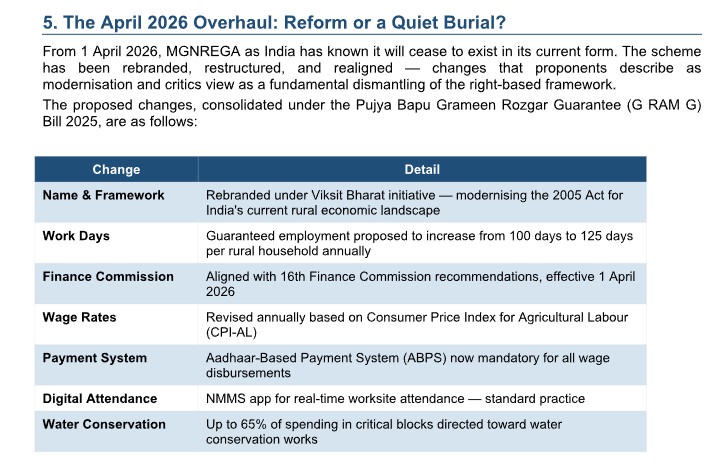
As the new framework leans heavily on technology — digital attendance, Aadhaar-based payments, app-based monitoring, and centralised tracking — it is important to ask whether these measures address existing challenges or risk introducing new barriers for rural workers.
Connectivity is inconsistent. Devices fail. Biometric systems do not always work. Administrative response is slow. For a rural worker, a failed biometric is not a technical glitch. It is a lost wage.
A system designed for efficiency can end up excluding those it is meant to serve.
Control vs Accountability
The original MGNREGS had one defining feature — it was demand-driven. Work had to be provided when demanded. That made the administration’s position unpredictable. But it also made it accountable.
A more centralised, technology-driven system brings control. It standardises processes. It reduces variation. But it also reduces the immediacy of entitlement.
The politics of a guaranteed right is different from the politics of a managed scheme. That distinction cannot be ignored.
The Question That Remains
Even as the structure changes, one basic question remains unanswered. Why has spending not translated into outcomes?
Thousands of crores have been spent. Yet employment has not reached those who need it. This is not a design problem alone. It is a governance problem.
Unless administrative capacity, accountability, and local implementation improve, no restructuring will change outcomes. It will only change the form of failure.
A Shift That Needs Scrutiny
Supporters of the new framework call it modernisation. Critics see dilution. The outcome will decide the truth — reform or dilution, improved delivery or lost rights.
As the scheme’s focus shifts, careful scrutiny of whether beneficiaries continue to have the right to work is essential.
At the centre of this debate is a simple question — does the State continue to guarantee work as a right, or does it move towards a system where employment support exists, but cannot be demanded?
That difference is not technical. It is fundamental.
A right creates an obligation. A scheme creates possibilities.
Editor’s Note
At TheNews21, our ongoing “World Bank Loan Trap” investigation has highlighted how large public spending often fails to translate into outcomes on the ground. The proposed restructuring of MGNREGS raises a similar concern — whether reform will address the core problem or simply redefine it.
Conclusion
India does not need cosmetic reform. It needs structural correction.
If the new framework strengthens delivery while protecting the right to work, it will succeed.
If it weakens that right in the name of efficiency, the failure will remain — only in a different form.
The future of MGNREGS will not be decided by policy language. It will be decided on the ground.