

A Book Review
Some books impress with scholarship. Others with eloquence. A very small number earn your trust because they are unmistakably written by someone who has lived what they are saying.
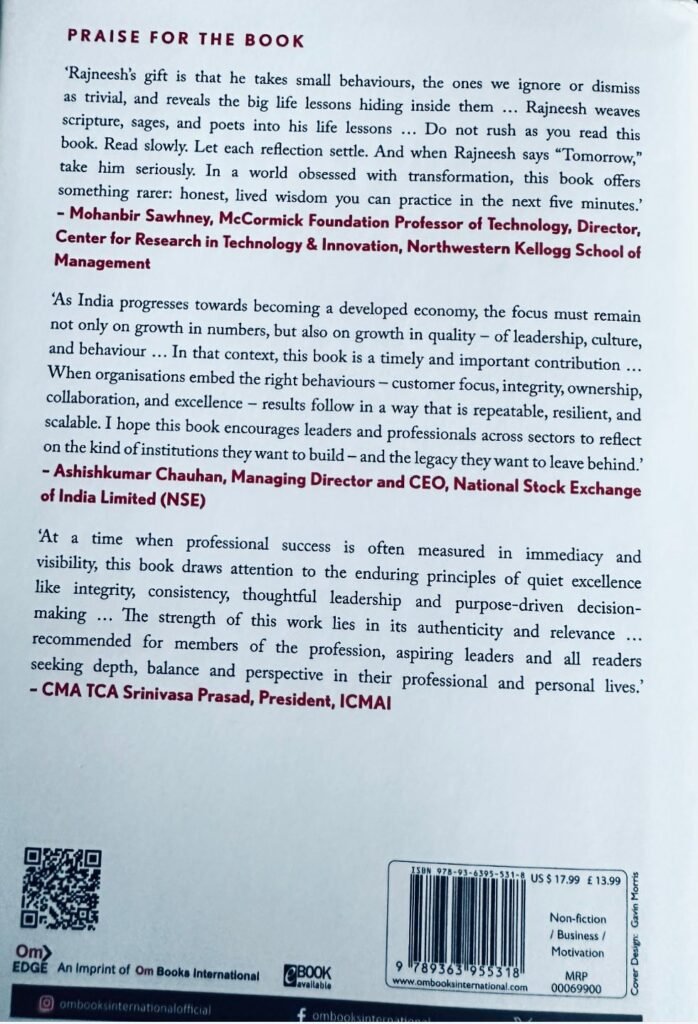
Quiet Excellence by Rajneesh Jain belongs firmly in that last category.
When Rajneesh sent me a copy recently, I began reading it with a certain curiosity. I had known him as a colleague in the private sector, though our interactions were mostly in online review meetings where I participated as an adviser. Even through a computer screen, one quality stood out unmistakably.
He was refreshingly different.
Corporate review meetings often become theatres of ego. Leaders defend positions with an acerbic tone, invoke decades of experience, or subtly remind everyone of their proximity to the top boss. Authority is asserted almost as often as ideas are discussed.
Rajneesh never seemed to play that game.
He was patient, soft-spoken and unfailingly courteous. Yet there was nothing tentative about him. He remained focused, intellectually sharp and remarkably clear in separating substance from noise. Humbug did not impress him; nor did ingenious excuses. He listened carefully, asked the right questions and quietly steered discussions towards what really mattered.
It struck me then that genuine authority seldom needs to announce itself.
Although a finance professional by training, his understanding extended well beyond finance. His grasp of people, organisations and the practical realities of work appeared almost intuitive. Looking back after reading this book, that intuition now makes perfect sense.
Only someone who combines honesty with humility, observation with perception, and competence with a strong moral core could have written a book like this.
Each of the fifty-two chapters is concise. Every reflection springs from lived experience rather than borrowed theory. Every chapter concludes with a distilled insight that lingers in the mind long after one has turned the page.
They are not slogans. They are hard-earned observations about work, leadership, judgement, relationships and the quiet disciplines that shape a meaningful life.
I have read more books on management and leadership than I can remember. Many are informative. Some are inspiring. Quite a few disappear from memory within weeks.
The uniqueness of Quiet Excellence lies elsewhere.
Its wisdom is authentic rather than fashionable. It is holistic without becoming abstract. It avoids management jargon, fashionable buzzwords and unnecessary complexity. The writing is economical, but never superficial. There is not a trace of intellectual exhibitionism. Nor does the humility in its pages feel performative. The author writes not to impress the reader, but to help the reader reflect.
That, perhaps, is the highest compliment one can pay a writer.
Reading this book also prompted a broader reflection.
We spend much of our professional lives celebrating visibility. We reward those who speak the loudest, market themselves the best or occupy the brightest spotlight. Yet when we look back over our careers, the people who have influenced us most are often different.
They are individuals whose integrity never wavered, whose judgement could be trusted, whose calm steadied organisations during difficult moments, and whose excellence announced itself quietly through consistent conduct rather than self-promotion.
They leave behind something far more durable than reputation.
They leave behind standards.
The older one grows, the more one realises that success is measured not merely by outcomes, but by the manner in which those outcomes are achieved. Professional competence matters enormously, but character matters even more. Relationships outlast transactions. Listening often achieves what argument cannot. Humility is not the opposite of confidence; it is confidence freed from the need to dominate.
These are timeless truths.
Rajneesh Jain has simply found a graceful way of reminding us of them.
Without exaggeration, I would recommend keeping one copy of Quiet Excellence on your work desk and another by your bedside. It is not a book to race through. It is a companion to return to — opening almost any chapter, reading a few pages, and allowing a single insight to accompany you through the day.
Each reflection is a small gem.
Taken together, they form something rarer still: a quiet guide to living and working with wisdom, integrity and grace.
In an age that celebrates noise, Quiet Excellence reminds us that the deepest influence often speaks in a softer voice.


