

The New Delhi Declaration demonstrated that an expanded and increasingly diverse BRICS can still produce consensus. But agreements on terrorism, payments, institutional reform, technology and Global South cooperation will matter only if they move beyond declarations and working groups.
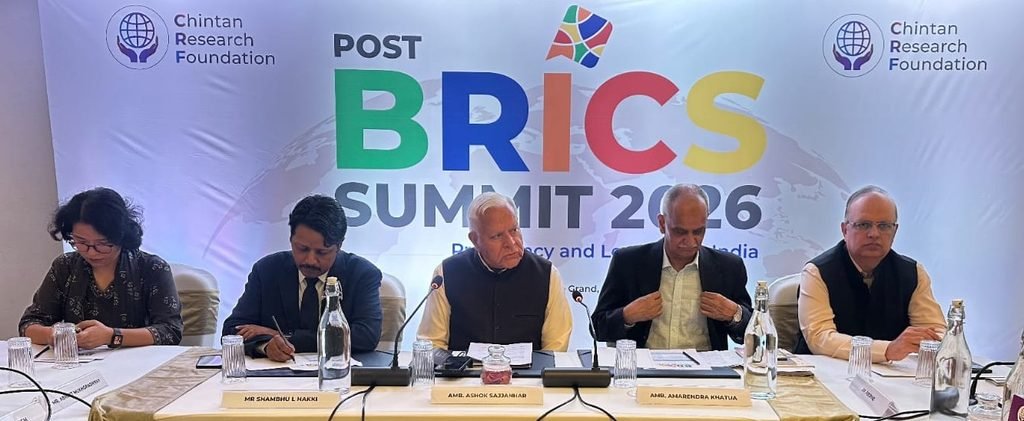
New Delhi: The 18th BRICS Summit has ended with a New Delhi Declaration, an enlarged agenda and another demonstration of how much the grouping has changed since its early years. For India, however, the more difficult phase begins after the summit. Bringing 11 countries with different strategic alignments, economic interests and regional priorities around a common declaration was itself a test. The summit adopted the New Delhi Declaration unanimously despite differences among members on conflicts, trade, global institutions and relations with the West. The question now is whether that diplomatic consensus can be converted into practical cooperation. That question ran through a post-summit roundtable convened by the Chintan Research Foundation in New Delhi on September 16. Diplomats, academics and members of the strategic community examined what India’s presidency achieved, where differences remain and what the expanded BRICS can realistically deliver.
Consensus in an increasingly diverse BRICS
Expansion has increased the political and economic weight of BRICS, but it has also made consensus more difficult. The grouping now brings together countries whose relationships with the United States and Europe differ substantially, as do their positions on regional conflicts, trade, energy and the international financial system. India’s approach during its presidency was therefore significant for what it did not attempt to do: turn BRICS into an explicitly confrontational or anti-Western bloc. The emphasis instead was on practical cooperation and the concerns of the Global South.
Shambhu L. Hakki, Joint Secretary (MRE & G20) and BRICS Sous Sherpa, told the roundtable that the New Delhi Declaration reflected cooperation among developing countries despite the difficult geopolitical and geoeconomic environment. The participation of the African Union (AU), Association of Southeast Asian Nations (ASEAN), Community of Latin American and Caribbean States (CELAC), Gulf Cooperation Council (GCC) and Bay of Bengal Initiative for Multi-Sectoral Technical and Economic Cooperation (BIMSTEC) also widened the conversation beyond the formal BRICS membership. This approach matters because BRICS has to accommodate two competing impulses: demands for reform of institutions dominated historically by developed economies, and the reluctance of some members to turn that reform agenda into permanent confrontation with the West. Ambassador Ashok Sajjanhar argued that India’s effort was to shape BRICS as a collaborative rather than confrontational forum. But he also identified the next challenge: points of consensus have to be implemented rather than remain on paper.
Terrorism: consensus, but with limits
For India, counter-terrorism remained an important part of the summit outcome. The New Delhi Declaration condemned the April 22, 2025 terrorist attack in Pahalgam, in which 26 people were killed, and reiterated zero tolerance towards terrorism, rejection of double standards and action against terrorist financing and safe havens. The reference continued language agreed by BRICS members at the 2025 Rio summit. The consensus is diplomatically relevant because BRICS includes countries with very different strategic relationships in South Asia.
Its limits are equally important. The declaration did not attribute responsibility for the Pahalgam attack to Pakistan. Consensus within BRICS therefore remains easier around principles of counter-terrorism than around politically contentious questions of attribution. That distinction illustrates the broader character of BRICS: it can establish a common language even where individual members continue to hold different strategic positions.
Beyond the de-dollarisation debate
Perhaps nowhere is the difference between political rhetoric and practical cooperation clearer than in finance. Debate around BRICS is frequently reduced to whether the grouping intends to challenge the dominance of the US dollar. But the immediate agenda is considerably more incremental. The New Delhi Declaration noted work on interoperability between payment and messaging systems and the use of members’ local currencies for trade settlements and investment. The CRF discussion similarly focused on cross-border payment mechanisms and strengthening the New Development Bank rather than the immediate creation of a common BRICS currency.
That distinction is important. Building payment infrastructure capable of reducing transaction costs and facilitating trade among members is a practical objective. Creating a common currency among economies with different monetary systems, capital controls and strategic priorities is an altogether different proposition. The effectiveness of BRICS financial cooperation will therefore be measured less by rhetoric about replacing the dollar and more by whether members can construct mechanisms they are actually willing to use.
An agenda much wider than geopolitics
The expanded BRICS agenda now stretches well beyond traditional debates about global power. Trade resilience, institutional reform, security, health, food and energy security, climate change, critical minerals, artificial intelligence, education, entrepreneurship and people-to-people exchanges have all entered the framework. That breadth provides opportunities, but it also creates a risk: an institution can accumulate initiatives faster than it develops the capacity to implement them. China’s proposal for a BRICS open-source artificial intelligence community illustrates both possibilities. According to participants at the roundtable, the proposal encountered scepticism among members. Technology cooperation raises questions extending beyond access to innovation. Data governance, cybersecurity, technological dependence and national regulatory frameworks can make cooperation in artificial intelligence substantially more complicated than agreement on its potential benefits.
Expansion brings influence — and complications
The future composition of BRICS presents another test. The roundtable considered growing interest from South Asian countries. Pakistan’s possible inclusion was discussed in terms of the complications it could create, while Malaysia was mentioned for the additional weight it could bring to the grouping. Participants also emphasised continued economic engagement with partner countries including Cuba and Bolivia. Expansion gives BRICS greater demographic and geographic reach. It also makes decision-making more difficult. The central question is therefore no longer simply how large BRICS can become. It is whether an enlarged BRICS can retain enough internal coherence to act. Every additional member brings economic opportunities and diplomatic reach, but also national interests, bilateral disputes and different relationships with major powers. Enlargement without mechanisms capable of managing those differences could eventually weaken the consensus model on which BRICS operates.
From New Delhi to implementation
Several proposals discussed during India’s presidency now provide concrete tests of that model. Participants at the CRF roundtable called for progress on cross-border payments, the BRICS grain exchange, remote-sensing satellite cooperation and strengthening the New Development Bank (NDB). They also identified wealth creation from waste as an area for practical cooperation. Institutional continuity will matter as presidencies rotate. The roundtable highlighted the importance of the Troika mechanism, while Prime Minister Narendra Modi proposed cooperation on ten global-governance reform initiatives to develop a BRICS Reform Roadmap ahead of the next summit in China. That transition will provide an early indication of whether initiatives launched or advanced under one presidency survive into the next.
India’s 2026 presidency has demonstrated that consensus remains possible in an enlarged BRICS. But convening leaders and negotiating a declaration are only the first part of multilateral diplomacy. The harder test is what follows: whether payment mechanisms become usable, institutions become stronger, agreed initiatives acquire timelines and resources, and cooperation survives differences among members. For BRICS, the distance between declaration and delivery may now matter more than the size of the summit table.


