

After two decades in a cramped rented room, Khandora’s children finally received a safe and dignified Anganwadi—through the persistence of villagers, women leaders and the Gram Sabha
Nestled amid the Mangarh hills of southern Rajasthan is Khandora, a small tribal village with a population of around 696 people and nearly 120 families. Located under Jher Gram Panchayat in the Anandpuri block of Banswara district, the village carries the deep imprint of Adivasi culture and tradition.
Yet for almost two decades, one concern troubled families across the village: Khandora’s children had no proper Anganwadi centre of their own.
Since 2004, the Anganwadi had been functioning from a rented private house. The small space offered children little room to sit, learn or play. There was no adequate arrangement for distributing supplementary nutrition, while Anganwadi workers had to discharge their responsibilities under cramped and difficult conditions.
The lack of a proper centre gradually affected attendance. Nutrition-related activities were disrupted, and the environment was unsuitable for the physical, emotional and educational development of young children.
Proposals for constructing an Anganwadi building were raised at the panchayat level several times. However, the matter was repeatedly deferred because of budget constraints and administrative obstacles. As the years passed, waiting became routine and the village’s hope for change began to fade.
The stagnation was finally challenged by the Krishi Evam Adivasi Swaraj Sangathan, formed in Anandpuri with the guidance of VAAGDHARA. Active across nearly 30 to 35 villages in the tribal belt, the organisation works on the principle that sustainable development must emerge from the participation and leadership of local communities.
When the organisation learnt about the condition of Khandora’s Anganwadi, it recognised the issue as more than the absence of a building. It was a serious gap in children’s access to nutrition, early education, healthcare and a safe environment.
Working with Khandora’s Gram Swaraj Samuh, the organisation convened a community meeting. Men, women, youth, elderly residents and Anganwadi workers came together to discuss the problem.
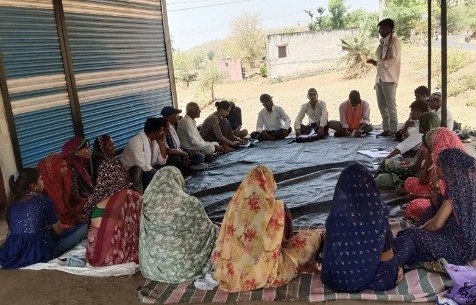
As the villagers listened to one another, they realised that this was not the difficulty of one family or one worker. It concerned the future of the entire village.
The meeting ended with a decisive resolution: waiting indefinitely for government action was no longer enough. The villagers would prepare a written demand and place it formally before the Gram Sabha.
Community members, including Mohan Makwana, Dinesh Makwana, Hariram, Ramesh Katara, Ramesh Pargi, Bapulal, Shankarlal Pargi, Vijaypal, Bapulal Pargi and Champalal, helped mobilise residents and explain that the demand was not merely for a structure of brick and cement. It was a demand concerning the future, health and dignity of Khandora’s children.
A Woman Leader Takes the Demand to the Gram Sabha
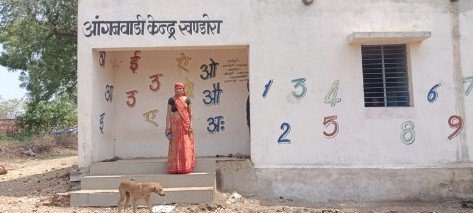
Kanta Kamol, a member of the organisation, played a central role when the matter came before the Gram Sabha.
She presented the proposed Anganwadi not simply as a local development facility but as part of children’s basic right to nutrition, early learning and care. She explained that children require a clean, open and secure environment for healthy physical and mental development.
She also highlighted the importance of a dignified space where pregnant and nursing women could receive health advice, nutrition support and essential services.
Her arguments were clear, practical and firmly grounded in the everyday experiences of women and children. When the proposal was put before the Gram Sabha, it was passed unanimously.
But securing a Gram Sabha resolution was only the beginning.
The written proposal was submitted to the concerned department, followed by a prolonged process of meetings, applications and follow-ups. Kanta Kamol repeatedly visited the block office, met officials and sought updates on the status of the proposal.
Her colleagues Sharmila, Kalpana, Leela and Hemlata stood beside her throughout the process. Their persistence eventually produced results. In 2024, formal approval was granted for the construction of the Anganwadi building.
After nearly 20 years of waiting, Khandora had finally secured official sanction.
Government Funds, Community Participation
Construction began at an approved cost of approximately ₹5.50 lakh. Although the funds came from the government, the villagers played an active role in shaping the project.
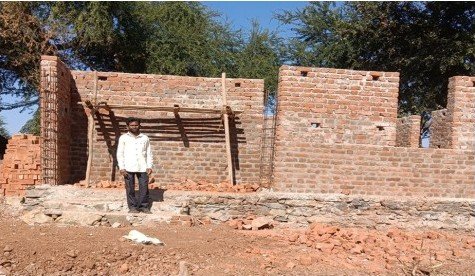
Some residents contributed voluntary labour. Others transported construction material or helped supervise the work. As the building gradually took shape, excitement spread through the village.
For the women of Khandora, the centre carried special meaning. They had witnessed children struggling in a cramped room for years. Now, they could see a proper space emerging through their collective action.
Within a few months, the construction was completed.
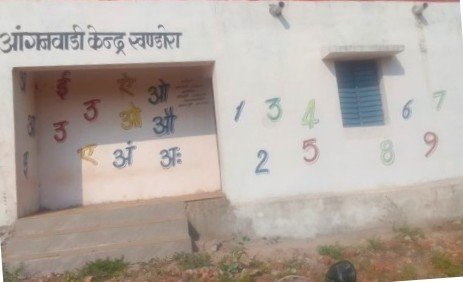
The new Anganwadi was markedly different from the rented room in which services had previously been offered. It had adequate space for children to sit and play, airy and well-lit rooms, sanitation facilities and a safer, more child-friendly environment.
Parents who had earlier hesitated to send their children to the centre began doing so with greater confidence. Attendance rose significantly.
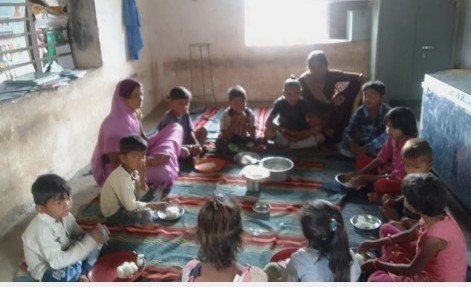
Today, 83 children—47 boys and 36 girls—regularly benefit from the centre. Anganwadi workers can now perform their duties in a dignified and comfortable environment. Pregnant and nursing women also have access to a cleaner and safer place for health and nutrition-related services.
The building has become more than an institutional facility. For the children, women and workers of Khandora, it has become a shared community space—a home built through their own resolve.
Voices from Khandora
“Earlier, I doubted whether we could really make the government act. But when we sat together, discussed the problem and took the proposal to the Gram Sabha, we realised that we could. When the village unites, doors begin to open.”
— Dinesh Makwana, member, Krishi Evam Adivasi Swaraj Sangathan
“Whenever I saw children crowded into that small room, it hurt me. As a mother, I know that children need open space, light and air. I went to the officials repeatedly. At times, I felt discouraged, but I did not stop until the building was constructed. Today, seeing the children play and learn there makes every visit and every hardship worthwhile.”
— Kanta Kamol, community leader and member, Krishi Evam Adivasi Swaraj Sangathan
“Earlier, asking the government for a building seemed like a long and exhausting struggle. But when we went together, we realised that we had strength. Seeing our unity, the officials also had to listen.”
— Ramesh Pargi, member, Gram Swaraj Samuh
“When the Gram Sabha passed the proposal, I felt as though we had won a major battle. This is not merely a structure of stone and cement. It is a symbol of our unity and proof of our resolve.”
— Vijaypal, resident of Khandora
Women at the Centre of Local Change
The role played by women such as Kanta Kamol deserves particular recognition. Tribal women are frequently excluded from formal decision-making processes. Yet when provided with institutional support and collective strength, they demonstrate that leadership does not necessarily arise from a degree, designation or official position. It grows from conviction, responsibility and persistence.
The approach of the Krishi Evam Adivasi Swaraj Sangathan is significant because it does not view communities merely as victims of deprivation. It encourages them to become creators of their own solutions.
Through monthly meetings, villagers discuss different aspects of local development. They receive assistance in documentation, applications and government procedures so they can articulate their demands independently and pursue them through democratic institutions.
The organisation’s engagement also extends beyond one issue. Its work encompasses drinking water, education, healthcare, livelihoods and local self-governance.
Development Built from Below
The story of Khandora’s Anganwadi is a reminder that development cannot be measured only through large infrastructure projects or government announcements.
Development is also visible when a child receives nutritious food in a safe environment, when a mother can access care with dignity, and when an Anganwadi worker can perform her duties with confidence and pride.
These outcomes may appear small when viewed from a distance, but they form the foundations of an equitable society.
Khandora’s Anganwadi was constructed from brick and cement. Its real strength, however, lies in the countless hands that struggled to make it possible.
The village has shown that when community resolve, women’s leadership, organisational guidance and panchayat participation move in the same direction, even two decades of administrative delay can be overcome.
The new Anganwadi is not merely a building. It is a symbol of democratic participation—and proof that when people organise around their rights, change can begin from the village itself.


