

Glasgow: The final evening in Glasgow was filled with smiles, hugs and countless photographs. Athletes who had spent ten days chasing medals walked into the arena one last time—not as rivals, but as one Commonwealth family. There was music, colour and celebration, but there was also a quiet sense that something special had come to an end.
Watching from inside the arena, it was impossible not to reflect on how much these Games had surprised everyone.
Many questioned whether a scaled-down Commonwealth Games could retain its magic. Glasgow answered that question with quiet confidence. It may have been smaller in scale, but it was no less rich in emotion, unforgettable performances and inspiring stories.
For India, the closing ceremony carried an even deeper meaning.
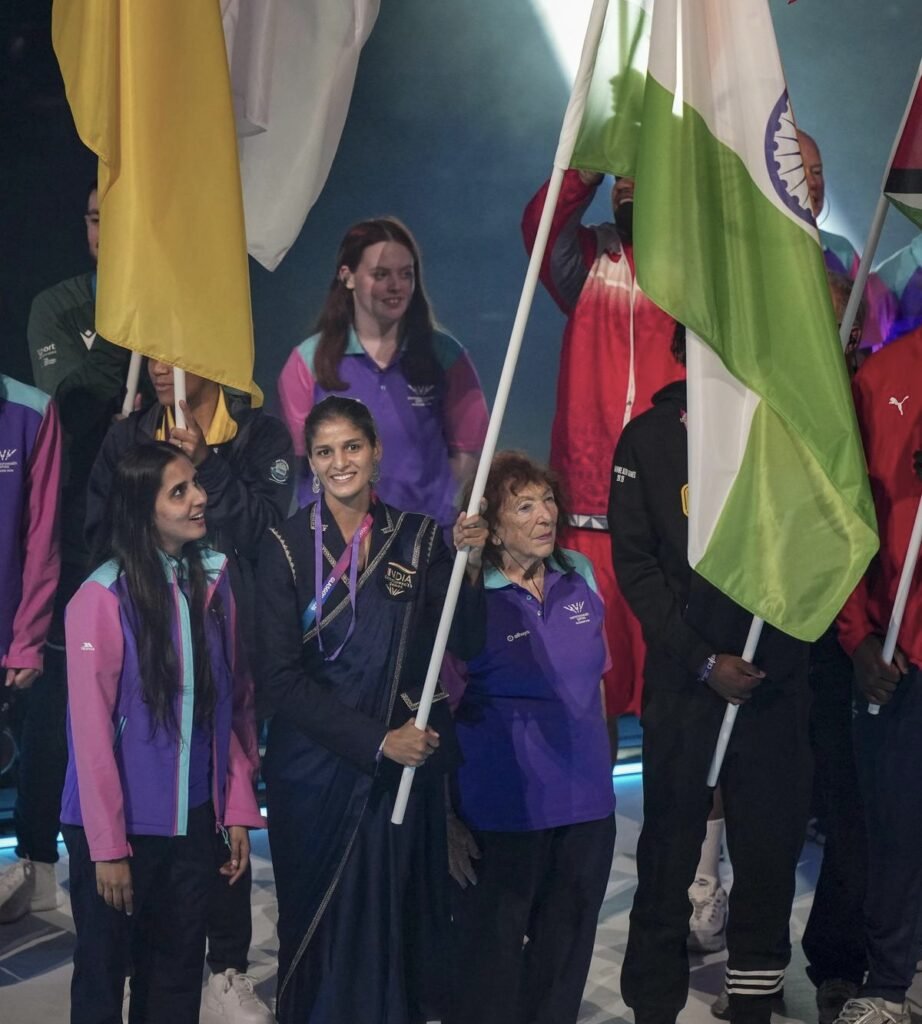
Jaismine Lamboria, fresh from her memorable boxing gold medal, proudly carried the Indian flag during the athletes’ parade. It was a fitting honour for one of the brightest stars of India’s campaign.
Then came the moment that belonged to the future.
As the Commonwealth Games flag was formally handed over, Olympic champion Neeraj Chopra and Indian Olympic Association President P. T. Usha received it on behalf of India, officially passing the baton to Ahmedabad, host of the 2030 Commonwealth Games.
It was a symbolic moment.
Only hours earlier, Neeraj had stood on the podium after winning silver in the javelin throw. Now he stood representing an entire nation preparing to welcome the Commonwealth back to India four years from now.
The Indian presentation that followed filled the arena with music, dance and vibrant colours, offering the world a glimpse of what awaits in Ahmedabad. For a few minutes, Glasgow felt a little like India.
As the lights dimmed and fireworks illuminated the Scottish sky, India’s campaign came to an end with 39 medals and a fourth-place finish.
On paper, it was fewer medals than the 61 won in Birmingham four years ago. But numbers alone do not define this campaign.
India competed without several of its traditional medal-winning sports—including wrestling, shooting, badminton, table tennis and hockey. Yet it still discovered new champions, celebrated historic firsts and proved that its sporting strength is becoming far more diverse.
Boxing emerged as the biggest success story.
Judo entered a new era.
Athletics continued to broaden its horizons.
Para-athletes once again reminded the world that courage and excellence know no boundaries.
As attention now shifts to the Asian Games in Japan, India carries home far more than medals.
It carries belief.
Belief that Indian athletes can compete across more disciplines than ever before.
Belief that today’s silver medallists can become tomorrow’s champions.
And belief that when the Commonwealth gathers again in Ahmedabad in 2030, India will not merely be the host nation—it will be ready to challenge for its finest-ever performance.
Glasgow closed its doors on Sunday night.
For Indian sport, however, this feels less like an ending than the beginning of an exciting new chapter.


