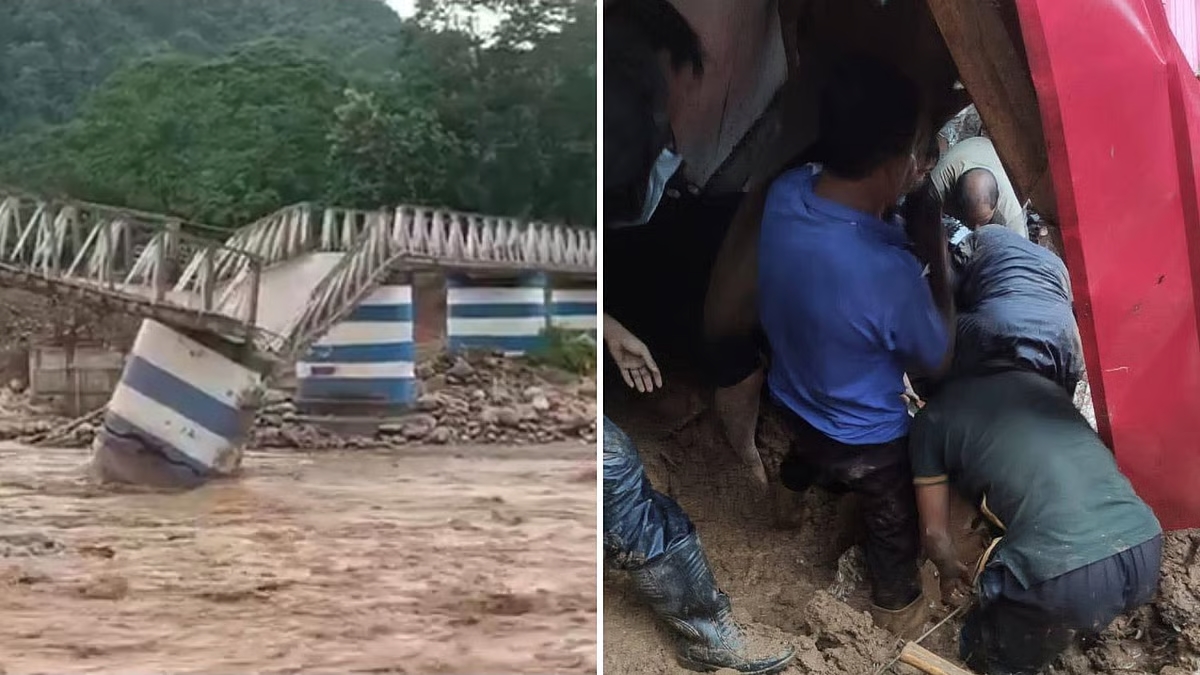
Darjeeling: At least 14 people have died in West Bengal’s Darjeeling district after relentless rainfall triggered a massive landslide in Mirik and caused the collapse of the Dudia Iron Bridge, severing the crucial link between Mirik and Kurseong. The incident has left key tourist areas and towns cut off, with authorities struggling to restore access. Earlier reports had placed the death toll at six.
The region remains under a red alert as heavy rains continue to lash Darjeeling, Kalimpong, and parts of Sikkim. The India Meteorological Department (IMD) has warned that intense rainfall is likely to persist until Sunday morning, raising fears of further landslides and flooding.
Visuals circulating on social media reveal the extent of devastation, with National Highway 110 at Hussain Khola near Kurseong completely buried under mud and debris, bringing traffic to a standstill. The collapse of the Dudia Iron Bridge has deepened the crisis, making rescue and relief operations even more difficult.
According to the IMD, a well-marked low-pressure system over west Jharkhand and adjoining areas of south Bihar, southeast Uttar Pradesh, and north Chhattisgarh is fueling the downpour. The system is expected to weaken by Saturday evening. Meanwhile, sub-Himalayan districts including Darjeeling, Kalimpong, Cooch Behar, Jalpaiguri, and Alipurduar remain at high risk, while heavy rain warnings have also been issued for Murshidabad, Birbhum, and Nadia until Monday.
In the last 24 hours, Bankura recorded the heaviest rainfall at 65.8 mm as of 8:30 am on Saturday. Authorities have appealed to residents and tourists to avoid non-essential travel and closely monitor official advisories.
Local administrations are working round the clock to clear debris, restore connectivity, and ensure relief reaches affected communities. However, the ongoing extreme weather continues to pose serious challenges to rescue and rehabilitation efforts in the hill districts.