

Noida: Watching Bobby Beauty Parlour reminded me how quietly most friendships actually end — not on a stormy note, but through the ordinary drift of two lives no longer heading the same way.
Directed by Shashwat Dwivedi and presented by Imtiaz Ali and Anurag Kashyap as part of Friendship Week, this 18-minute short has already done the festival rounds, including stops at the Dharamshala International Film Festival and IFFLA, before landing on YouTube. It is easy to see why it travelled well.
The setup is simple, almost to a fault: Eelu (Adrija Sinha) is leaving for college; Manu (Parul Rana), her childhood best friend, is staying behind at the beauty parlour where she works.
A heatwave and a fainting salon owner strand the two together for one last afternoon. That is really all the plot you need going in. The film is not interested in the incident; it is interested in what surfaces once two people run out of small talk.
What I appreciated most is how little the film tries to explain itself.
It gestures at a possible romantic undercurrent between the two women without ever cashing that in, and it is smarter for the restraint. Instead, it leaves you to sit with the harder-to-name ache of watching someone you love get to leave a place you know you never will.
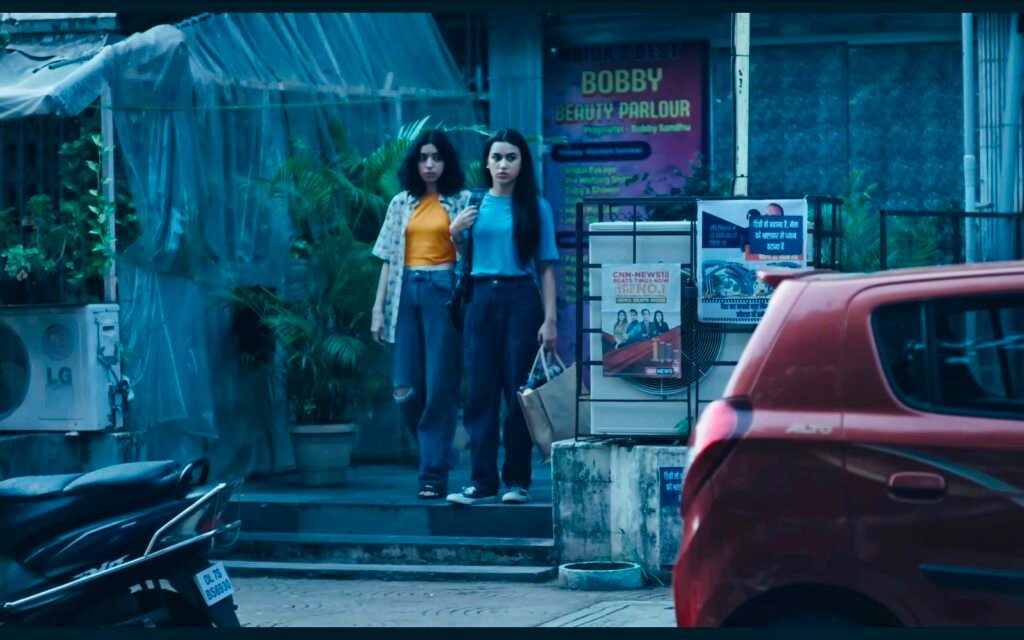
Parul Rana is doing the heaviest lifting here, and she knows it.
Manu spends most of the film smiling through what she already understands about her own future, and Rana lets you see the calculation behind that smile without ever overplaying it — pride, envy and grief sitting on her face at once, none of them cancelling the others out.
Adrija Sinha’s Eelu is the lighter counterpart, all deflection and chatter, which works precisely because it makes her avoidance legible rather than shallow.
Saksham Raj, as Eelu’s boyfriend, does not get much room to be a person, but that appears to be by design. He is there mostly to remind you that even as one woman edges towards a bigger life, the old expectations do not simply evaporate.
Shashwat Dwivedi’s direction trusts stillness more than dialogue, and it pays off.
The Baba Bulleh Shah number Charkha does some genuinely lovely narrative work, returning near the end with a completely different emotional charge from the one it carried at the start.
Janhavi Asthana’s camera stays close and patient rather than showy, which suits a film this small in scale and this large in feeling.
Does it all land in eighteen minutes?
Mostly, yes.
Bobby Beauty Parlour understands something a lot of longer films don’t: that growing apart can hurt exactly as much as falling out, and sometimes more, because there’s no one left to be angry at.


