

Beth Mooney’s brilliance, Phoebe Litchfield’s fearless strokeplay and another clinical team performance power Australia to a record seventh Women’s T20 World Cup crown
London: Great teams celebrate success. Sporting dynasties redefine it. On a glorious summer evening at Lord’s, where cricket’s greatest stories have unfolded for more than a century, Australia added another unforgettable chapter to their extraordinary legacy. Before a packed house of 28,887 spectators—the largest crowd ever to watch a women’s cricket match at the Home of Cricket—the women in green and gold once again proved why they remain the gold standard of the modern game.
England arrived unbeaten, carrying the hopes of a nation eager to witness history on home soil. Australia arrived carrying something even more powerful—the weight of expectation that accompanies champions. When the contest reached its defining moments, experience, composure and ruthless execution once again separated the two sides.
Australia comfortably chased down England’s 150 for four, reaching the target with nearly three overs to spare to lift the ICC Women’s T20 World Cup for a record seventh time. The margin of victory may have been seven wickets, but the contest itself felt even more one-sided. From the opening overs to the final celebrations, Australia dictated almost every phase of the match. For the rest of the cricketing world, the gap continues to narrow. Yet every global tournament seems to end with the same image—Australian players celebrating beneath a shower of confetti.
Lord’s Wakes Up for a Final
The excitement began long before the toss. By early afternoon, the streets surrounding St John’s Wood had transformed into a sea of cricket supporters. Buses arriving outside Lord’s were packed with fans wearing England shirts, Australian jerseys and wide smiles. Families posed for photographs beneath the famous Grace Gates, children clutched miniature cricket bats, and supporters from both nations gathered outside the ground discussing tactics, favourite players and predictions.
Lord’s, a venue often associated with tradition and quiet elegance, embraced a carnival atmosphere. British singer Rita Ora ignited the crowd with an energetic pre-match performance, turning the historic ground into a festival before the cricket began. Thousands sang along, waved flags and filled the stadium with noise that was extraordinary for the game’s most revered venue. Inside the press box, journalists from around the world watched the spectacle unfold while final preparations continued below. The stage could hardly have been grander.
Molineux’s First Winning Decision
When Australia captain Sophie Molineux walked out for the toss, there was little hesitation after winning the call. She chose to bowl first. It was a bold decision, but one entirely consistent with Australia’s approach throughout the tournament. Rather than allowing England’s powerful batting line-up to dictate the game, Australia backed their bowlers to create early pressure and force mistakes.
That confidence was rewarded almost immediately. Lucy Hamilton struck with just her first wicket of the tournament, dismissing Amy Jones cheaply and handing Australia an ideal start. England captain Nat Sciver-Brunt responded in characteristic fashion, driving confidently through the covers and refusing to let the early setback dictate the innings. But Australia’s bowlers never allowed England to settle. Annabel Sutherland, Kim Garth, Ashleigh Gardner and Sophie Molineux bowled with remarkable discipline, varying their pace cleverly on a surface that offered little assistance but required patience. Every boundary England managed seemed to be followed by several quiet overs, preventing the hosts from building the sustained momentum required in a World Cup final.
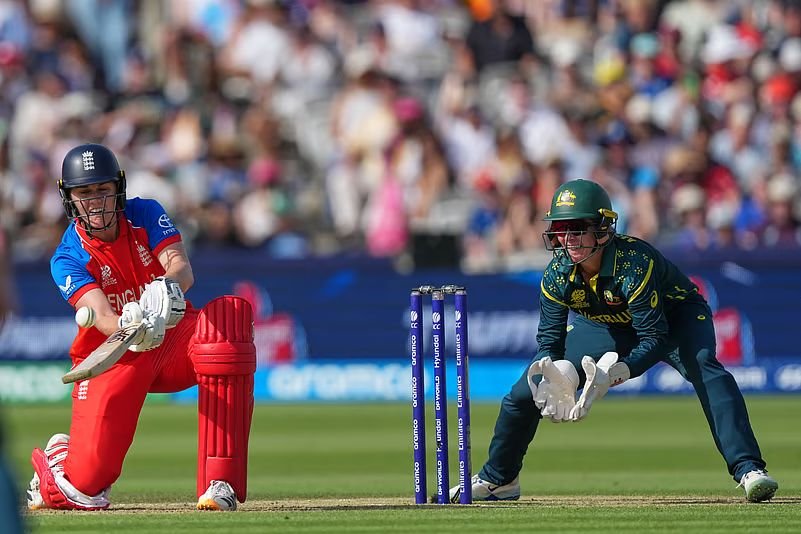
Danni Wyatt-Hodge, one of the tournament’s most prolific batters, never found her rhythm before falling for eight. Alice Capsey briefly threatened to shift the momentum with a series of attacking strokes, including a towering six over midwicket, only to lose her wicket attempting an ambitious reverse sweep. Heather Knight also departed cheaply, trapped leg before by Kim Garth, leaving England under considerable pressure at 70 for four.
If England remained competitive, it was largely because their captain refused to surrender. Nat Sciver-Brunt once again demonstrated why she has become one of the most dependable performers in world cricket. Calm under pressure, she paced her innings beautifully, rotating the strike, punishing anything loose and ensuring England’s innings never completely stalled. Her unbeaten 58 anchored England’s recovery and earned another place in the record books as she became the first player to register nine half-centuries in Women’s T20 World Cup history. Freya Kemp provided the perfect supporting act. The young left-hander displayed maturity beyond her years, accelerating beautifully during the closing overs. Her unbeaten 44 from just 28 deliveries ensured England recovered from their early wobble to post 150 for four—respectable on a surface where timing never came easily. An unbroken partnership worth 80 runs gave the home supporters renewed belief. Yet even as England walked off at the interval, there remained a lingering feeling that they were perhaps 15 or 20 runs short against the world’s strongest batting line-up.
England strike first, but Australia stay calm.
Lord’s erupted during the opening Powerplay. Lauren Bell, England’s most reliable new-ball bowler throughout the tournament, produced the breakthrough her side desperately needed. Georgia Voll, Australia’s highest-ranked T20 batter, dragged the ball back onto her stumps and departed for nine. England sensed opportunity. The crowd found its voice. Every dot ball was cheered. Every appeal carried renewed hope.
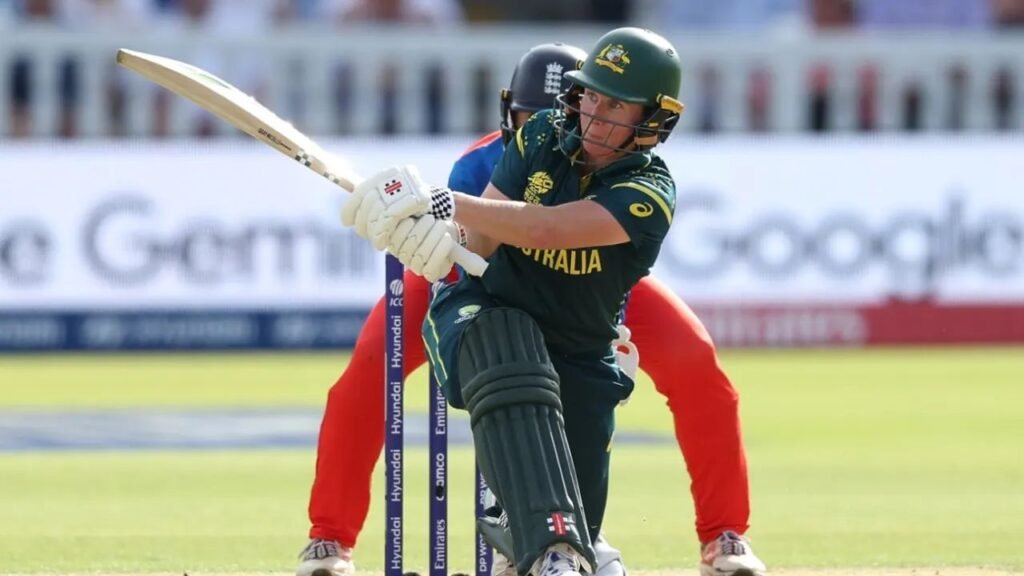
Australia, however, displayed the quality that has defined their dominance over the past decade. There was no panic inside the dressing room. No reckless counterattack. No visible frustration. Beth Mooney simply walked to the middle, surveyed the field and began constructing another championship innings. At the opposite end stood Phoebe Litchfield, whose fearless temperament has quickly established her as one of the brightest young talents in international cricket. Together they produced the partnership that decided the World Cup.
Instead of chasing boundaries from the outset, the pair first dismantled England’s pressure. Singles became twos. Dot balls disappeared. Every loose delivery was dispatched with authority. Bell’s swing was negotiated confidently. Linsey Smith’s left-arm spin was met with clever footwork. Sophie Ecclestone’s subtle variations failed to slow Australia’s momentum. The partnership gathered pace almost unnoticed before suddenly overwhelming England’s attack. By the end of the powerplay, Australia had already erased the early setback. Soon afterwards they had seized complete control of the contest. Named both Player of the Match and Player of the Tournament, Mooney was the heartbeat of Australia’s unbeaten march to the title. Whether behind the stumps or with the bat, Mooney delivered whenever her team needed her most.
Veterans Ellyse Perry and Ashleigh Gardner calmly guided Australia home with the assurance that has become synonymous with Australian cricket. In a fittingly effortless finish, victory arrived through five wides as England’s frustration finally boiled over. Gardner smiled broadly before embracing Perry, and within seconds the Australian dugout emptied as teammates sprinted towards the middle.
Molineux Passes Her Biggest Test
The tournament also marked the beginning of a new era under Sophie Molineux. Replacing one of the most successful captains in women’s cricket was never going to be straightforward. Yet throughout the tournament Molineux displayed calm decision-making, tactical clarity and the ability to keep an experienced squad united.
Her decision to bowl first in the final set the tone for Australia’s victory. Equally impressive was the trust she placed in every member of her squad. Australia’s success never relied on one superstar carrying the side. Instead, contributions came from every department—Hamilton’s early breakthrough, Garth’s disciplined spell, Gardner’s control in the middle overs, Mooney’s brilliance with bat and gloves, Litchfield’s fearless stroke play and the finishing touch supplied by Perry and Gardner. If this tournament is any indication, Australian cricket appears to have found another captain capable of sustaining one of sport’s greatest winning cultures.
Numbers That Tell the Story
Australia’s triumph was remarkable not just for the win but also for the manner in which they achieved it. They completed the tournament unbeaten, winning every match with the confidence and consistency that have become their hallmark. The successful chase of 151 was the highest ever completed in the history of a Women’s T20 World Cup final, underlining both the quality of Australia’s batting and the composure with which they approached the biggest occasion. It was also Australia’s seventh Women’s T20 World Cup title in ten editions, reaffirming one of the most extraordinary records in international sport.
Against England, the numbers are equally striking. Australia have now won every Women’s World Cup final they have contested against their oldest rivals, extending a rivalry that has increasingly tilted in their favour whenever silverware is at stake. The wait for England’s first Women’s T20 World Cup title since the inaugural edition in 2009, therefore, continues.
The Dynasty Continues
Every generation produces exceptional teams. Very few become dynasties. Australia’s latest triumph at Lord’s was not merely another World Cup victory. It was another statement of sustained excellence in an era where the standard of women’s cricket has never been higher. India, England, South Africa, New Zealand and the West Indies continue to improve. Young players are emerging across the globe. Professional leagues have transformed the landscape, and international competition has become stronger with every passing season. Yet whenever the stakes are highest, Australia continues to discover another level. Perhaps that is their greatest strength. Not simply producing world-class cricketers, but creating an environment where excellence becomes routine and pressure becomes an opportunity.
As confetti drifted across Lord’s and the famous balcony once again belonged to Australia, the message to the rest of the cricketing world was unmistakable. The challengers are coming. The competition is stronger than ever. But the summit of women’s cricket remains painted in green and gold.
Another World Cup. Another unforgettable final. Another reminder that Australian excellence is no longer a phase of dominance—it is one of the greatest sporting dynasties ever assembled.


