

Developments and official summit documentation have been considered up to September 14, 2026.
India carried several development, technology and financial priorities into the New Delhi Declaration. Yet the West Asian crisis demonstrated why an expanded BRICS remains a consensus-based consultation platform—not a collective-security alliance.
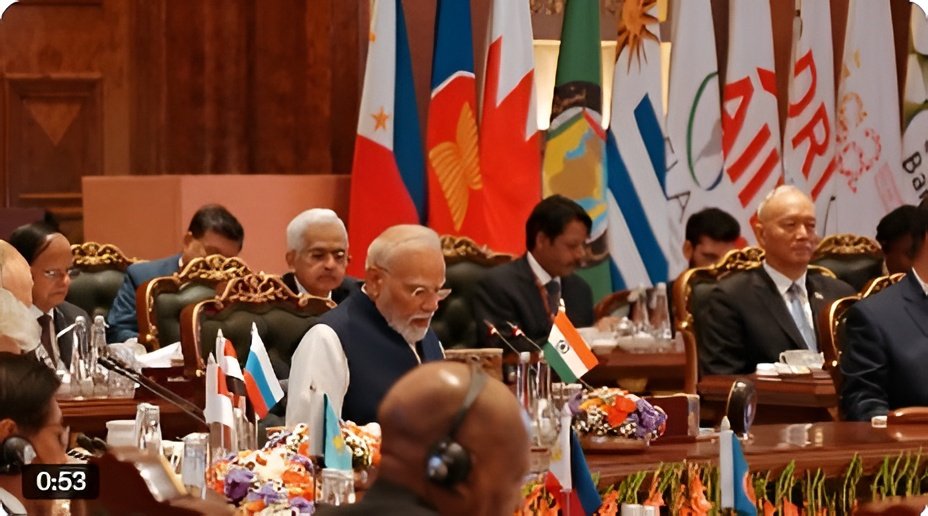
Kolkata : The 18th BRICS Summit, held at Bharat Mandapam in New Delhi on September 12–13, 2026, unfolded amid severe disruption in global energy markets and heightened instability in West Asia. As chair of an expanded grouping of eleven full members, India sought to use the summit to advance institutional reform, supply-chain resilience and digital public infrastructure under the broader banner of the Global South. Yet the geopolitical setting complicated that agenda. Maritime risks in the Strait of Hormuz, continuing conflict in West Asia and the divergent strategic interests of BRICS members tested the grouping’s political cohesion. The central question was whether India could translate its chairship priorities into a meaningful consensus among countries whose foreign-policy orientations and security interests differ substantially.
India’s Priorities and the Limits of Consensus
India structured its 2026 chairship around the theme “Building for Resilience, Innovation, Cooperation and Sustainability.” Its agenda emphasised practical areas of cooperation: digital public infrastructure, resilient supply chains, sustainable and green finance, and the safe and human-centred use of emerging technologies. The agenda also addressed priorities with wider appeal across the Global South, including capacity building, foundational literacy, protection for workers in the gig and platform economy and women-led development. India’s approach sought to present BRICS as an inclusive forum for reforming global institutions and expanding development cooperation, rather than as an explicitly anti-Western bloc.
The resulting BRICS New Delhi Declaration, comprising 140 paragraphs, reflects the balance between India’s national priorities and the negotiated position of the expanded grouping. India secured collective support for reform of global governance institutions, a rules-based multilateral trading system centred on the World Trade Organisation and continued discussions on trade and investment using local currencies. But agreement on international security issues required more cautious language. The declaration therefore separates areas in which technical cooperation can proceed—such as payment-system discussions, digital infrastructure and counter-terrorism—from geopolitical disputes on which members retain different national positions.
West Asian Conflict within an Expanded BRICS
The continuing crisis in West Asia was one of the summit’s most difficult diplomatic tests. Iran is now a full BRICS member alongside the United Arab Emirates, Egypt and Saudi Arabia. Their presence gives the grouping greater regional weight but also brings competing security and economic priorities into the same forum. Iran faces sanctions and sustained external pressure. The UAE and Saudi Arabia, meanwhile, have major interests in maritime stability, energy markets, trade, investment and maintaining working relationships with different global powers. These interests do not necessarily produce a common position during an active regional conflict.
Paragraph 28 of the New Delhi Declaration reflects this divergence. It records “deep concern” over the continued escalation of tensions in West Asia while recalling the respective national positions of members. It calls for maximum restraint, avoidance of further escalation, protection of civilians and civilian infrastructure, and respect for sovereignty and territorial integrity. The declaration also encourages dialogue and diplomacy while stressing the need to maintain the flow of global trade, supply chains and energy. This was calibrated consensus rather than collective intervention. The declaration did not assign responsibility for specific military actions or endorse the demands of any one regional actor. Its language enabled the grouping to register concern without forcing members into a common security position that they were unlikely to accept.
Hormuz and Energy-Market Volatility
The crisis surrounding West Asian transit routes has had direct consequences for energy markets and maritime trade. The Strait of Hormuz remains one of the world’s most important energy chokepoints. According to the US Energy Information Administration, an average of 20.5 million barrels per day of crude oil and petroleum products passed through the strait in 2023—equivalent to roughly 20% of global petroleum-liquids consumption. This concentration makes energy traffic and prices highly sensitive to military escalation, shipping interruptions and changes in risk perception. The International Energy Agency’s July 2026 Oil Market Report illustrates this volatility. North Sea Dated crude fell by $22 per barrel month-on-month to around $68 per barrel in June as tanker traffic from the Gulf recovered. Renewed hostilities in early July then pushed the benchmark back to approximately $77 per barrel when the report was published.
The movement is important because it demonstrates that geopolitical disruption does not produce a simple, continuous increase in oil prices. Prices respond rapidly to changing expectations about military escalation, ceasefires, tanker movements, production and the restoration of supply. For India, these fluctuations create direct economic risks. The Petroleum Planning and Analysis Cell’s July 2026 snapshot documents the country’s continuing high dependence on imported crude. That dependence leaves India exposed not only to changes in international prices but also to shipping delays, freight costs and instability at maritime chokepoints. Energy exporters within BRICS face a different calculation. Price movements may affect their revenues, while disruptions can alter shipping routes, market access and demand. The crisis therefore affects BRICS members differently, but it reinforces a shared interest in stable energy flows, resilient supply chains and diversified transport corridors.
Strategic Autonomy as a Working Framework
For New Delhi, chairing the summit amid these tensions was a practical test of strategic autonomy. India’s approach was not based on equidistance from every power. It was based on retaining the freedom to work with different countries according to the issue involved. India continued to engage the United States on defence, trade and technology, maintained strategic and commercial relations with Russia, kept diplomatic channels open with Iran and sustained important relationships with Israel and the Gulf states. These relationships sometimes pull in different directions. India’s energy security, defence requirements, maritime interests and diplomatic partnerships cannot be fitted neatly into a single geopolitical camp.
India’s balancing posture during the summit can therefore be read as an effort to preserve BRICS as a non-alliance-based platform rather than allow it to acquire an explicitly anti-Western identity. This did not eliminate ideological differences within the grouping. It created enough political space for members to negotiate common positions without demanding strategic alignment. In this sense, strategic autonomy is not merely a statement of distance from rival blocs. It is a method of protecting policy choices while maintaining cooperation across competing centres of power.
Local Currencies, Payments and the NDB
Financial cooperation remained one of the more practical pillars of the summit, although the outcomes were incremental rather than revolutionary. The New Delhi Declaration did not propose the creation of a single BRICS currency. Instead, it concentrated on cross-border payment mechanisms, the interoperability of payment and messaging channels and discussions on promoting trade settlements and investments using members’ national currencies. Paragraph 90 acknowledges the work of the BRICS Payment Task Force in studying payment and messaging-channel interoperability. It also encourages further discussions aimed at developing cross-border payments that are faster, cheaper, more accessible, efficient, transparent and secure. This does not amount to an operational, unified BRICS settlement network. The declaration itself recognises that there is no uniform solution suitable for every member. Progress will depend on national regulatory systems, technical compatibility and voluntary cooperation among participating countries.
Also Read: Security Without Alliances: India’s Emerging Defence-Capacity Model in Sri Lanka
The New Development Bank’s General Strategy for 2022–2026 separately sets a target of providing 30% of its total financing in local currencies. This is an institutional target of the bank, not a new decision adopted at the New Delhi summit and not evidence that a common BRICS currency is being developed. The distinction is important. BRICS financial cooperation is moving through national currencies, development-bank lending, technical studies and voluntary payment arrangements. It is not yet constructing a centralised alternative to the existing international monetary system.
Different Members, Different Interests
The expanded membership gives BRICS greater economic and political weight, but it also widens the range of interests that India must reconcile.
| Country | Membership | Author’s analytical assessment | Principal West Asian or energy interest |
|---|---|---|---|
| India | Full member | Strategic autonomy, Global South advocacy and digital infrastructure | Crude-import security, maritime routes and remittance stability |
| Brazil | Full member | Multilateral reform and agricultural trade | Sustainable trade and export-route security |
| Russia | Full member | Multipolar coordination and trade-route diversification | Energy markets and alternative financial channels |
| China | Full member | Geoeconomic integration and industrial trade | Crude-import security and maritime-route stability |
| South Africa | Full member | African representation and development finance | Governance reform and market access |
| Egypt | Full member | Red Sea transit and development financing | Suez and Red Sea security and commodity imports |
| Ethiopia | Full member | Regional integration and development assistance | Red Sea access and agricultural trade |
| Indonesia | Full member | Regional economic integration and commodity trade | Energy imports and maritime-route stability |
| Iran | Full member | Sanctions mitigation and regional integration | Energy exports and Persian Gulf security |
| United Arab Emirates | Full member | Economic diversification and logistics | Hormuz security and protection of capital flows |
| Saudi Arabia | Full member | Energy-market stability and economic transformation | Oil-market management and regional security |
(The strategic and energy-interest classifications in this table are the author’s analytical assessments, not standard definitions issued by BRICS or its member governments.)
Assessment: Influence without Collective Security
India’s 2026 chairship succeeded in carrying several of its priorities into the joint declaration. Paragraph 77 notes India’s proposal for a BRICS Digital Public Infrastructure repository and pilot projects involving DPI solutions. The wording is significant: these remain proposals and pilots, not completed or operational BRICS-wide mechanisms. Counter-terrorism produced stronger consensus. Paragraph 40 condemns terrorism in all its forms and manifestations, specifically condemns the April 2025 terrorist attack in Jammu and Kashmir, and calls for action against the cross-border movement of terrorists, terrorism financing and safe havens. The contrast between these provisions illustrates how BRICS works. Members can adopt strong common language where a broad political consensus exists. In areas involving financial integration, digital systems or institutional innovation, progress is generally more cautious and dependent on voluntary participation.
The Payment Task Force remains engaged in technical discussions rather than operating a unified settlement network. The DPI repository remains a proposal. The NDB’s local-currency financing objective remains a bank-level strategic target. Reform of the IMF and World Bank depends on negotiations extending well beyond BRICS itself. The West Asian crisis exposed the grouping’s clearest limitation. BRICS possesses considerable combined economic and political weight, but it does not have collective-defence obligations, a common security command or enforcement machinery. Its members are not prepared to surrender their independent regional relationships to a common security policy.
India therefore succeeded less by producing a unified BRICS response to the West Asian crisis than by preventing the crisis from overwhelming the summit’s development agenda. The declaration preserved consensus through carefully negotiated language while allowing members to retain their national positions. That is both BRICS’ strength and its limitation. Its flexibility enables countries with sharply different interests to remain at the same table. But the same flexibility restricts its ability to act collectively during an active security crisis. Under India’s chairship, BRICS demonstrated that it can serve as an influential platform for economic cooperation, institutional reform and political consultation. It did not demonstrate that it is becoming a geopolitical or military alliance—and the New Delhi summit offered little evidence that its members presently want it to become one.


