

PAMPORE: By mid-August, the elevated tablelands of Pampore look like dry, sun-baked stretches of pale earth. To anyone driving down the Srinagar-Jammu National Highway, the quiet plateaus appear almost abandoned under the late-summer heat.
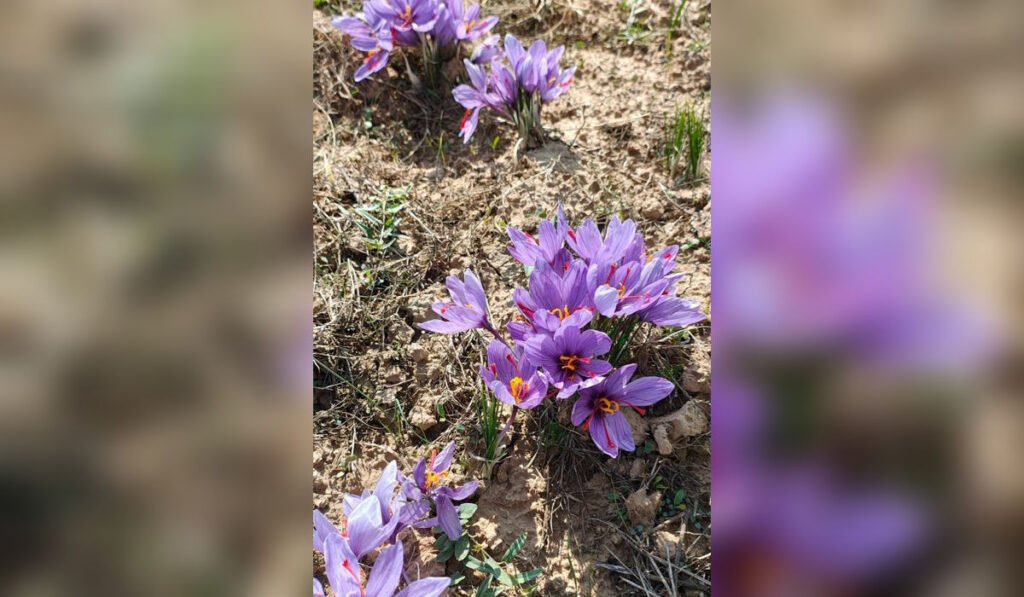
But beneath the surface, the corms of Crocus sativus are quietly beginning their internal cycle. In about eight weeks, if the crucial late-summer soil moisture arrives in time, these flat fields will break into purple flowers. Right now, though, there are no blossoms in sight — only bare dirt that needs weeding, turning and hoeing before the autumn chill sets in.
On a four-kanal plot in Dusoo village, located just off the main highway in Pulwama district, sixty-four-year-old Mohammad Altaf sits on an upturned wooden crate, clearing dry weeds with a small hand hoe. A few yards away, his twenty-one-year-old grandson, Sahil, stands under the shade of a poplar tree, checking his phone.
Sahil isn’t holding a farming tool today. He is wearing a clean, ironed shirt, waiting for his minibus to Srinagar, where he is in his second year of a computer applications degree.
“My grandfather comes out here every morning in August to turn the dirt,” Sahil says, keeping an eye on the road. “I come along to give him company, but I am not going to do this for a living. My family has four kanals here. Thirty years ago, that land paid for marriages, built our home, and fed a full house. Today, after an entire year of waiting and working, the yield doesn’t even cover my university fees. Why would I tie my future to a field that gives back less every season?”
This is the shared reality of young people across Pulwama district. While public discussion around Kashmir’s declining saffron sector usually stays fixated on shifting weather patterns, land conversion and stalled government schemes, a much more decisive change is taking place inside farming households: the young are simply walking away.
The Social Stigma Around the Soil
For decades, news coverage of Kashmir’s saffron belt has circled macro-economic themes: falling rainfall, concrete encroachment on elevated agricultural land or broken government irrigation schemes. But step away from official figures and talk to families in Dusoo, Lethpora or Sambora, and the core issue becomes clear.
The most urgent threat to Kashmir’s saffron landscape isn’t just dry weather; it is a social collapse in how young people view the work itself.
Official figures show that the current area under saffron cultivation in Jammu and Kashmir stands at 1,116.27 hectares, while production has continued to fluctuate. In 2023–24, production rose to 23.53 metric tonnes before falling to 19.58 MT in 2024–25.
Yet, for the young generation living in these villages, the decision to leave has less to do with state production totals and everything to do with social mobility and daily dignity. In past generations, owning a saffron plot carried immense local prestige. Today, educated youth view small-scale farming as a path to financial instability and social stagnation.
In Lethpora, a major saffron-growing township situated along the highway about five kilometres south of Pampore, thirty-six-year-old Farooq Ahmad sits at a roadside tea stall. His family owns three kanals of saffron land on the plateau above the village. After completing a master’s degree in commerce, Farooq spent two years sitting for competitive exams before taking an accounting job with a private firm in Srinagar.
“If you go to a family in our villages today and say you are a full-time saffron grower, nobody wants to marry their daughter to you,” Farooq says candidly. “That is the reality. Families want a groom with a monthly salary, on the 1st of every month. Saffron is an absolute gamble against nature. If one autumn passes without rain, or if porcupines dig up the corms, your income for the year vanishes. Young people cannot build a life or start a family on a gamble.”
Farooq also points out a critical policy gap: crop insurance has not provided saffron growers with the same kind of protection they say they need against crop losses.
“If a hail storm destroys an apple crop, there is a clear mechanism to apply for relief,” Farooq adds. “If drought kills the corms underground, the saffron farmer absorbs 100 percent of the loss alone. Why would anyone in my generation willingly step into a profession where all the financial risk falls squarely on our shoulders?”
The Unseen Indoor Labour and the Choice of Young Women
While public photos of the autumn harvest showcase workers picking flowers under open skies, the most gruelling phase of saffron production happens indoors, carried almost entirely by women.
When the harvest arrives in late October or early November, blossoms are brought into homes in wide wicker baskets. Sitting on carpets in dimly lit back rooms, women spend endless hours dissecting each flower to separate the three dark-red stigmas from the yellow stamens and purple petals.
In a house in Dusoo, fifty-two-year-old Haleema prepares her household for the coming months. Next to her, her seventeen-year-old daughter, Bisma, organises her high school textbooks.
“It takes thousands of flowers to produce just one single kilogram of dry saffron,” Haleema explains. “During harvest weeks, your back stiffens after two hours, your eyes burn under the bulb, and by midnight your fingers feel completely numb. I have done this work since I was ten years old. But my daughter is preparing for her competitive exams. She helps me when she can, but she isn’t going to spend her adult life sitting on this floor doing seasonal manual work.”
Bisma agrees without hesitation.
“My mother’s generation accepted that constant back pain and eye strain as a normal part of life because rural women had very few educational choices back then,” she says. “Today, girls from Pampore are going to college, becoming teachers, nurses, or running small businesses. Spending weeks bent over flower baskets for seasonal work that offers zero financial independence makes no sense to us.”
Even on the marketing and infrastructure front, government interventions have struggled to bridge the gap for small families. Under the National Saffron Mission, launched in 2010–11, the government set up the Saffron Park/India International Kashmir Saffron Trading Centre at Pampore, and Kashmir saffron received its Geographical Indication (GI) tag in 2020.
However, key irrigation infrastructure under the mission has remained largely non-functional, limiting its impact on farmers.
For small families owning one or two kanals, high market prices offer little relief when overall production remains low, making saffron cultivation economically uncertain at the household level.
An Inheritance on the Line
Back on the Dusoo plateau, sixty-four-year-old Mohammad Altaf finishes clearing his second soil bed. He rests both hands against his lower back and stands up slowly with a heavy breath.
A short distance away, his grandson Sahil picks up his backpack. His minibus is approaching the highway junction.
“If my grandson doesn’t work this land, I cannot manage four kanals alone much longer,” Mohammad Altaf says, looking down at his dust-covered hands. “I will keep clearing a small patch near the house as long as my legs allow it. The rest we will have to lease out.”
He pauses, staring across the dry tableland toward a newly constructed residential house sitting right where purple flowers grew a decade ago.
Sahil says goodbye and walks down the dirt track toward the highway. Behind him, the old man bends down again toward the dry earth, working alone in the quiet expanse of the plateau.
As the older generation of growers slowly steps back and the young continue to head toward the cities, an inescapable question remains over the fields of Pampore:
When these old hands can no longer turn the soil, who will be left to grow Kashmir’s saffron?


