

By Ruchita Rane
Researcher, Academician and Cultural Practitioner
The installation of Maharshi Sushruta’s statue at the Royal College of Surgeons of Edinburgh was more than a ceremonial tribute. It renewed global attention on Kashi’s ancient tradition of surgical education, clinical observation and medical ethics.
There are moments in history that pass without the noise normally associated with momentous events. They neither announce the beginning of a new age nor immediately command global headlines. Their significance becomes apparent only when viewed across the long arc of civilisation.
June 19, 2026, was one such day.
Edinburgh had awakened to a familiar Scottish morning. A gentle drizzle softened the outlines of its centuries-old stone buildings, while a cool breeze carried the unmistakable presence of history. It is a city where scholarship has been nurtured for generations and where institutions have shaped the intellectual life of Europe.
On that day, however, Edinburgh was preparing to acknowledge a tradition of knowledge that had taken shape thousands of kilometres away—on the banks of the Ganga in the ancient city of Kashi.
At the heart of Edinburgh stands the Royal College of Surgeons of Edinburgh, established in 1505 and recognised as one of the world’s oldest and most respected surgical institutions. For more than five centuries, it has trained generations of surgeons and contributed significantly to the advancement of medical science.
Its Fellowship remains an internationally respected mark of professional excellence, earned through years of rigorous study, clinical training and practice.
Yet the excitement inside its distinguished hall on June 19 was not centred on robotic surgery, artificial intelligence or a breakthrough medical procedure. Surgeons, researchers, Ayurveda practitioners and scholars had gathered to honour a physician-teacher from ancient India whose ideas helped give surgery a systematic intellectual and educational framework.
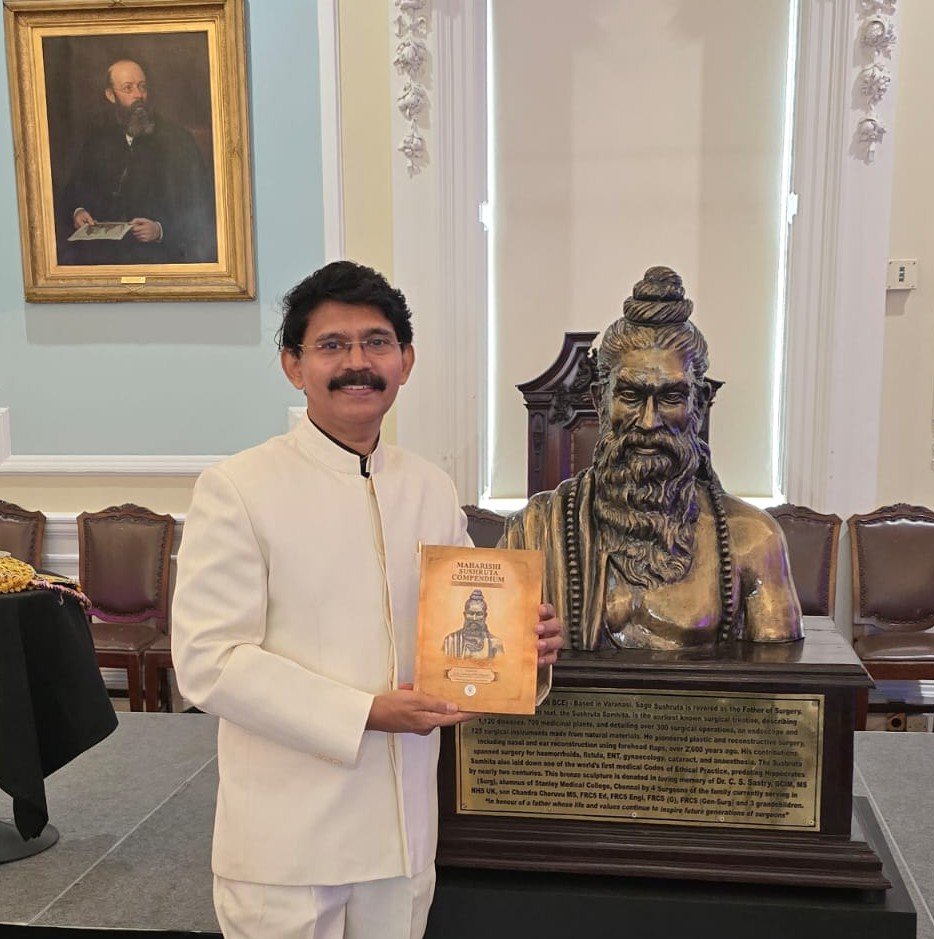
The occasion was the installation and unveiling of a statue of Maharshi Sushruta.
As the audience applauded, the ceremony became much more than the unveiling of a sculpture. It represented an acknowledgment by one of the world’s foremost surgical institutions of India’s contribution to the evolution of surgery.
For some, it was a tribute to an extraordinary physician. For others, it was recognition of one of history’s most influential teachers of surgical science. But viewed through the deeper currents of civilisation, it symbolised something larger: Edinburgh was not merely honouring Sushruta; it was saluting Kashi as an ancient centre of learning.
That distinction matters.
A scholarly rediscovery
The initiative was driven by prominent British surgeon Professor Chandra Cheruvu, whose vision extended far beyond the installation of a statue.
Through the Sushruta Project, undertaken by the Cheruvu Family Foundation, he sought to encourage a fresh, evidence-based examination of Maharshi Sushruta’s place in the history of surgery.
Over the preceding year, surgeons, medical historians, Sanskrit scholars, Ayurveda practitioners and researchers from different countries collaborated on the project. Their work culminated in a volume of scholarly essays examining Sushruta’s legacy from multiple perspectives.
The publication is not merely commemorative. It attempts to reassess India’s surgical tradition through an interdisciplinary framework, bringing ancient textual sources into conversation with modern medicine and historical research.
Importantly, several contributors are practising surgeons rather than historians alone. Ancient Indian surgery has therefore been examined not merely as a civilisational memory, but through the eyes of professionals familiar with contemporary surgical principles.
Among the contributors is Mumbai-based Ayurvedic physician Dr Ashwin Sawant, who contributed three research papers and played an editorial role in the project.
His paper, India: The Birthplace of Surgery, draws upon sources including the Sushruta Samhita, Charaka Samhita, Rigveda, Atharvaveda, Ramayana, Mahabharata, Panini’s Ashtadhyayi, Patanjali’s Mahabhashya and other Indian and international studies to examine the development of India’s surgical heritage.
Why does Sushruta still matter?
The Edinburgh ceremony raised a series of questions.
Why does a physician associated with the ancient world continue to command the respect of modern surgeons? What was so distinctive about his work that no serious discussion of early surgical history can easily overlook him? Why is the Sushruta Samhita still examined by medical historians? And why would one of the world’s leading surgical institutions choose to honour an Indian sage?
To explore these questions, one must travel intellectually from the cobbled streets of Edinburgh to the ghats of Kashi.
Today, Kashi is primarily regarded as one of India’s holiest cities and a centre of faith and spirituality. In the ancient world, however, it was also an important centre of learning. Traditions of scholarship in philosophy, grammar, astronomy, music, logic, medicine and the Vedas flourished there.
It was within this intellectual environment that a sophisticated tradition of medical and surgical education developed.
Ayurveda beyond herbs and therapies
Ayurveda is widely admired in India, but it is also frequently misunderstood.
For many people, it is associated mainly with herbs such as tulsi, ashwagandha, guduchi and triphala, or with therapeutic practices such as Panchakarma. Others understand it primarily as a holistic lifestyle system.
Far less widely appreciated is the fact that classical Ayurveda also incorporated a developed branch of surgery.
The classical system speaks of Ashtanga Ayurveda, or eight principal branches of medical knowledge. Among these is Shalya Tantra, the science of surgery.
Maharshi Sushruta’s importance lies in the systematic framework he gave to this branch. His legacy does not rest only on the procedures attributed to his tradition, but also on the approach he established towards surgical training, anatomy, clinical observation, instruments, dissection and professional conduct.
He emerges from the text not merely as a physician, but as a teacher, researcher, philosopher and exceptionally careful observer of the human body.
The opening chapters of the Sushruta Samhita describe students arriving at the school of King Divodasa of Kashi, revered in the Ayurvedic tradition as Dhanvantari, the divine teacher of medicine.
Traditional and modern interpretations differ over how these accounts should be understood historically. Yet they point towards a broader reality: Kashi was associated with an organised tradition of medical and surgical education.
Sushruta’s most enduring contribution was the transformation of accumulated medical knowledge into a disciplined system of teaching and practice.
Dating Sushruta: A continuing debate
The period in which Maharshi Sushruta lived remains a matter of scholarly debate.
Traditional Indian accounts place him in a very ancient era. Some scholars and independent researchers have proposed dates extending deep into the second millennium BCE or earlier, drawing upon textual, astronomical and cultural evidence.
Other historians, relying on linguistic analysis, manuscript traditions and textual criticism, generally place the formation of the core Sushruta Samhita in the first millennium BCE, while recognising that the text underwent revisions and additions over several centuries.
The chronology may remain contested, but the significance of the tradition is much less disputed.
The Sushruta Samhita is widely regarded as one of the most important surviving texts in the history of early surgery. Whatever the final resolution of the dating debate, Sushruta’s influence on the conceptual development of surgery remains substantial.
More than the work of one individual
It is tempting to imagine the Sushruta Samhita as a book written in its entirety by a single person. But like most mature intellectual traditions, it represents knowledge accumulated, refined and transmitted across generations.
Medical experience moved from teacher to student, with successive generations preserving, expanding and systematising what they had inherited.
Sushruta’s great achievement was the organisation of this accumulated wisdom into a coherent discipline.
Among the three major classical works of Ayurveda—commonly referred to as the Brihat Trayi—the Charaka Samhita, Sushruta Samhita and Ashtanga Hridaya occupy a pre-eminent position.
While the Charaka Samhita is primarily associated with internal medicine and therapeutics, the Sushruta Samhita establishes surgery as a distinct and specialised branch of medical knowledge.
Modern surgery immediately evokes sophisticated operating theatres, anaesthesia systems, robotic equipment and advanced imaging technology. But surgery, at its most fundamental level, begins whenever medicines alone are insufficient and direct physical intervention becomes necessary.
The procedures discussed in the Sushruta tradition include the removal of foreign bodies, treatment of wounds and abscesses, fracture management, bladder-stone procedures, reconstruction of damaged noses and ears, and the treatment of certain eye conditions.
Such interventions demanded more than courage. They required anatomical knowledge, manual skill, clinical judgment, discipline and careful observation.
Observation as the foundation of medicine
Perhaps the quality that most clearly distinguishes Sushruta’s clinical philosophy is observation.
The physician was expected to study a patient’s gait, complexion, facial expression, voice, breathing pattern, swelling and the nature of pain. The appearance, discharge and even the odour of a wound could provide important diagnostic clues.
Modern medical students are often reminded to listen carefully because the patient may be revealing the diagnosis through symptoms and behaviour.
Sushruta’s approach reflects a similar clinical wisdom.
In an age without laboratory testing, CT scans or MRI machines, trained observation became the physician’s most powerful diagnostic instrument. His approach remains relevant because it reminds modern practitioners that technology can strengthen medicine, but it cannot replace an attentive mind and a carefully trained eye.
The text also describes methods of surgical training, anatomical study and practice on models before performing procedures on patients.
This emphasis on preparation is among the reasons Sushruta is often described as a pioneering medical educator rather than merely an early surgical practitioner.
Knowledge that crossed civilisations
Scientific knowledge has rarely respected political boundaries. It has travelled with merchants, physicians, scholars and translators.
The history of Sushruta is also part of this larger movement of ideas.
Indian works on mathematics, astronomy, philosophy and medicine were translated, studied and transmitted across West and Central Asia. The Sushruta Samhita became known beyond India through translations into Persian and Arabic, contributing to the broader circulation of medical knowledge.
Sushruta’s distinction does not depend upon one spectacular operation. It rests upon the comprehensiveness of the intellectual system associated with his name.
The text discusses surgical education, professional ethics, anatomical observations, cadaveric examination, classifications of procedures, wound management, fractures, burns, reconstructive techniques and a wide range of surgical instruments.
Not every method described in an ancient medical text can or should be applied in modern practice. Medicine has advanced enormously, and historical traditions must always be evaluated through contemporary evidence and safety standards.
The lasting importance of the Sushruta Samhita lies instead in its intellectual framework—observation, practice, experimentation, documentation and ethical responsibility.
These remain central to medical science.
Science without ethics is incomplete
One aspect of Sushruta’s teachings receives less attention than his surgical descriptions, yet it may be among his most enduring contributions.
For Sushruta, medicine was not merely a technical profession. It was a moral responsibility.
A surgeon required steady hands, but also compassion. Confidence could not become arrogance. Learning had to continue throughout life. The physician was expected to recognise not only when to operate, but also when an operation should be avoided.
Above all, the welfare of the patient had to take precedence over personal fame or financial gain.
These principles resonate with modern medical ethics.
Technology changes, but the need for humility, judgment and responsibility does not. In that sense, Sushruta’s message speaks as directly to the twenty-first century as it did to the medical tradition that preserved his work.
More than a bronze statue
Visitors walking through the Royal College of Surgeons of Edinburgh encounter memorials to figures who shaped the history of surgery. Among them now stands Maharshi Sushruta.
The statue is more than a tribute to an ancient Indian physician. It symbolises the recognition that scientific history does not belong to one country or civilisation.
It also reminds India that its intellectual heritage deserves neither blind glorification nor automatic dismissal. It deserves critical scholarship, careful reading, scientific examination and honest appreciation.
On that rainy morning in Edinburgh, history appeared to complete a circle.
Knowledge associated with the ghats and learning traditions of Kashi had travelled across languages and civilisations. Centuries later, one of the world’s most respected surgical institutions formally acknowledged the legacy of the tradition from which it emerged.
The moment was not simply a matter of national pride. It was a reminder that genuine knowledge can survive the rise and fall of empires, changing political boundaries and the disappearance of languages.
It may remain obscured for centuries, only to be rediscovered by a later generation.
The recognition of Sushruta in Edinburgh also raises an uncomfortable question: if institutions thousands of kilometres away are rediscovering India’s scientific heritage, has India itself done enough to understand it?
Too often, ancient knowledge is approached from two opposing extremes. One dismisses it entirely as mythology. The other accepts every traditional claim without evidence.
Neither approach serves scholarship.
The pursuit of knowledge demands enquiry, logic, observation and intellectual honesty. It requires us neither to reject an idea merely because it is ancient, nor to accept it simply because it has been repeated for generations.
A beginning, not an end
The story of Sushruta does not end with the installation of a statue in Edinburgh. In many ways, it begins again there.
Every generation inherits history. Whether that history is examined, preserved or forgotten depends upon the choices that generation makes.
For physicians, researchers, historians and students, Sushruta’s legacy carries an enduring message: read original sources, question accepted narratives, examine evidence objectively and maintain respect for both tradition and scientific inquiry.
Maharshi Sushruta continues to inspire not merely because he belongs to India’s past, but because the principles associated with his work—observation, disciplined training, ethical responsibility and intellectual curiosity—continue to speak to medicine’s future.
Whenever humanity rediscovers one of its forgotten pioneers, history quietly corrects itself.


