

THE ULHAS CORRIDOR SERIES | PART III OF III
As urban expansion accelerates and infrastructure costs continue rising, Maharashtra may eventually be forced to rethink rivers, creeks and waterways not as neglected backwaters — but as strategic economic and mobility assets.
By Vivek Bhavsar
For decades, Maharashtra’s development imagination has been shaped largely by roads, railways and highways. From the Mumbai–Pune Expressway to the Coastal Road, from Metro corridors to the Samruddhi Mahamarg, the state’s infrastructure story has traditionally been written on land. Economic expansion, urban planning and transport policy have all evolved around the assumption that growth would continue to move through roads, rail tracks and conventional transit systems. But across the world, a quieter shift is beginning to emerge.
Cities are slowly rediscovering waterways. Not as romantic symbols of the past. But as strategic infrastructure assets for the future.
The proposed Kalyan–Badlapur Water Metro along the Ulhas River may or may not eventually materialise in its current form. The engineering, environmental and financial challenges discussed in Part II of this series remain significant and unresolved. Yet the proposal has already succeeded in doing something important. It has forced a larger policy question into public discussion: Could Maharashtra eventually be compelled to rethink the role of rivers, creeks and waterways in future urban planning?
That question may become increasingly relevant over the next two decades. Because the economic mathematics of traditional infrastructure is rapidly becoming more difficult. Urban land acquisition costs continue rising sharply. Metro rail systems require enormous capital expenditure. Road expansion inside dense urban regions is becoming politically contentious and physically constrained. Environmental concerns are growing. Climate pressures are intensifying. And metropolitan populations continue expanding faster than transport systems can comfortably absorb.
At the same time, India’s logistics and mobility priorities are changing. The Union government has already begun placing greater emphasis on inland waterways and multimodal freight systems through initiatives linked to Sagarmala and the Inland Waterways Authority of India. Across parts of Europe and Asia, water-based transport systems are gradually re-entering urban planning discussions because waterways offer one advantage that modern cities increasingly lack: space.
That does not automatically mean every river can become a transport corridor. But it does mean that governments may eventually be forced to examine waterways more seriously than they have in the past.
Maharashtra itself possesses a vast but largely underutilised network of rivers, creeks and coastal channels. The Mumbai Metropolitan Region alone contains: Thane Creek, Vasai Creek, Ulhas River basin, Panvel Creek, and extensive coastal stretches connected to industrial and urban clusters.
Historically, many of these waterways were viewed primarily through narrow lenses: flood management, pollution, encroachment, or environmental degradation.
Very rarely were they integrated into long-term mobility thinking. That may gradually begin to change. The Kalyan–Badlapur Water Metro proposal becomes important precisely because it attempts to insert waterways into mainstream regional infrastructure imagination. Not merely as tourism projects. But as functional transport and economic systems.
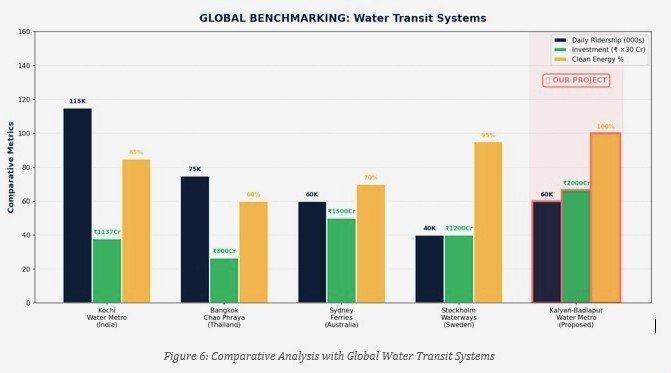
The DPR submitted by former Kulgaon-Badlapur Municipal Council President Nandkishor alias Ram Patkar repeatedly frames the Ulhas River not simply as a passenger transit corridor, but as a future economic spine capable of integrating mobility, tourism, riverfront development and potentially even industrial logistics. Whether that vision ultimately proves practical remains uncertain. But globally, several cities once considered unsuitable for large-scale water mobility eventually transformed their waterways into integrated urban transport systems.
Stockholm, Sydney, Bangkok and increasingly Kochi demonstrate different models of water-linked urban movement adapted to local geography. The lesson from those examples is not that Maharashtra can blindly replicate them. It cannot.
Geography, commuter behaviour, climate conditions and urban patterns differ enormously. The real lesson is something else: Cities evolve when infrastructure imagination evolves. And infrastructure imagination often changes only when existing systems begin approaching saturation.
Mumbai Metropolitan Region may now be approaching precisely such a phase. The pressure building across the suburban railway network is no longer temporary. Road congestion continues intensifying across both eastern and western corridors. Freight movement demands are increasing. Industrial expansion is pushing further into peripheral zones. New urban nodes are emerging beyond traditional city limits.
In that environment, future policymakers may eventually face an uncomfortable reality: conventional infrastructure expansion alone may not be enough. That does not mean waterways will suddenly replace roads, metros or railways. They will not. But future urban systems may become increasingly multi-layered: rail corridors, highways, metro networks, logistics routes, feeder mobility, and selective water-based transport systems operating together.
The future of infrastructure may therefore lie less in replacing one system with another — and more in integrating multiple systems intelligently. This is where the larger philosophical significance of the Ulhas River debate emerges. Because at its core, the proposal is not merely about boats. It is about whether Maharashtra is prepared to think differently about urban growth itself.
For generations, rivers inside Indian cities have often been treated as burdens: polluted drains, flood threats or encroached wastelands. Very rarely have they been viewed as strategic public assets. That mindset may become increasingly difficult to sustain in an era of exploding urbanisation and rising infrastructure stress.
Ram Patkar argues that Maharashtra should at least remain open to unconventional infrastructure thinking if future studies establish technical viability. “If detailed feasibility studies support the project, Maharashtra should not hesitate to think differently about future mobility,” Patkar told TheNews21.
That statement may ultimately capture the real importance of this debate. Not because the Water Metro is guaranteed to succeed. But because the proposal reflects a larger transition underway inside urban India: the search for new infrastructure imagination in increasingly crowded metropolitan regions.
The Kalyan–Badlapur Water Metro may eventually emerge as: a transformative mobility system, a limited pilot project, a modified riverfront initiative, or perhaps simply an unrealised vision document.
At this stage, no one can predict that outcome with certainty. But the larger question raised by the proposal is unlikely to disappear. Because Maharashtra’s future infrastructure challenges are only becoming more complex. And eventually, governments may be forced to ask difficult questions that earlier generations of planners rarely considered: Can rivers become part of urban mobility? Can waterways support regional economic systems? Can environmental restoration and transport planning coexist? And can future cities survive if infrastructure imagination remains trapped entirely on land?
Those questions may define not merely the future of the Ulhas River. But the future of metropolitan planning itself.


