

Kerala deep-water port says it has handled over 2.3 million TEUs and captured nearly 30% of India’s transshipment market; expansion aims to handle five mother vessels simultaneously by 2028
THIRUVANANTHAPURAM: Less than two years after beginning commercial operations, Vizhinjam International Seaport is rapidly expanding beyond its initial design as India attempts to bring home container traffic that has traditionally been transshipped through overseas hubs.
The deep-water port near Thiruvananthapuram, developed under a Public-Private Partnership (PPP) between the Kerala government and Adani Vizhinjam Port Private Limited, began commercial operations on December 3, 2024. Its Phase I was designed for an annual handling capacity of one million Twenty-foot Equivalent Units (TEUs). The Union government said in January 2026 that the port had already handled more than 1.43 million TEUs and was operating at over 130% of its designed capacity. (Press Information Bureau)
A briefing provided during a visit by a Press Information Bureau media delegation this week said the port has since crossed 2.3 million TEUs and handled more than 1,000 commercial vessels. The port also claimed that it now accounts for nearly 30% of India’s container transshipment market. The rapid increase has placed Vizhinjam at the centre of India’s effort to reduce its dependence on overseas transshipment hubs.
Natural depth gives Vizhinjam an advantage
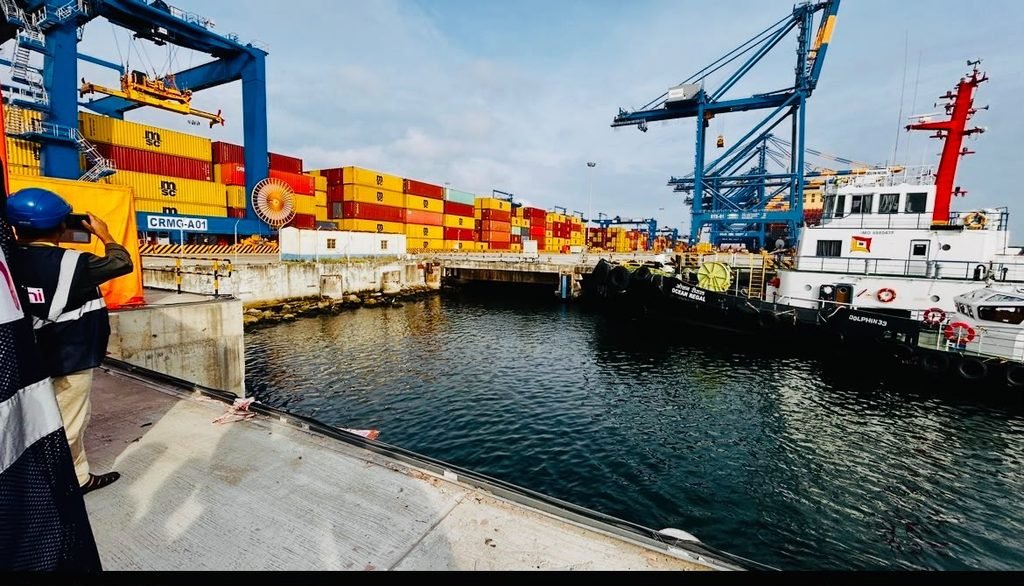
Located around 10 nautical miles from the international East-West shipping route, Vizhinjam has a natural draft of around 18 to 20 metres, allowing Ultra Large Container Vessels (ULCVs) to berth with relatively limited dredging requirements. This geographical advantage is crucial. Large mother vessels need deep water, and insufficient draft has historically restricted the ability of several Indian ports to directly handle the world’s biggest container ships.
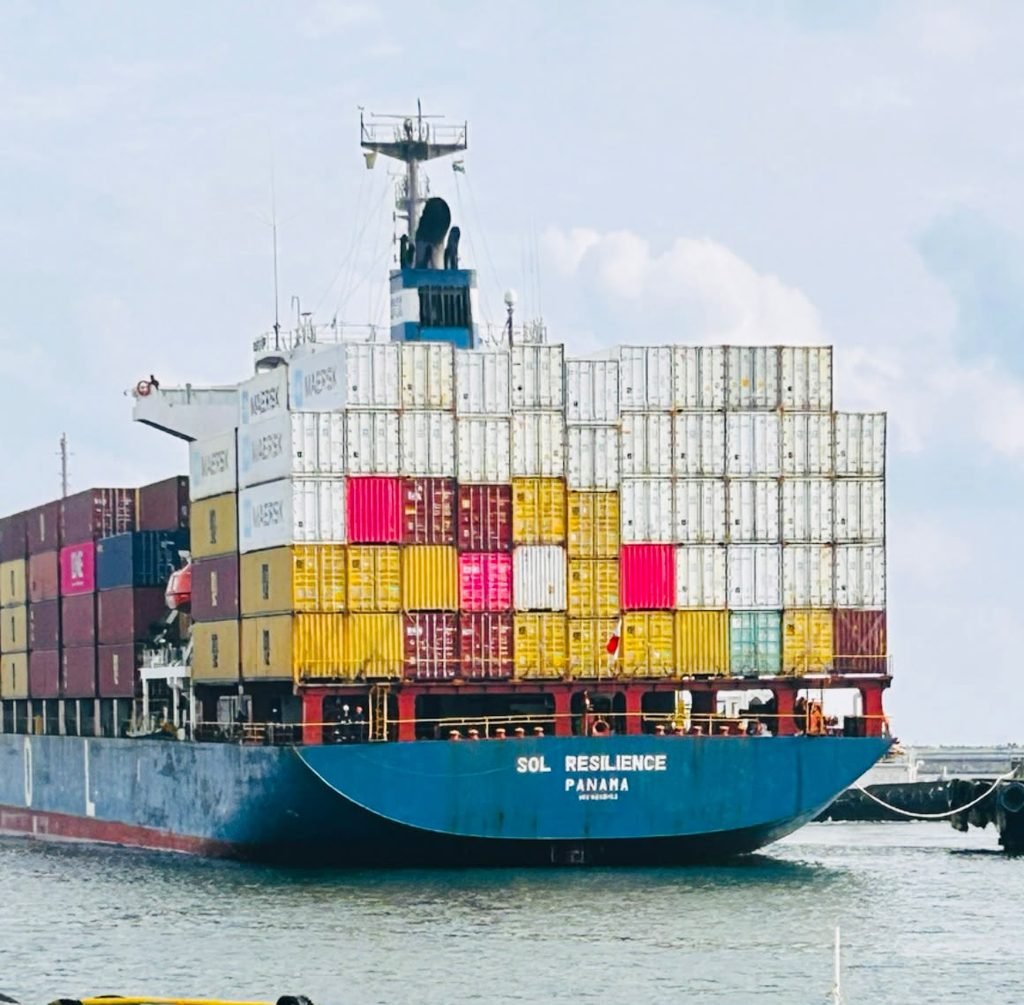
Vizhinjam has already received more than 80 ULCVs of around 400 metres in length, according to the port briefing. More than 70 vessels have arrived with drafts exceeding 16 metres. The briefing said MSC Verona entered with a draft of 17.1 metres, while MSC Irina, one of the world’s largest container vessels, has also called at the port.
Prime Minister Narendra Modi dedicated the ₹8,800-crore port to the nation on May 2, 2025. At the time, he said around 75% of India’s transshipment cargo had traditionally been handled outside the country, resulting in revenue flowing to foreign ports. (Press Information Bureau)
From transshipment to direct EXIM cargo
Vizhinjam’s role is now beginning to move beyond transshipment. Full-fledged Export-Import (EXIM) operations were launched in August 2026, according to the port briefing, opening the possibility of exporters and importers moving cargo directly through Vizhinjam instead of using it primarily to transfer containers between mother vessels and feeder ships.
The development could be particularly significant for southern India’s seafood, spices, coir, textile, engineering and manufacturing sectors. The extent to which Vizhinjam can emerge as a major gateway port, however, will also depend on its landside connectivity.
The port is proposed to receive a 10.7-km railway connection to Balaramapuram station. A Union government reply had set March 2028 as the target for completion of rail connectivity. (Press Information Bureau) Until that connectivity becomes operational, the rapid expansion of EXIM cargo will place greater importance on road-based cargo evacuation.
Also Read: MahaCSR Authority Proposed in Maharashtra, But Key Questions on Control, Audit and NGO Selection Remain
Expansion to handle five mother vessels simultaneously
The Kerala government and Adani Vizhinjam Port Private Limited signed a supplementary concession agreement in November 2024 to implement Phases II, III and IV together rather than sequentially. The accelerated expansion is targeted for completion by December 2028.
According to the Union Ministry of Ports, Shipping and Waterways, total investment envisaged in Vizhinjam International Seaport is approximately ₹16,000 crore, of which about ₹7,398 crore relates to the expansion phases. (Press Information Bureau)
On completion, the port’s stated capacity will rise to three million TEUs annually, with automation and operational efficiencies potentially allowing throughput of as much as 5.7 million TEUs per year. (Press Information Bureau)
The expansion envisages extending the container berth into a continuous two-kilometre facility and increasing the breakwater to about 3.88 km. The expanded port is expected to be capable of accommodating as many as five mother vessels simultaneously and handling next-generation container ships with capacities of up to 28,000 TEUs. (Press Information Bureau)
The port briefing provides further engineering details: approximately 1,200 metres of additional berth, around 920 metres of additional breakwater, about 7.6 million cubic metres of dredging, bunkering facilities, a liquid-cargo jetty and multipurpose berths are planned.
Automation at the heart of operations
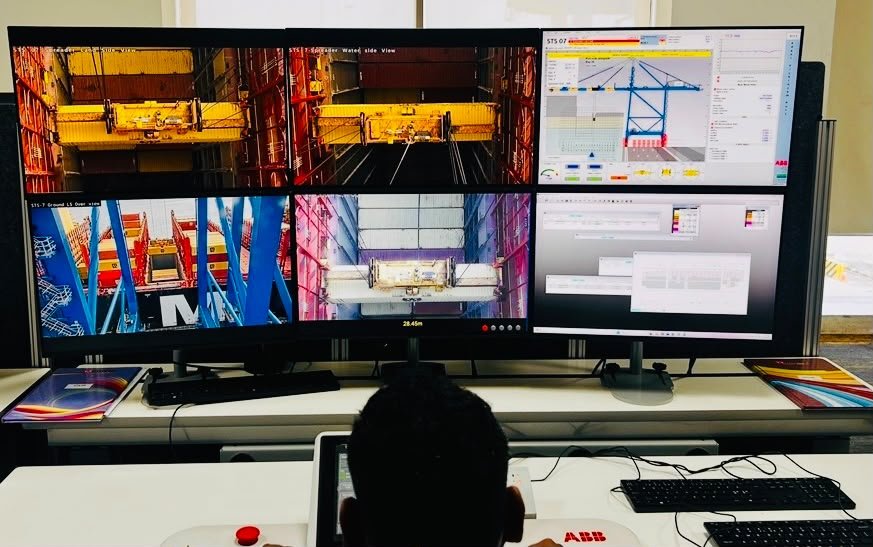
Vizhinjam is also positioning itself as a technology-intensive port. The facility uses the Navis N4 Terminal Operating System, Internet of Things-enabled equipment, Artificial Intelligence and Machine Learning-based berth and yard planning, digital-twin technology and an Integrated Command and Control Centre. The briefing also lists an indigenous Vessel Traffic Management System developed by the Indian Institute of Technology Madras.
During the PIB delegation’s visit, officials described Vizhinjam as India’s first semi-automated container terminal. Port Chief Executive Officer Pradeep Jayaraman and other officials briefed journalists on the project’s operational performance and expansion. The port has also deployed women as automated crane operators, an initiative aimed at expanding women’s participation in a sector traditionally dominated by men.
Bigger question: Can India bring transshipment home?
Vizhinjam’s importance ultimately goes beyond the number of ships or containers it handles. India has long generated enormous container volumes while allowing a substantial part of the transshipment business associated with that cargo to be handled at foreign hubs. Vizhinjam’s location alongside a major international shipping corridor, coupled with its natural depth, is intended to alter that equation.
Its early throughput suggests shipping lines are willing to call at the new terminal. The next test will be whether Vizhinjam can convert that early momentum into a sustainable Indian transshipment ecosystem while simultaneously developing its new role as an EXIM gateway.
The completion of rail connectivity, the pace of the ₹7,398-crore expansion, continued attraction of global mother vessels and the proportion of India’s overseas transshipment traffic that actually shifts to Vizhinjam will determine whether the project fulfils that larger ambition.
For now, India’s newest deep-water transshipment port has moved unusually quickly from construction project to operating maritime hub — and is already being expanded for a scale considerably beyond that for which its first phase was designed.


