By: Ayanangsha Maitra
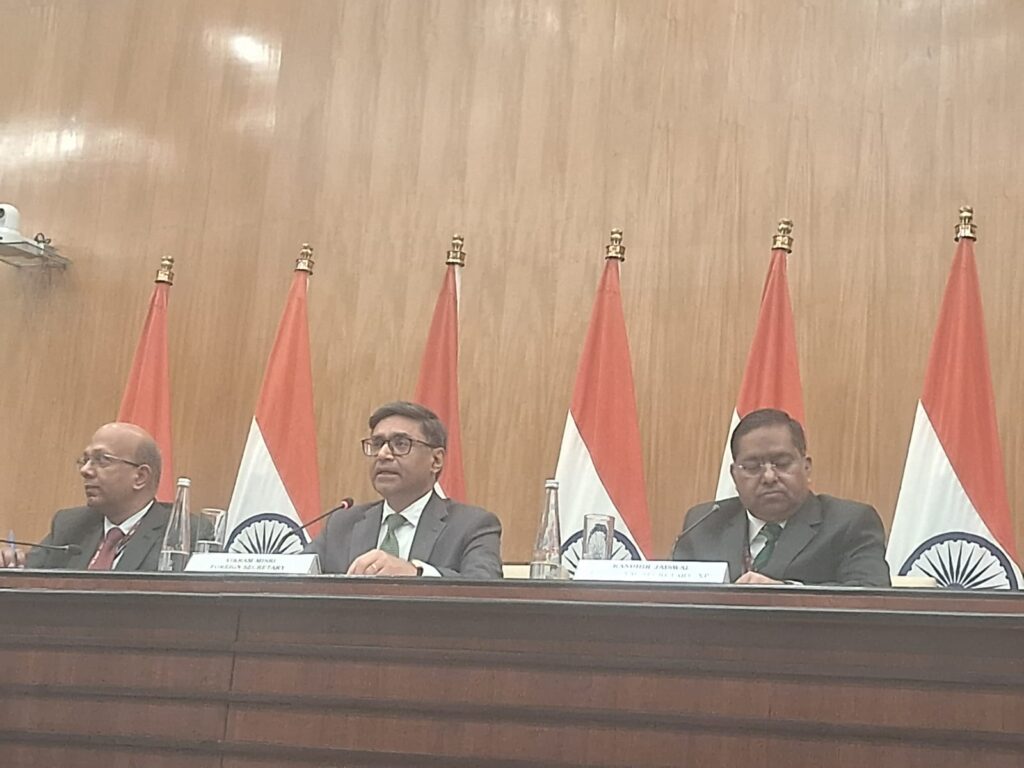
Just hours after Russian President Vladimir Putin’s bilateral meeting with Prime Minister Narendra Modi on Friday, Foreign Secretary Vikram Misri confirmed here that tripartite cooperation with Russia and Bangladesh on the Rooppur Nuclear Power Plant in Bangladesh remains on track, with ongoing coordination among the three nations. Speaking to this journalist, Foreign Secretary Misri stated that “there is ongoing collaboration on Rooppur – work is continuing on that”. He added that Indian officials “remain in touch with both our partners in Russia as well as in Bangladesh on taking forward the work that needs to be done,” signifying a steady progress.
Collaboration continues on Kudankulam plant, with work underway on units three to six. The selection of a second site for a nuclear power plant is currently under consideration by the Department of Atomic Energy, Misri briefed the media in New Delhi, returning from the Hyderabad House.
On being asked by this journalist about the Russian Community in Nadia, West Bengal, Foreign Secretary Misri responded “I really don’t have anything on this issue related to the Russian community in West Bengal”. He further stated that the issue of the Russian diaspora in Nadia did not come up in the discussions .
For the uninitiated: In 2011, a local petition was filed in Tomsk, Russia in an attempt to ban the Russian language edition of Bhagavad Gita As It Is, citing concerns related to its commentaries. However, the local court rejected the case, allowing continued mass distribution of the sacred text, including ongoing efforts by ISKCON after the verdict. Following this episode, several people from Russia and other former Soviet nations became disciples of ISKCON and began arriving in Mayapur, Nadia – the organization’s international headquarters to live and pursue their spiritual practices.
During the visit of President Putin, a major objective was reaching an understanding on how to increase Indian exports to Russia, specifically in the industries like pharmaceuticals, agriculture, marine products, and textiles – to better address the existing trade deficit. Foreign Secretary on Friday affirmed that economic cooperation was the “driving impulse and the most important focus” of the visit, centred on achieving the shared goal of reaching $100 billion in bilateral trade by 2030.
Both sides are continuing to work together to promote mutual trade settlement in national currencies, he said.
Special rupee vostro accounts have been opened in significant numbers by close to two dozen banks, Vinay Kumar, India’s Ambassador to Russia said on Friday.
Misri further showed optimism that currency trade between two nations will resolve the trade imbalance.
PM Modi and President Putin’s discussions focused on fast-tracking negotiations for an early conclusion of the Free Trade Agreement with the Eurasian Economic Union. The leaders discussed key corridors designed to reduce transit times and expand trade access, including the International North South Transport Corridor, the Eastern Maritime Corridor (Chennai-Vladivostok), and cooperation along the Northern Sea Route.
The summit adopted a new Program of Economic Cooperation going up to 2030, Misri said.
In the summit, PM Modi appreciated Russia’s support in expediting the opening of two new Indian consulates in Kazan and Yekaterinburg. Furthermore, agreements were signed on temporary labour activity and combating irregular migration, intended to help meet Russia’s labour needs with skilled Indian manpower in the fields like IT, construction, and engineering, Misri confirmed the reporters in New Delhi – ahead of the state dinner in honour of President Putin.