

Three-year initiative will cover 82 Gram Panchayats through an integrated model focusing on health, education, livelihoods, infrastructure and access to government schemes
NITI Aayog and Tata Motors Foundation have joined hands to strengthen an integrated rural-development initiative covering 162 villages across 82 Gram Panchayats in Maharashtra. The three-year programme will focus on health, education, nutrition, livelihoods, infrastructure and access to government schemes.
Mumbai: NITI Aayog and Tata Motors Foundation have entered into a partnership to promote integrated rural development in selected Aspirational Blocks, strengthening an ongoing initiative that covers 162 villages across 82 Gram Panchayats in Maharashtra. The partnership was formalised through the signing of a Statement of Intent between NITI Aayog and Tata Motors Foundation. The initiative will be implemented under the Integrated Village Development Project, or IVDP 2.0, in selected Aspirational Blocks in Maharashtra and Uttar Pradesh.
In Maharashtra, the programme covers 15 clusters comprising 162 villages spread across 82 Gram Panchayats. The three-year initiative aims to improve the delivery of government schemes and essential services while strengthening social infrastructure and local governance. Priya Khan, Officer on Special Duty to Maharashtra Chief Minister Devendra Fadnavis, said the programme is being implemented by Tata Motors Foundation in coordination with the Maharashtra Government.
The intervention will focus on health, nutrition, education, agriculture, livelihoods, skilling and village infrastructure. It will also seek to improve access to government welfare schemes, strengthen village-level institutions and promote greater participation by local communities.
Women-led livelihoods through Self-Help Groups will form another important component of the initiative. The programme seeks to work closely with district administrations, Gram Panchayats and community institutions to create development models that can eventually be sustained and managed at the local level.
According to NITI Aayog, the partnership will use a convergence-based approach by bringing together existing government programmes, local institutions and the resources and expertise of the corporate and development sectors. The objective is to accelerate progress across indicators monitored under the Aspirational Blocks Programme. The Statement of Intent was formalised in the presence of K. S. Rejimon, Joint Secretary and Programme Director for NITI Aayog’s Aspirational Districts Programme and Aspirational Blocks Programme.
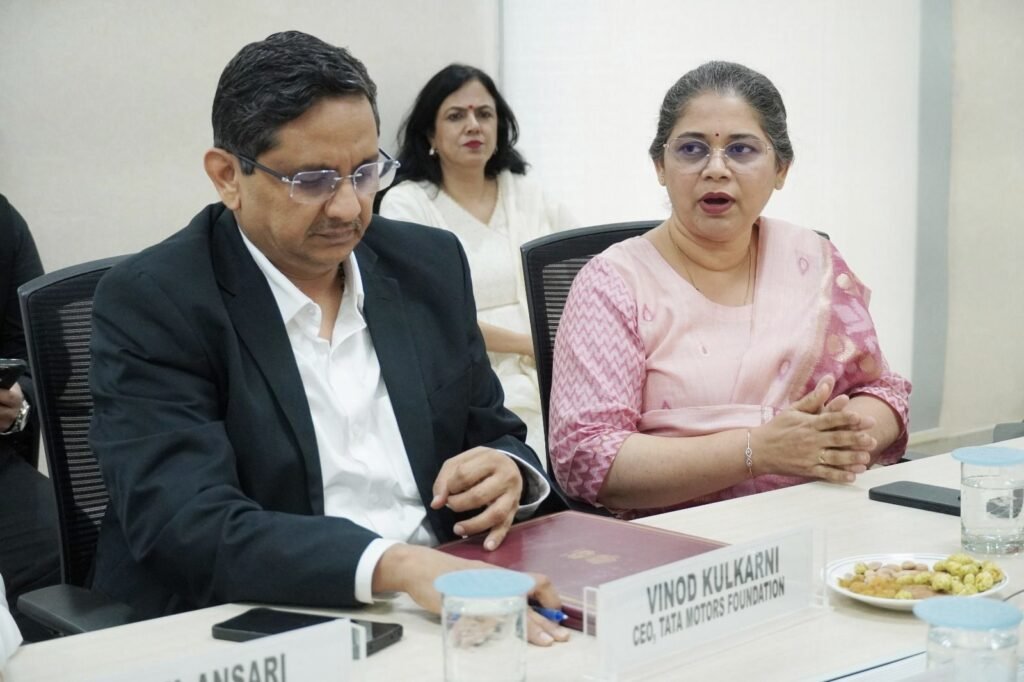
Khan said the Maharashtra Chief Minister’s Office was closely invested in the initiative as it offered a practical and scalable model based on convergence, resource optimisation and sustainability. The programme has also incorporated a monitoring framework aligned with the indicators of the Aspirational Districts Programme and the Aspirational Blocks Programme. Its impact will additionally be assessed against relevant Sustainable Development Goal outcomes.
The Maharashtra Knowledge Corporation Limited is collaborating on the technology framework supporting the initiative. The digital system is expected to facilitate activities ranging from household-level surveys to periodic reviews and monitoring of the programme.
The initiative will involve Cluster Coordinators and field associates deployed by Tata Motors Foundation in the selected areas. These teams will work at the village level, including in difficult geographical regions, to coordinate with communities and assist in the implementation of development interventions.
Khan acknowledged the contribution of Tata Motors Foundation officials, including Vinod Kulkarni, Shailesh Mahulikar and Prafulla Sutar, as well as Maharashtra Government officials and professionals associated with the programme. She also credited Rahul Mhatre for helping shape the initiative and acknowledged the support provided by Vinita Ugaonkar and Ashutosh Bhujbal in areas including health, nutrition, agriculture and education.
Tata Motors Foundation said the agreement with NITI Aayog would strengthen its commitment to convergence-driven development and lasting impact through IVDP 2.0. The foundation also acknowledged Chief Minister Devendra Fadnavis for facilitating the partnership.
The programme is intended to produce a community-owned and sustainable framework that can be adapted and replicated by other organisations engaged in rural development. Corporate partners and philanthropic organisations have been invited to study the model, adapt it according to local requirements and participate in extending it to additional villages.
Khan described the initiative as a possible model for an “Aspirational Village Programme”, building on the experience of the Union Government’s Aspirational Districts Programme and Aspirational Blocks Programme. The initiative, however, is presently being implemented as a collaborative integrated village-development model and has not been described by NITI Aayog as a separately notified national programme.


