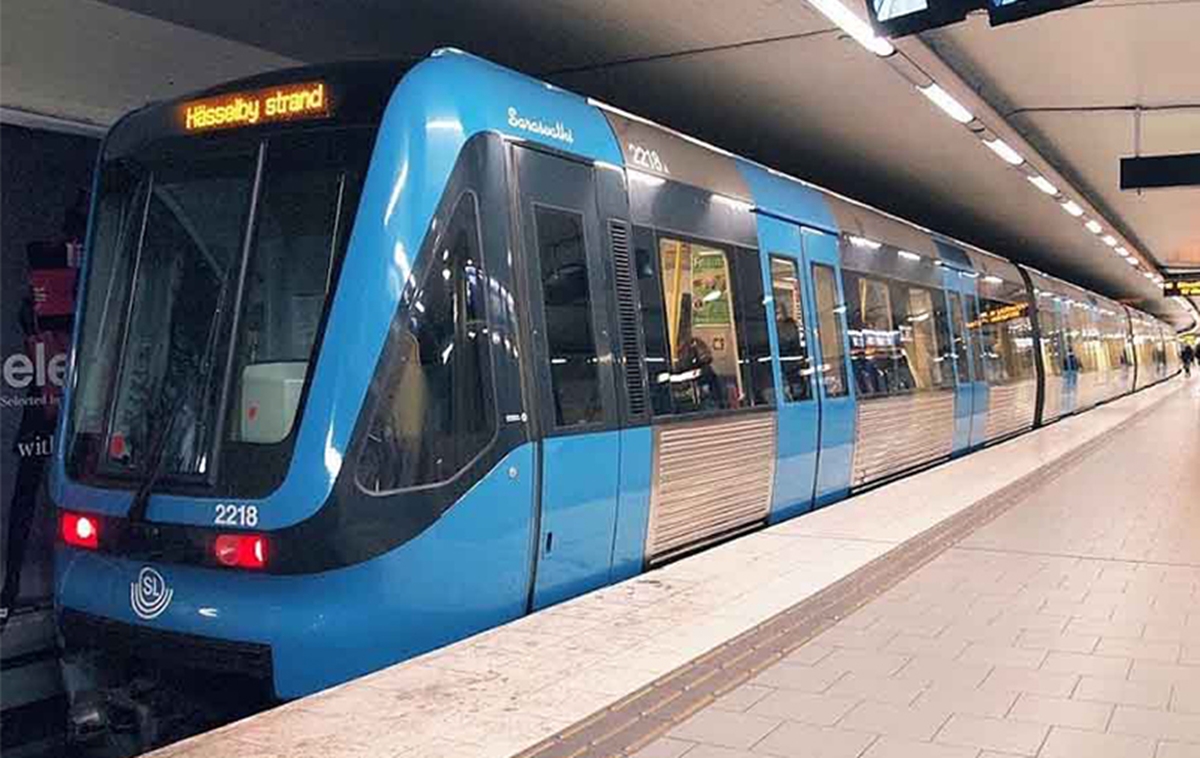
Mumbai: Mumbai’s first fully underground metro corridor — Metro Line 3 (Colaba–Bandra–SEEPZ) — will finally be fully operational from October 8, 2025, marking a milestone in the city’s transport infrastructure. The final stretch between Science Museum Station and Cuffe Parade Station will be inaugurated on that day, completing the 34-kilometre north-south line supported by a Japanese ODA loan through the Japan International Cooperation Agency (JICA).
The project, executed by the Mumbai Metro Rail Corporation Limited (MMRCL), has been over a decade in the making and is set to dramatically reduce travel time across Mumbai’s most congested corridors.
Project Overview
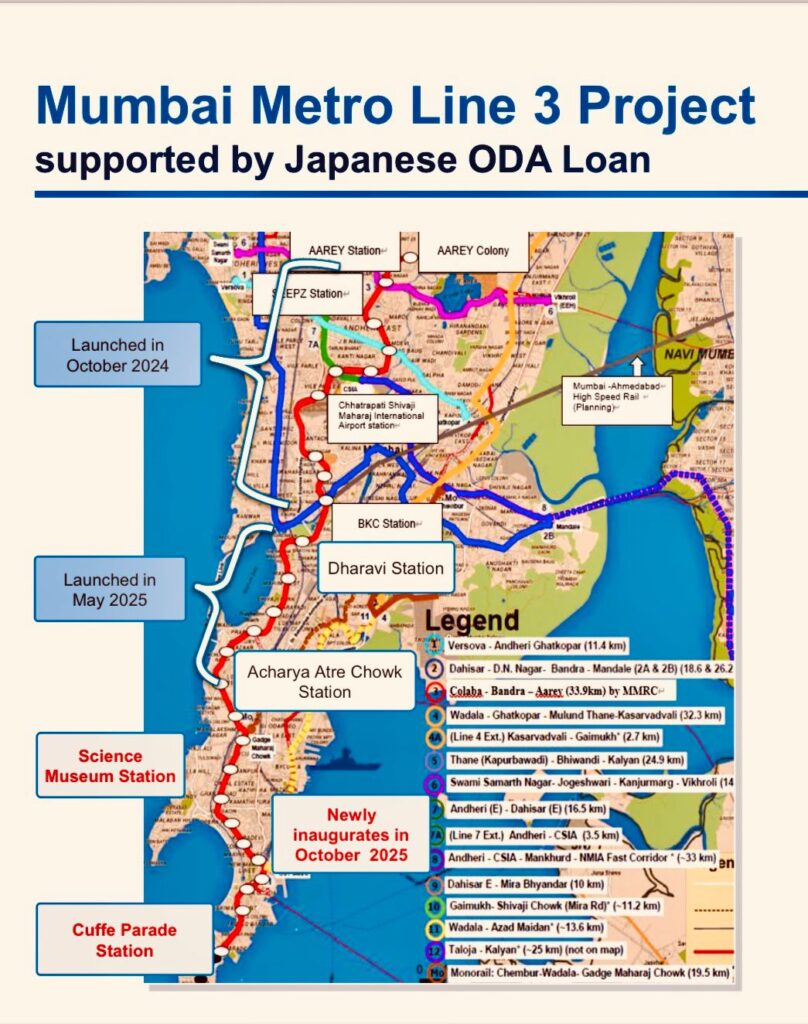
The ₹2,500 crore (680,692 million Japanese Yen) project connects Mumbai’s southern business district at Cuffe Parade to SEEPZ in the north, passing through densely populated commercial zones such as Churchgate, Dadar, Bandra-Kurla Complex (BKC), Dharavi, and Airport terminals.
According to official data, the metro line comprises 27 stations — 26 underground and 1 at-grade — with a total route length of 34 km.
- First phase (Aarey to BKC): Launched in October 2024
- Second phase (BKC to Dharavi to Science Museum): Launched in May 2025
- Final phase (Science Museum to Cuffe Parade): Launching October 8, 2025
The last leg includes 11 underground stations, completing the long-awaited connectivity between Mumbai’s business, residential, and airport zones.
Japanese Partnership and Funding
The project is a flagship example of Indo-Japanese collaboration in urban infrastructure.
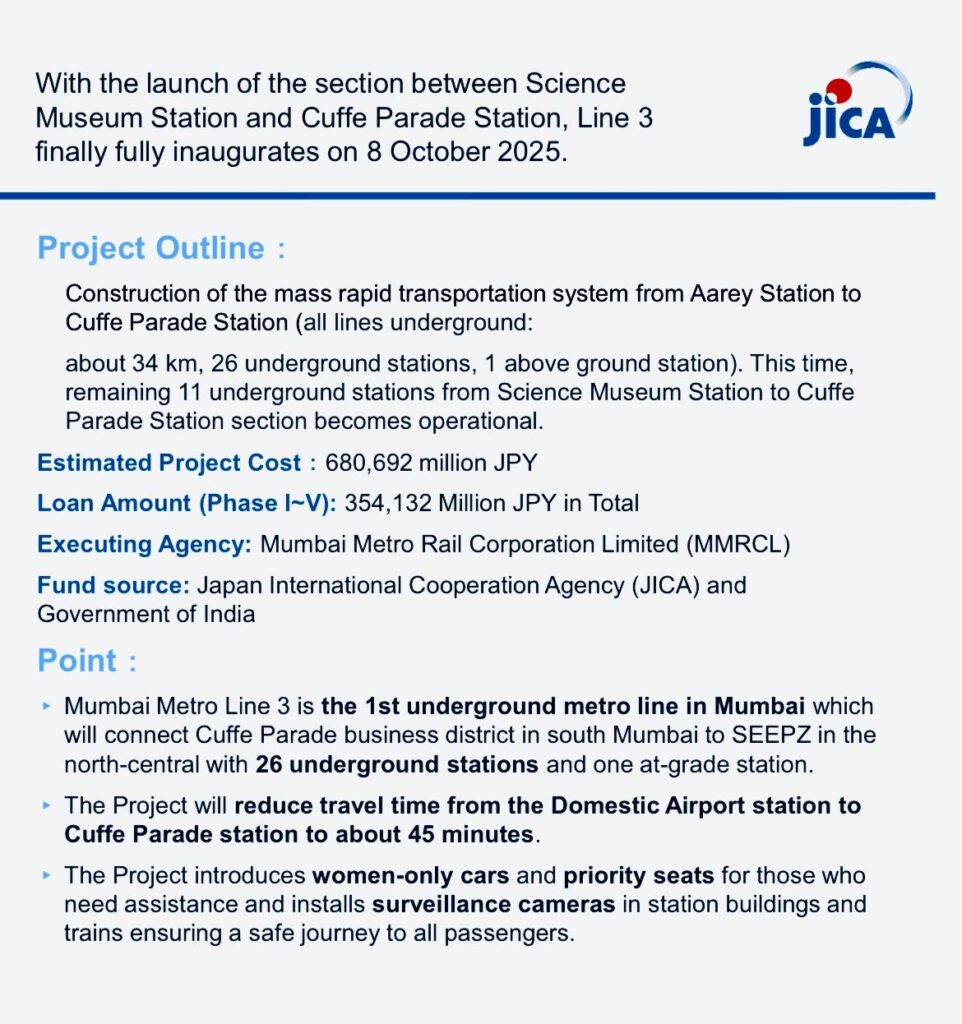
It is being implemented under the Official Development Assistance (ODA) framework by the Japan International Cooperation Agency (JICA), which has extended a total loan assistance of 354,132 million Japanese Yen over five phases.
The Government of India and JICA jointly fund the project, with MMRCL as the executing agency.
A JICA spokesperson said, “The Mumbai Metro Line 3 will significantly reduce congestion and emissions, providing a sustainable and inclusive mode of mobility for one of the world’s most crowded cities.”
Transforming Mumbai’s Commute
Once operational, Line 3 will cut travel time between Cuffe Parade and Mumbai Airport (Domestic Terminal) from nearly two hours to just 45 minutes.
With trains running at high frequency, commuters travelling between south Mumbai and central suburbs will be able to bypass congested road networks such as the Western Express Highway and LBS Road.
The project also features women-only coaches, priority seating for elderly and disabled passengers, and advanced surveillance systems at every station and onboard trains — ensuring safety and accessibility.
“This is not just a metro line; it’s a lifeline for the next generation of Mumbaikars,” said an MMRCL official. “It will decongest road traffic, reduce pollution, and make inter-city travel more predictable.”
Environmental and Urban Impact
Line 3 passes through several environmentally sensitive and high-density urban areas — including Aarey Colony, Worli, and Marine Drive. After years of controversy and protests over the Aarey car shed, construction resumed following policy clearances in 2023, with mitigation measures and tree compensations incorporated as per JICA’s environmental guidelines.
JICA’s involvement ensured compliance with international environmental and social safeguards, focusing on sustainability, noise reduction, and minimum displacement.
Economic Significance
Urban economists estimate that the project will generate tens of thousands of direct and indirect jobs and stimulate new business corridors between Bandra-Kurla Complex, Dharavi, and south Mumbai.
The metro will also connect with other major transport projects, including:
- Mumbai-Ahmedabad High-Speed Rail (Bullet Train) at BKC,
- Monorail at Mahalaxmi, and
- Upcoming Metro Lines 2, 7, and 9 in the western suburbs.
With 1.6 million daily ridership projected by 2030, the project is expected to bring economic savings worth ₹10,000 crore annually through time efficiency, fuel savings, and pollution reduction.
A Decade in the Making
Approved in 2013, Mumbai Metro Line 3 faced multiple hurdles — environmental litigation, tunnelling delays, and pandemic disruptions.
However, steady progress since 2021 has finally paved the way for completion.
The 2025 inauguration will mark the culmination of 12 years of planning, construction, and diplomatic cooperation between India and Japan.
“Line 3 is the backbone of Mumbai’s future metro network,” said a senior urban transport planner. “It symbolises how international collaboration can deliver long-term infrastructure gains.”
The Road Ahead
With Line 3 nearing completion, MMRCL and the Maharashtra government are already exploring Line 3 extensions to Thane and Navi Mumbai, and integrated ticketing systems across all metro corridors.
The full operationalisation of Line 3 is expected to reshape Mumbai’s mobility geography, linking residential clusters, financial hubs, and transport nodes under one seamless network.
At a Glance: Mumbai Metro Line 3
| Parameter | Details |
|---|---|
| Total Route Length | 33.5 km (Aarey to Cuffe Parade) |
| Stations | 27 (26 underground + 1 at-grade) |
| Total Project Cost | 680,692 million JPY |
| Loan Assistance (JICA) | 354,132 million JPY (Phases I–V) |
| Implementing Agency | Mumbai Metro Rail Corporation Ltd. (MMRCL) |
| Full Inauguration Date | October 8, 2025 |
| Total Travel Time (Airport–Cuffe Parade) | ~45 minutes |
| Daily Ridership (Projected 2030) | 1.6 million passengers |
As the final 11 stations — from Science Museum to Cuffe Parade — prepare to open, Mumbai stands on the verge of a new transport era.
The completion of Line 3 is more than an infrastructure achievement — it’s a symbol of how international cooperation and local perseverance can together build a modern, sustainable, and connected Mumbai.