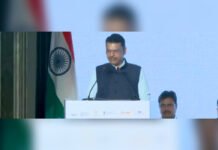
New Delhi: The Maharashtra government has developed its own ‘Vision 2047’ aligned with the national mission of ‘Viksit Bharat 2047’, structured in three phases. As part of this, over 700 objectives were achieved within a 100-day good governance program, and an extended 150-day action plan is now underway. Chief Minister Devendra Fadnavis, speaking at the NITI Aayog meeting held in New Delhi today, stated that the short-term (up to 2029), mid-term (up to 2035), and long-term (up to 2047) planning would guide Maharashtra’s development during the Amrit Mahotsav period.
Fadnavis said that the Maharashtra government is committed to transforming the state’s current economy into a $1 trillion economy by 2030 and a $5 trillion economy by 2047. He expressed his heartfelt gratitude to Prime Minister Narendra Modi and the Indian Armed Forces for ‘Operation Sindoor’, noting that the operation highlighted the central government’s zero-tolerance policy towards terrorism.
Discussing the new industrial policy, Fadnavis stated that the key objective is to increase the manufacturing sector’s contribution to the state’s GSDP to 20%. Through the ‘MAITRI 2.0’ single-window system, sectors like EVs, semiconductors, green hydrogen, and data centers are being actively promoted.
Fadnavis further mentioned that Maharashtra attracted the highest foreign investment in the country during the first quarter of 2024–25, amounting to ₹1.39 lakh crore. At the World Economic Forum in Davos, the state signed MoUs worth ₹15.96 lakh crore, with more than 50% of these projects already under implementation. Notably, much of this investment is flowing into Tier-2 and Tier-3 cities.
Speaking on infrastructure, Fadnavis emphasized that projects such as the Samruddhi Mahamarg, Atal Setu, and Coastal Road are driving development. Initiatives like Vadhavan Port, Navi Mumbai International Airport, metro and rail networks, and multimodal logistics parks are contributing to regional balance.
He also noted that the government aims to transform the Mumbai Metropolitan Region (MMR) into a $1.5 trillion economy by 2047, and requested special financial assistance from the central government to achieve this goal.
Fadnavis said the state is boosting industrial growth in Tier-2 and Tier-3 cities through projects such as Gadchiroli Steel City, Nagpur Defense Hub, Amravati Textile Cluster, Chhatrapati Sambhajinagar EV Manufacturing Zone, and a Smart Industrial City at Dighi.
To promote the services sector, Maharashtra is implementing policies in IT, logistics, exports, AVGC (Animation, Visual Effects, Gaming, Comics), and Global Capability Centers (GCC). Agreements worth ₹5,000 crore have been signed to establish two global studios in Mumbai. The state has also established academic collaborations with the University of York and the University of Western Australia.
Fadnavis said that an ‘Innovation City’ is being developed to promote startups and innovation. World-class training is being provided in rural ITIs through public-private partnerships. Sector-specific ecosystems are being created in areas like AI, green energy, biotech, fintech, and agritech.
In the energy sector, the state has signed power purchase agreements for an additional 45,500 MW of electricity, of which 36,000 MW is green energy. Fadnavis stated that by 2030, 52% of the state’s power will be sourced from renewable energy. Under the Solar Agriculture Feeder Scheme 2.0, projects with a capacity of 16,000 MW are being set up across 10,000 feeders, of which 1,400 MW are already operational. He assured that by December 2026, 100% of daytime agricultural power needs will be met through solar energy.
For pumped storage projects, 45 proposals with a capacity of 62,125 MW have been submitted, and 15 agreements have been signed. These will result in an investment of ₹3.42 lakh crore and the creation of 96,190 jobs, Fadnavis added.
To promote environmentally friendly development, the state is encouraging a circular economy and is developing special recycling parks for e-waste, plastic, metal, and vehicles.
Fadnavis expressed hope that the central government will extend guidance and financial support for the 2027 Nashik Kumbh Mela. Thanking Prime Minister Narendra Modi for conferring classical language status on Marathi, he said it was a symbolic recognition of the sentiments of the Marathi-speaking community.
“Maharashtra will remain fully committed to achieving the vision of ‘Vikas and Virasat’ for Viksit Bharat 2047 in coordination with the central government and all states,” Fadnavis affirmed in the conclusion of his speech.