

TheNews21 visits Kochi Water Metro and speaks to the team behind Mumbai’s DPR; tidal conditions, navigational depth, connectivity and project economics will determine whether Kerala’s model can be replicated across Mumbai, Thane and Kalyan
KOCHI : Maharashtra’s ambitious ₹6,066-crore Mumbai Water Metro will not be a simple replication of Kerala’s Kochi model. Differences in tidal conditions, navigational depth, creeks, open-sea stretches and existing transport networks could make the Mumbai Metropolitan Region (MMR) a far more complex test of water-based mass transit. This emerged during TheNews21’s visit to Kochi Water Metro, where Dr M. P. Ram Navas, Director (Projects), Kochi Metro Rail Limited (KMRL), and Shaji P. Janardhanan, Chief General Manager, Kochi Water Metro, explained the operational and technical architecture of the system.
The interaction assumes significance for Maharashtra because KMRL itself has been associated with the planning of Mumbai Water Metro, first through a feasibility study and subsequently through the Detailed Project Report (DPR). The current Maharashtra proposal envisages an investment of about ₹6,066 crore for a water transport network extending roughly 340 km, comprising 33 routes, 44 terminals and 203 electric or hybrid vessels.
But the bigger question is whether a system developed around Kochi’s relatively sheltered backwaters can be adapted to Mumbai’s sea, harbour, creeks and inland waterways—and what such a network could eventually mean for Thane, Kalyan and the Ulhas River belt.
Kochi Model Goes Beyond Running Boats
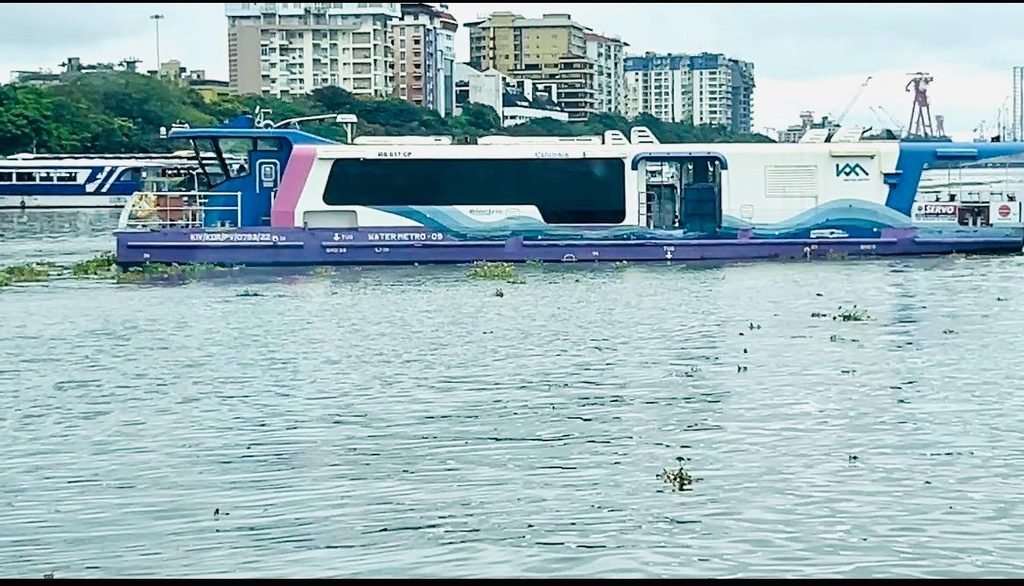
Kochi Water Metro is not merely a ferry service using electric boats. Its full network is planned across about 76 km, with 38 terminals and more than 75 vessels. The sanctioned project cost is ₹1,136 crore, backed substantially by German development bank KfW under Indo-German financial cooperation. At present, 20 battery-powered boats are operating through 12 terminals, carrying around 6,000 passengers daily. What distinguishes the system from conventional ferry operations is the integration of vessels, terminals, ticketing, passenger facilities, communication and centralised operational control.
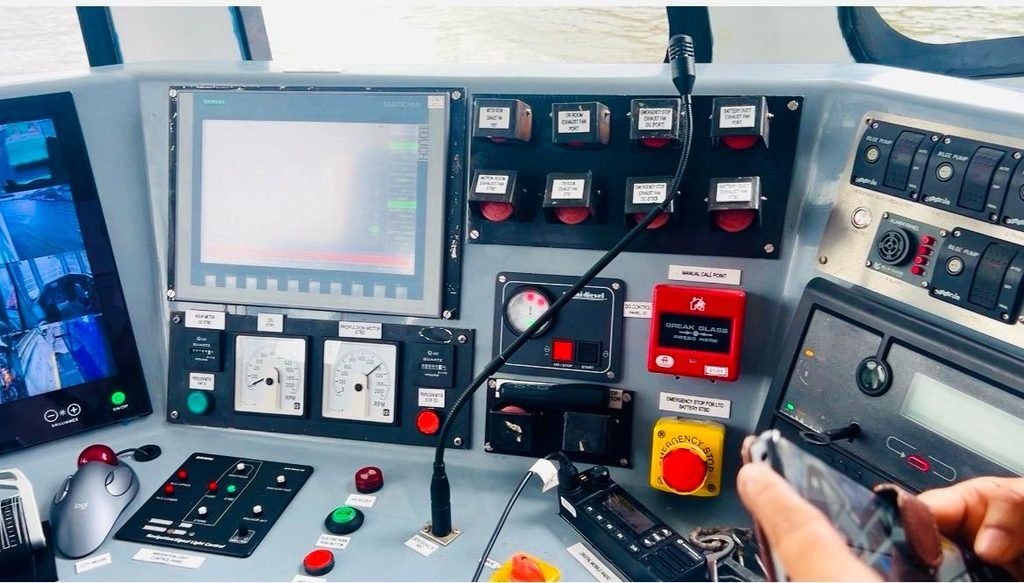
During the interaction with journalists, Janardhanan explained that communication between boats and terminals is connected to the central Operation Control Centre (OCC), allowing the network to be monitored and managed through an integrated system. Universal accessibility has also been built into the terminal design.
Floating pontoons rise and fall with changes in the water level, reducing the height difference between the vessel and boarding platform. This allows easier access for senior citizens, persons with disabilities and other passengers. This aspect could be particularly relevant to Mumbai, where substantial tidal variations pose challenges for fixed passenger jetties.
Mumbai Presents a Different Challenge
However, Mumbai’s geography is fundamentally different. Kochi operates largely through backwaters and relatively protected waterways. The proposed Mumbai network would have to deal with harbour waters, creeks, rivers, tidal variations and, on some routes, coastal or open-sea conditions. KMRL’s original feasibility exercise for Maharashtra had examined waterways including Vaitarna, Vasai, Manori, Thane, Panvel and Karanja.
That initial concept was smaller. Maharashtra’s subsequent plan has expanded to approximately 340 km with 33 routes and 44 terminals, connecting different parts of Mumbai, Navi Mumbai, Thane, Kalyan, Vasai and Mira-Bhayandar. Therefore, Maharashtra cannot simply reproduce Kochi’s infrastructure specifications. Navigational depth, tidal variation, siltation, underwater rock formations, bridge clearances, environmental restrictions and terminal locations will have to be assessed separately for different corridors.
Navigational Depth Will Be Critical
Water depth was among the important technical issues discussed during TheNews21’s interaction with the Kochi Water Metro officials. Janardhanan explained that the navigational depth required depends upon the draft of the vessel and the characteristics of the waterway. Kochi’s official project specifications provide for roughly 2 to 2.5 metres of depth at chart datum in navigation channels and around 1.5 metres in approaches and jetty pockets. But those figures cannot automatically be applied to Maharashtra.
Mumbai’s creeks and rivers have different physical characteristics, tidal behaviour and underwater conditions. This becomes particularly relevant as the proposed network moves towards Thane and Kalyan.
Where Does the Ulhas River Fit?
This is where the proposed Mumbai Water Metro becomes particularly significant for the eastern MMR. TheNews21 has previously reported on proposals for passenger water transport through the Ulhas River, with the possibility of connecting the rapidly urbanising Kalyan-Dombivli, Ulhasnagar and Badlapur belt.
The current Mumbai Water Metro concept includes Kalyan within its wider geographical footprint. However, the inclusion of Kalyan in a broader network does not by itself establish that a commercially viable Water Metro service can be extended along the Ulhas River. That will depend on navigational depth, river morphology, rock formations, existing bridges, terminal locations, environmental clearances, monsoon conditions and last-mile connectivity.
There is another crucial factor—ridership. For any Ulhas River service to work as public transport, it must provide commuters with a meaningful alternative to existing road and suburban railway journeys. This is where the experience of Kochi becomes relevant.
Floating Jetties Could Be a Key Lesson
One of the most visible differences between Kochi Water Metro and conventional ferry operations is its terminal infrastructure. Floating pontoons connected through gangways adjust to changing water levels, helping maintain relatively level access between terminal and boat. Mumbai already has passenger ferry routes, including services towards Mandwa and Elephanta. But developing a Water Metro requires much more than replacing conventional ferries with battery-operated catamarans.
Terminals, jetties, passenger information systems, automated ticketing, vessel schedules, safety and rescue infrastructure, centralised communication and last-mile connectivity must function as parts of the same transport network. This is one of the important lessons Maharashtra can draw from Kochi.
Battery-Powered Boats, Built in India
Kochi’s electric-hybrid catamarans have been built by Cochin Shipyard Limited. The vessels are designed for frequent urban passenger operations in shallow waterways and primarily use battery propulsion. Maharashtra’s proposal also envisages a large fleet of electric and hybrid vessels—203 under the current plan. The Maharashtra Maritime Board has separately been exploring an electric-vessel manufacturing ecosystem in the state. If the Mumbai Water Metro proceeds at the proposed scale, therefore, the project could create demand not only for boats but also for maintenance, charging infrastructure, maritime technology and associated manufacturing.
Economics Could Be as Difficult as Engineering
Building the network is only one part of the challenge. Operating it sustainably will be another. During the Kochi interaction, officials acknowledged that public transport projects such as Water Metro cannot necessarily depend entirely on passenger fares. Non-fare revenue and commercial utilisation of infrastructure are also important.
This question assumes greater significance for Maharashtra because a ₹6,066-crore network involving 44 terminals and 203 vessels would have substantial recurring costs. These would include vessel operations, electricity, crew, maintenance, terminal management, security, navigation systems and, depending upon the route, maintenance of navigable channels.
Maharashtra has projected substantial future passenger demand for the network. But projected ridership and actual commuter behaviour are two different things. For a passenger from Kalyan, Thane, Navi Mumbai or Vasai, the success of Water Metro will ultimately depend on four basic factors—travel time, frequency, fare and connectivity from the terminal to the final destination. Without those, even technologically advanced vessels could remain an alternative ferry service rather than become mass transit.
Maharashtra Has Tried Water Transport Before
Mumbai and the MMR have discussed water-based passenger transport for decades. Several ferry, coastal and creek transport proposals have either remained limited in scale or struggled to become an everyday commuting alternative comparable with suburban rail, Metro or bus services. The new Water Metro proposal therefore has to address a fundamental issue that goes beyond procurement of vessels.
Can Maharashtra make water transport reliable enough for a commuter to depend upon it every working day?
Kochi demonstrates that this requires integration. The Water Metro there is designed to connect with Metro rail and other modes of public transport. Its terminals operate as organised transit facilities rather than conventional ferry points. For Mumbai, this could mean integrating Water Metro terminals with suburban railway stations, Metro corridors, bus networks and last-mile transport.
Also Read: Vizhinjam Races Past Initial Capacity as ₹7,398-Crore Expansion Targets 5.7 Million TEUs
Kochi Is a Model, Not a Template
The comparison between Kochi and Mumbai therefore needs some caution. Kochi’s planned Water Metro network extends about 76 km. Mumbai is proposing approximately 340 km. Kochi largely serves sheltered backwaters and island communities. Mumbai’s network is proposed across a much more varied maritime geography and one of the world’s densest metropolitan regions.
Maharashtra does not need to copy Kochi boat for boat or terminal for terminal. What it can potentially replicate are the principles behind the Kerala model—battery-powered vessels, accessible floating terminals, centralised operational control, predictable frequency, passenger facilities and integration with other modes of public transport.
The real test will begin when these principles encounter Mumbai’s tides, creeks, coastline and commuter volumes and for residents of Thane, Kalyan and the Ulhas River belt, another question remains equally important:
Will the ₹6,066-crore Mumbai Water Metro eventually open a dependable new commuter corridor towards the eastern MMR—or will water transport once again remain largely on the drawing board?
That answer will depend not on the success of Kochi’s Water Metro, but on how carefully Maharashtra adapts its lessons to its own waterways.


