

What started as a short jewellery commercial has, over the past few days, turned into a wider argument about who gets to decide what a woman wears during a Hindu festival — one that has now pulled in a BJP MP, the Leader of the Opposition, and a large section of Indian social media.
And now, the brand itself has stepped in.
What the Ad Actually Shows
The advertisement, for jewellery brand GIVA, features Kriti Sanon in an ivory Indo-Western outfit — a bralette-style blouse layered under a cape and paired with a draped skirt — as she celebrates Raksha Bandhan.
The ad shows her tying a rakhi to her on-screen brother and also extending the idea of the festival’s bond of protection to a pet dog.
The campaign itself was intended to present Raksha Bandhan as a celebration of family in a broader sense, including pets.
Why Kriti Sanon’s Rakhi Ad Drew Criticism
Two aspects of the advertisement became flashpoints.
The first was Sanon’s outfit.
Several viewers argued that the bralette-and-cape styling felt too modern or Western for a festival associated with traditional ritual. Some also questioned the absence of more conventional visual elements normally associated with Raksha Bandhan.
The second was the dog sequence.
Some viewers felt that tying a rakhi to a pet diluted the traditional brother-sister bond at the centre of the festival. Others saw it simply as an extension of the idea of family and protection.
At their core, both arguments were about the campaign’s creative choices — whether a contemporary interpretation suited a festival rooted in tradition.
Alongside that, however, ran a separate and far more personal strand of commentary.
Some posts mocked Sanon’s outfit as a “bikini” or “undergarments” and moved beyond criticism of the advertisement into personal trolling.
Other users pushed back against that framing, arguing that the outfit was neither obscene nor an appropriate reason to target the actor personally.
Kangana Ranaut Enters the Conversation
The controversy escalated when actor and BJP MP Kangana Ranaut posted an Instagram Story criticising the campaign.
Ranaut argued that women today have countless clothing choices — from lehengas and saris to jeans — and questioned why a Raksha Bandhan advertisement had styled Sanon in an outfit she compared to a bikini or undergarments.
“From all the options that are available to us today why would you tie your brother a Rakhi in your bikini/undergarments? Where are all your styling options?” she wrote, while calling the campaign “intentionally creepy.”
Coming from a sitting MP with a large public following, the remarks pushed what had largely been an online advertising debate into national news.
Kriti Sanon Responds
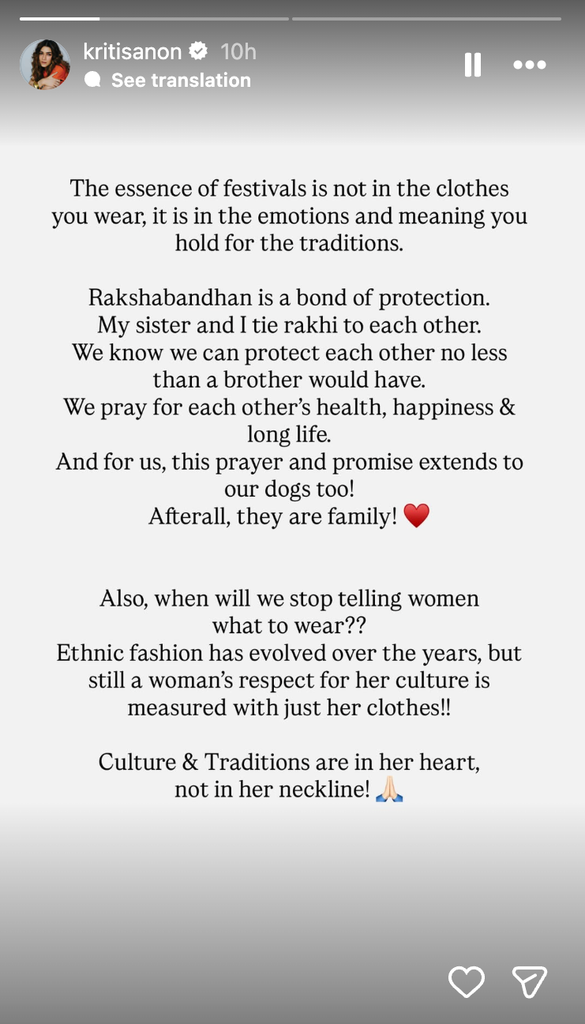
Sanon responded the following day with an Instagram Story of her own.
She questioned why women were still being told what they should wear and argued that the meaning of a festival lies in the emotion and intent behind it rather than in a particular dress code.
“The essence of festivals is not in the clothes you wear,” she wrote, adding that culture and tradition are “in her heart, not in her neckline.”
Sanon also explained why the advertisement included a pet dog.
She said that she and her sister tie rakhis to each other and that, for her family, the same prayer for protection, health and happiness extends to their dogs because they are part of the family.
Rahul Gandhi Steps In
The controversy then acquired a political layer.
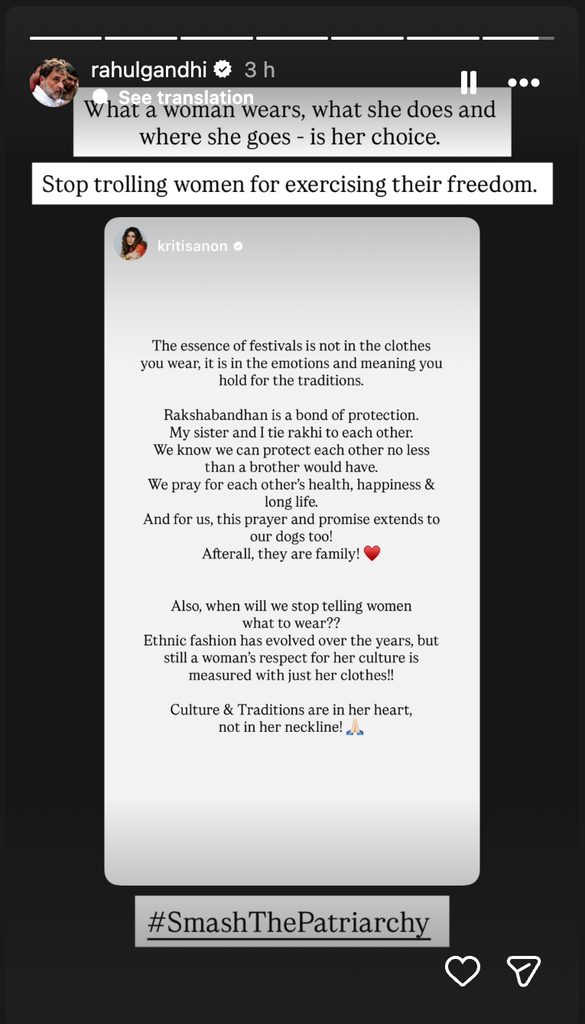
Congress MP and Leader of the Opposition Rahul Gandhi shared Sanon’s response and publicly supported her right to choose what she wears.
“What a woman wears, what she does and where she goes — is her choice,” Gandhi wrote, urging people to stop trolling women for exercising their freedom and using the hashtag #SmashThePatriarchy.
Ranaut later responded indirectly by resharing a BJP post challenging Gandhi’s position on women’s issues.
GIVA Withdraws the Advertisement
The biggest development came on August 26, when GIVA withdrew the campaign from its media platforms.
The jewellery brand said it has “the highest regard and deep respect for Indian culture, traditions and festivals” and clarified that the campaign had been intended to celebrate Raksha Bandhan with the entire family, including pets.
It said hurting sentiments had not been the intention behind the advertisement, but that it had decided to withdraw the campaign “out of respect” after the backlash.
The withdrawal effectively brought the brand itself into a debate it had initially stayed out of.
What the Controversy Is Really About
By this point, the argument is no longer only about one jewellery advertisement.
Different sides are reading the same campaign through very different ideas of culture, personal choice and what counts as an appropriate representation of a religious festival.
For critics, the question is whether commercial campaigns should respect the visual and ritual conventions traditionally associated with festivals such as Raksha Bandhan.
For Sanon and those defending her, the larger concern is whether a woman’s respect for culture should be judged through her clothes — and whether criticism of an advertisement crossed the line into policing her personally.
The fact that GIVA ultimately withdrew the ad shows that what began as a creative decision in a 36-second campaign had become something much larger: a public argument about tradition, advertising, women’s autonomy and who gets to define cultural appropriateness.


