

Maharashtra is preparing a major regulatory overhaul for private coaching centres, with the state government proposing a new law that could bring strict rules on admissions, fees, teaching hours, student safety, counselling and the overall functioning of coaching institutes.
The proposed Maharashtra Private Coaching Centers (Registration and Regulation) Act, 2026 seeks to bring coaching centres under a formal registration system and introduce stronger safeguards for students and parents.
The draft is currently open for public feedback and is not yet a law. The School Education and Sports Department has invited suggestions and objections until 6 pm on September 4, 2026.
The proposed legislation would broadly cover coaching or tuition centres catering to more than 25 students.
Coaching Centres Would Need Mandatory Registration
If the draft becomes law, eligible coaching centres will have to register with the state through an online system.
Existing institutes would get six months from the date the Act comes into force to complete the registration process.
A registration would remain valid for three years. Centres would then have to apply for renewal at least three months before the registration expires.
Every branch of a coaching organisation would be treated separately, meaning each branch would require its own registration.
No Coaching For Children Below 13
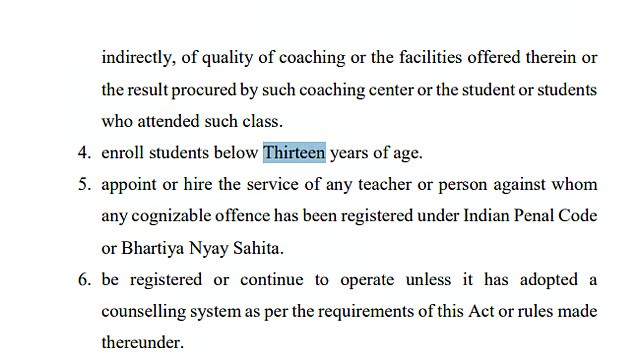
The draft proposes that coaching centres cannot admit students below 13 years of age.
It would also prohibit institutes from making misleading claims about results, ranks or academic performance. Coaching centres would not be allowed to promise students or parents guaranteed marks or ranks.
Institutes would also have to publish important information on their websites, including teachers’ qualifications and experience, courses, class timings, fees, facilities and refund policies.
Five-Hour Daily Limit Proposed For Classes
One of the most significant proposals is a limit on coaching hours.
Under the draft, students cannot be made to attend coaching classes for more than five hours a day. Classes would also have to be scheduled at reasonable times rather than very early in the morning or late at night.
Students and teachers would be entitled to one weekly day off.
Coaching centres would also not be permitted to conduct an examination or assessment immediately after the weekly holiday.
The draft further proposes special leave arrangements around important regional festivals so students can spend time with their families.
Student Mental Health Gets Major Focus
The proposed legislation puts considerable emphasis on students’ emotional and mental wellbeing.
Coaching centres would have to establish counselling arrangements and provide students and parents with information about available counsellors or psychologists.
Institutes would also be expected to respond when students show signs of excessive academic pressure or emotional distress.
Another proposed change concerns the practice of dividing students into batches according to academic performance.
The draft seeks to prevent academic ranking from being used to create separate batches, with students instead proposed to be placed in batches based on their admission order. The batch would generally remain unchanged until the course ends.
Coaching centres would also be required to conduct aptitude assessments to understand students’ abilities and interests and communicate realistic expectations to parents.
Coaching Fees Could Not Be Increased Mid-Course
The proposed law would also tighten rules around fees.
Students and parents would have to receive receipts for payments, while coaching centres would be required to clearly disclose the total cost of a course.
The declared fee would cover items such as study material, notes, prospectus and internal examinations. Centres would not be allowed to introduce additional charges under separate headings beyond the declared course fee.
Once a course starts, its fee could not be increased during the course.
Students leaving a course after paying the complete fee would be entitled to a proportional refund for the unused period. The draft proposes that such refunds be made within 10 days.
Similar refund provisions could apply to hostel and mess charges where applicable.
Basement Coaching Centres Could Be Banned
Safety requirements form another major part of the proposed law.
Coaching centres would not be allowed to operate from basements.
The draft proposes a minimum of one square metre of space per student in classrooms or batches.
Institutes would also have to comply with fire and building safety requirements and maintain valid safety certificates.
Other proposed requirements include:
- First-aid and basic medical assistance
- Safe drinking water
- Clean and separate toilets for boys and girls
- Facilities accessible to children with special needs
- CCTV coverage across the premises
- Preservation of CCTV recordings for at least one month
- Display of emergency information, including hospitals, police and fire services
Maharashtra Moves Against ‘Dummy School’ Model
The draft also proposes a major restriction on the integrated coaching model, commonly described as the “dummy school” system.
The proposed law would prohibit formal or informal arrangements connecting recognised schools with coaching centres in academic, administrative, financial, managerial or operational matters.
Coaching centres would also be barred from operating from recognised school or college premises.
If a recognised school is found to be actively participating in a prohibited arrangement, the authorities could take action against it, including recommending derecognition.
However, the school would have to be given an opportunity to explain its position before such action is recommended.
Restrictions Proposed On Tutors And Staff
The draft also lays down conditions for hiring staff.
A coaching centre would not be permitted to employ a teacher or other person against whom a cognizable offence has been registered under applicable criminal law.
Government-approved or recognised school and junior-college teachers would also be prohibited from simultaneously working at coaching centres under the proposed framework.
Tutors would need to possess at least a graduation-level qualification.
Student Records Could Be Preserved For 10 Years
Coaching centres would also have to maintain detailed student records.
These could include information relating to students’ educational progress, aptitude and learning abilities.
The draft proposes maintaining these records digitally and preserving them for at least 10 years from the commencement of the Act.
Heavy Penalties Proposed For Violations
The proposed law gives authorities powers to inspect coaching centres and examine documents, financial records and other material.
Investigating officials could also access CCTV footage and, in specified circumstances, search premises and seize relevant documents or electronic material.
Violations would be divided into minor and major categories.
For minor violations, proposed penalties could start at ₹1 lakh and go up to ₹5 lakh. Repeated minor violations could attract fines of up to ₹10 lakh.
Major violations could lead to penalties ranging from ₹10 lakh to ₹50 lakh.
Depending on the nature and repetition of violations, authorities could also suspend or cancel registration or order the closure of a coaching centre.
24-Hour Response Proposed For Sexual-Harassment And POCSO Complaints
The draft also proposes a rapid-response requirement for serious complaints.
Where an incident involves provisions of the POCSO Act or the law dealing with sexual harassment of women at the workplace, coaching centres would have to initiate appropriate action within 24 hours.
The requirement would also cover certain misconduct by tutors, non-teaching employees or people representing the coaching centre.
What This Could Mean For Students And Parents
If enacted, the proposed law could substantially change the private coaching sector in Maharashtra.
Parents could receive greater clarity about fees, refunds, teacher qualifications and facilities, while students could benefit from restrictions on excessive class hours and stronger safety and counselling requirements.
The proposed restrictions on very young students and dummy-school arrangements could also affect how coaching institutes structure their businesses.
However, it is important to note that these provisions are currently part of a draft. They will not become legally enforceable unless the proposed legislation is finalised and brought into force.
Public Can Submit Suggestions Until September 4
The Maharashtra government has invited members of the public and stakeholders to submit suggestions and objections on the draft.
The deadline is 6 pm on September 4, 2026.
The official draft notice is available through the Maharashtra School Education Department.


