

For Durga Maida, self-reliance did not begin with more land or a large investment. It began by discovering new value in the livestock, cow dung, seeds and soil already around her home.
In the Sailana block of Madhya Pradesh’s Ratlam district lies a small village called Govardhanpura. This is where Durga Maida lives with her husband and four daughters.
For a family of six, farming on just one bigha of land was never enough. Producing grain sufficient for the entire year was difficult, and meeting everyday household expenses was an even greater challenge. Along with farming, Durga kept livestock and took up wage labour whenever work was available.
There was no shortage of hard work. What was missing was an income that matched that effort.
By the end of many months, household expenses exceeded what the family had earned, leaving borrowing as the only option.
Looking back, Durga remembers those years as a period when farming offered little hope. No matter how hard the family worked, there seemed to be no clear way forward.
And hers was hardly an isolated struggle. For many small farming families in the region, tiny landholdings and uncertain income make survival a constant calculation.
A Meeting That Changed Her Thinking
The turning point came when Divya Sharma, a facilitator associated with VAAGDHARA, invited Durga to become part of the Saksham Samuh, or Empowerment Group.
Durga began attending its monthly meetings.
There, conversations revolved around things that were immediately relevant to rural households—organic farming, preparing manure from cow dung, preserving seeds and developing a small nutrition garden close to home.
Some of what she heard was new.
But some of it was strangely familiar.
When the discussion turned to cow dung and organic manure, Durga remembered what she had seen during her childhood. Her elders regularly applied cow dung to agricultural fields, and she remembered the crops growing well.
Over the years, however, many such traditional practices had gradually declined.
That memory prompted a simple question:
Could something already available in her own household be put to better use?
Durga had four buffaloes and two cows. Until then, the livestock had primarily served the family’s household requirements.
She began looking at them differently.
Instead of seeing livestock merely as part of everyday rural life, she began thinking about how every available resource could contribute to the family’s livelihood.
Turning Livestock Into a Small Income Stream
Durga first began making better use of the milk produced at home.
She started preparing ghee, curd and buttermilk, selling part of what the family produced and creating a small but regular source of income.
Then she turned her attention to cow dung.
What had previously not been fully utilised as an income-generating resource could, she realised, have economic value.
Durga began making dung cakes.
Her first major batch consisted of around 1,000 cakes. According to Durga’s account, she sold them to a nearby brick kiln at ₹5 per cake.
The calculation was simple:
1,000 dung cakes × ₹5 = ₹5,000.
For a family struggling to make ends meet from one bigha of agricultural land, ₹5,000 earned from a resource already available at home was significant.
It changed Durga’s understanding of what constituted an economic resource.
Today, according to her account, making and selling dung cakes has become part of her regular work, bringing her around ₹5,000 a month.
It is not a fortune.
But for Durga, that supplementary income matters.
More importantly, it comes from livestock the family already owns and from labour she can undertake close to home.
What Was Sold Also Went Back Into the Soil
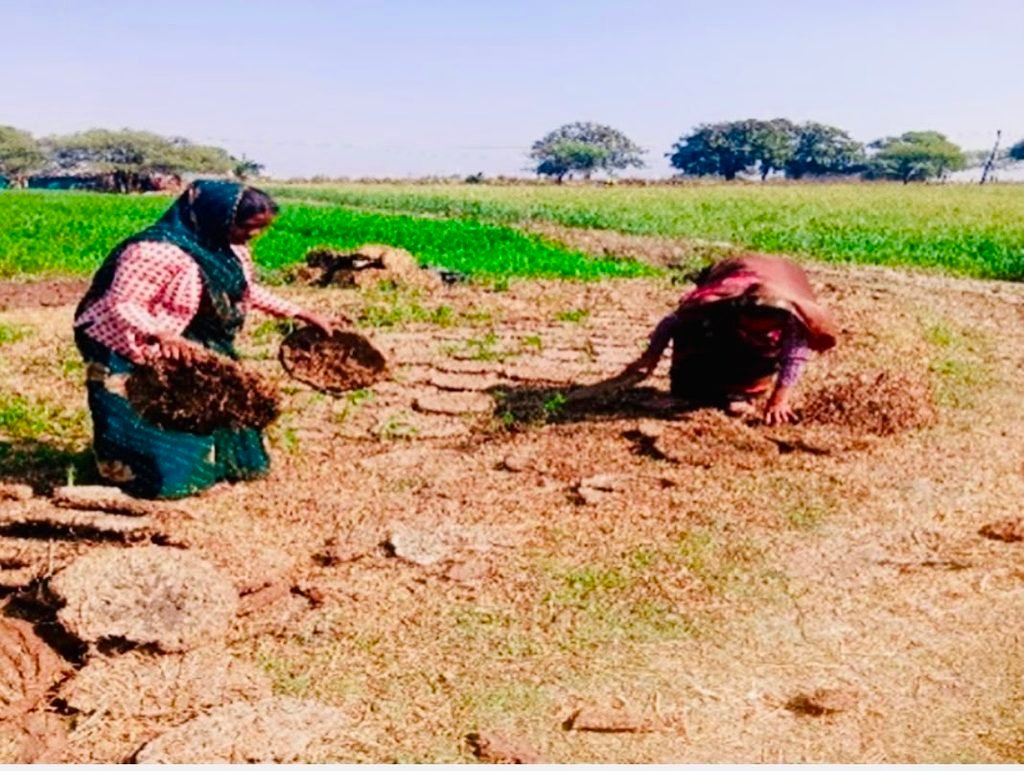
Durga did not convert all the dung into something to sell.
Part of it returned to the farm.
She began preparing and applying dung-based organic manure to her field. She says the practice helped improve the soil, retain moisture and reduce some cultivation costs.
The change was therefore doing two things at once.
One part of the same household resource was generating cash.
Another was supporting the family’s agriculture.
This was precisely the kind of connection Durga had begun discovering through the Saksham Samuh: a rural household does not necessarily need to look outside first for every solution. Sometimes, resources already available around the home and farm can be used differently.
Returning to Indigenous Seeds
Her approach to seeds changed as well.
Durga began using indigenous seed varieties suited to local conditions and adopted traditional methods to protect them during storage.
She stores seeds with neem leaves and ash, a practice intended to protect them from pests.
Gradually, she began maintaining her own small collection of seeds—a household seed bank that reduces dependence on purchasing seed afresh and helps preserve locally used varieties.
The change may appear modest when viewed individually.
But together, these practices began altering the economics of her household:
livestock provided milk; milk became ghee, curd and buttermilk; dung became both manure and a saleable product; seeds were preserved at home; and cultivation costs could be reduced.
Durga was learning to extract greater value from resources that had been around her all along.
A Garden That Reduced Another Expense
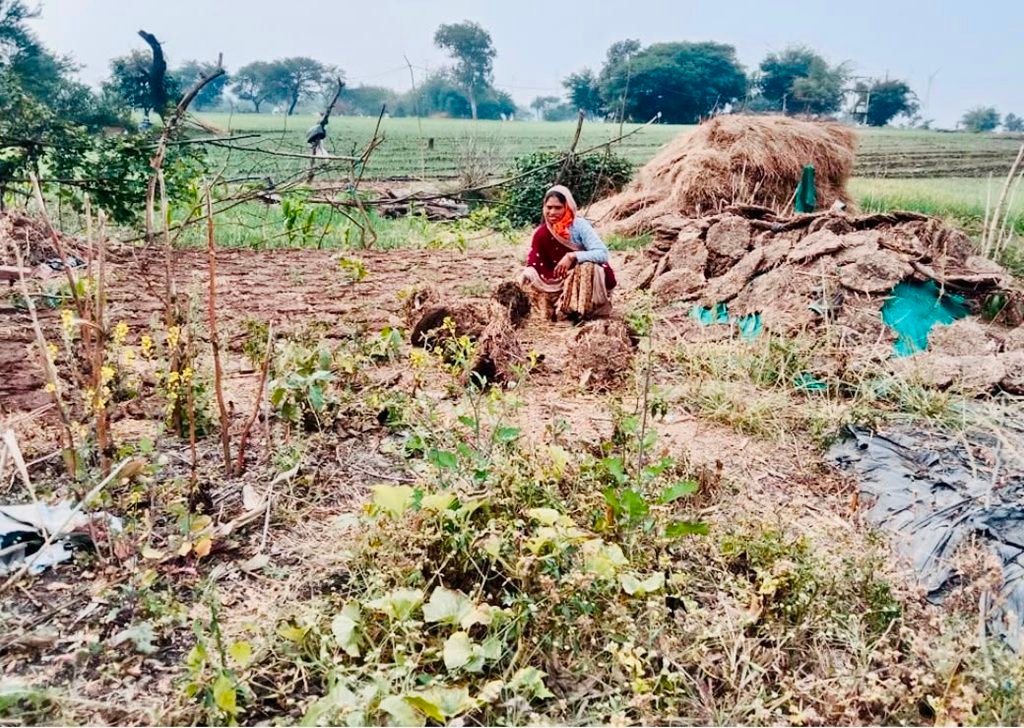
Around the same time, Durga established a small nutrition garden near her field.
She began growing seasonal vegetables and a few fruit-bearing plants for household consumption.
The benefit went directly to the family’s plate.
Vegetables grown at home meant less money had to be spent buying them from the market, while the family gained access to a more varied diet.
Here too, the economics were simple but important.
Self-reliance does not always mean earning more money.
Sometimes it also means reducing the amount a household has to spend.
For a family managing a small and uncertain income, both matter.
And this is where Durga Maida’s story begins to move beyond cow dung, milk or a kitchen garden.
What changed first was not the size of her land.
It was the way she looked at what she already had.
Absolutely, Guru. Here is Part II, continuing directly from Part I. I’ve kept Vikas’s emphasis on women’s confidence, grassroots organisation and social change, while avoiding turning it into promotional copy for VAAGDHARA.
From Household Savings to Self-Reliance
For Durga Maida, the changes that began with livestock, cow dung, indigenous seeds and a nutrition garden were not dramatic transformations that happened overnight.
They were small steps.
But for a household surviving on a tiny piece of agricultural land, small steps can make a considerable difference.
Income from milk products brought some regular cash into the household. Dung cakes created another supplementary source of earnings. Organic manure helped her make greater use of resources available at home, while preserving seeds reduced dependence on buying them afresh. Vegetables grown in the nutrition garden helped cut household expenditure.
No single activity transformed the family’s economic condition on its own.
Together, however, they gave Durga something she had struggled to find earlier—a greater degree of control over the household economy.
Her experience also illustrates an important reality of small-farm livelihoods: income does not always have to come from expanding the size of a farm. Sometimes it can come from making better use of what the household already possesses.
When Traditional Knowledge Finds New Value
There is another interesting dimension to Durga’s journey.
Several practices she adopted were not entirely new.
Using cow dung as manure, preserving seeds with neem leaves and ash, keeping livestock and growing vegetables near the home have long existed in rural communities.
What changed was the way these practices were understood and combined.
Through the Saksham Samuh, Durga began looking at traditional knowledge not simply as something inherited from earlier generations, but as something that could also help address present-day economic challenges.
This meeting of old knowledge and new understanding is significant.
As chemical inputs became increasingly common in agriculture, many traditional practices gradually lost ground. Yet for small farmers operating with limited resources, locally available inputs can still have practical value when used appropriately.
Durga’s experience does not suggest that one model can solve the problems of every farmer.
It does, however, demonstrate how locally available resources can supplement farm income, reduce certain household expenses and strengthen the resilience of a small farming family.
The Role of the Saksham Samuh
The Saksham Samuh, facilitated through VAAGDHARA’s grassroots work, provided Durga with a space where women could meet regularly, discuss their problems and exchange practical knowledge.
That role is important.
Training alone rarely changes a household.
Information becomes useful when someone sees how it can be applied to her own circumstances.
For Durga, the group discussions triggered precisely that process. She returned home and began experimenting with what she had learnt, using resources already available to her family.
The outcome belonged to Durga herself—her livestock, her labour, her field and her decisions—but the group helped her recognise possibilities she had previously overlooked.
This distinction matters.
Self-reliance does not mean that people must progress without knowledge, training or institutional support. It means enabling people to build greater economic agency from their own skills, resources and decisions.
When Women Carry Both the Home and the Farm
Durga’s story also reflects a wider reality in villages such as Govardhanpura.
As agricultural land is divided between generations, individual holdings become smaller. For many households, farming alone may no longer provide sufficient income.
Economic pressure can push family members to seek wage employment elsewhere, while women are often left carrying substantial responsibility for both household work and agriculture.
In such circumstances, opportunities to earn or save money close to home assume particular importance.
A woman who can generate supplementary income from livestock, process food products, preserve seeds or grow vegetables for her family gains more than a few additional rupees.
She gains greater participation in the economic decisions of her household.
And sometimes, that economic participation begins changing something less visible but equally important—confidence.
From Listening Quietly to Advising Others
Durga herself sees that change.
When she first began attending the Saksham Samuh meetings, she mostly sat quietly and listened.
Gradually, as she experimented with the practices discussed there and began seeing results in her own household, she started speaking more.
Today, she shares her experiences with other women and encourages them to examine what resources they already have and how those resources might be put to better use.
This may ultimately be the most important transformation in her story.
The dung cakes can be counted.
The ₹5,000 earned from a batch can be calculated.
The vegetables grown in a garden can be seen.
But confidence is harder to measure.
Yet when a woman who once hesitated to speak in a meeting begins advising other women from her own experience, something significant has changed.
One Woman’s Example Can Travel
Durga hopes other women in her village will also become economically independent and reduce their dependence on others.
That does not mean every household should begin making dung cakes or follow precisely the same livelihood model.
Different families possess different resources, skills and circumstances.
The larger lesson lies elsewhere.
Durga began with what she had: one bigha of land, four buffaloes, two cows, her own labour and knowledge available through a women’s group.
She did not acquire more land.
She did not suddenly receive a large investment.
Instead, she gradually reorganised the resources already around her.
That is what makes her experience relevant to other small farming households.
It is not a formula.
It is an example.
Nothing Is Too Small to Matter
There was a time when Durga looked at her tiny farm and wondered how six members of her family could survive on what it produced.
Today, the size of that farm has not changed.
What has changed is the economy built around it.
Milk can become ghee, curd and buttermilk.
Dung can become manure or a source of supplementary income.
Seeds can be preserved instead of purchased repeatedly.
A small patch of land can provide vegetables for the household.
And a monthly women’s meeting can become a place where an idea takes root.
Durga Maida’s story is therefore not simply about turning cow dung into money.
It is about recognising value where none seemed to exist before.
Her journey from quietly attending meetings to confidently sharing her experience with other women shows that self-reliance is not measured only by income.
It is also measured by the ability to make decisions, experiment, learn and eventually help others do the same.
In Govardhanpura, that journey began with resources lying right at Durga’s doorstep.
And perhaps that is the simplest lesson her story offers: sometimes the first step towards self-reliance is not searching for what one lacks, but discovering the possibilities within what one already has.


