

From a childhood spent carrying firewood in the hills of Manipur to becoming India’s first gold medallist at the Glasgow 2026 Commonwealth Games, Mirabai Chanu’s latest triumph was not simply another victory—it was the reward for years of sacrifice measured in hunger, pain and relentless belief.
There are victories that belong to the record books. Then there are victories that belong to the heart.
Standing inside the weightlifting arena in Glasgow, I watched the familiar ritual unfold. The barbell was loaded. The arena fell silent. Mirabai Chanu walked towards the platform with the calm expression that has become synonymous with Indian weightlifting. There was no outward display of emotion, no unnecessary theatrics—just another athlete preparing to do what she has done countless times.
Yet nothing about this evening felt routine.
When the final lift was completed and India’s tricolour began its ascent, the tears gathering in her eyes were impossible to miss. They were not tears born merely of another gold medal. They carried the weight of months of rehabilitation, years of discipline, and a lifetime spent refusing to surrender.
For a few moments, the arena grew quiet in my mind. I was no longer watching Glasgow. I was thinking about Nongpok Kakching in Manipur, where a young girl once carried bundles of firewood heavier than herself because it was simply part of daily life. Long before she learned Olympic technique, she had already learned resilience.
Perhaps that was where the champion was truly born.
The Medal Everyone Expected but Nobody Understood
Mirabai Chanu has reached a stage of her career where victories almost appear inevitable. Olympic silver medallist. World champion. Multiple Commonwealth Games champion. National icon.
Success can create the illusion that winning becomes easier.
It never does.
If anything, it becomes harder. Every competition arrives carrying expectation rather than opportunity. Every lift is judged not against rivals but against one’s own remarkable past.
Glasgow demanded something even more unforgiving.
The scale.
Not the scoreboard.
After the medal ceremony, Chanu smiled as the media gathered around her. Then she revealed the battle the public never sees.
“I have been almost hungry for three days because I had to keep my weight under control,” she said.
The sentence landed harder than any successful clean and jerk.
Weightlifting audiences celebrate kilograms raised above the head. Athletes often celebrate kilograms successfully removed from their bodies.
Competing in the 48 kg category demanded extraordinary discipline. Every meal became a calculation. Every sip mattered. Hunger itself became part of the preparation.
Then, with a smile that transformed the entire conversation, she added:
“I will eat pizza today.”
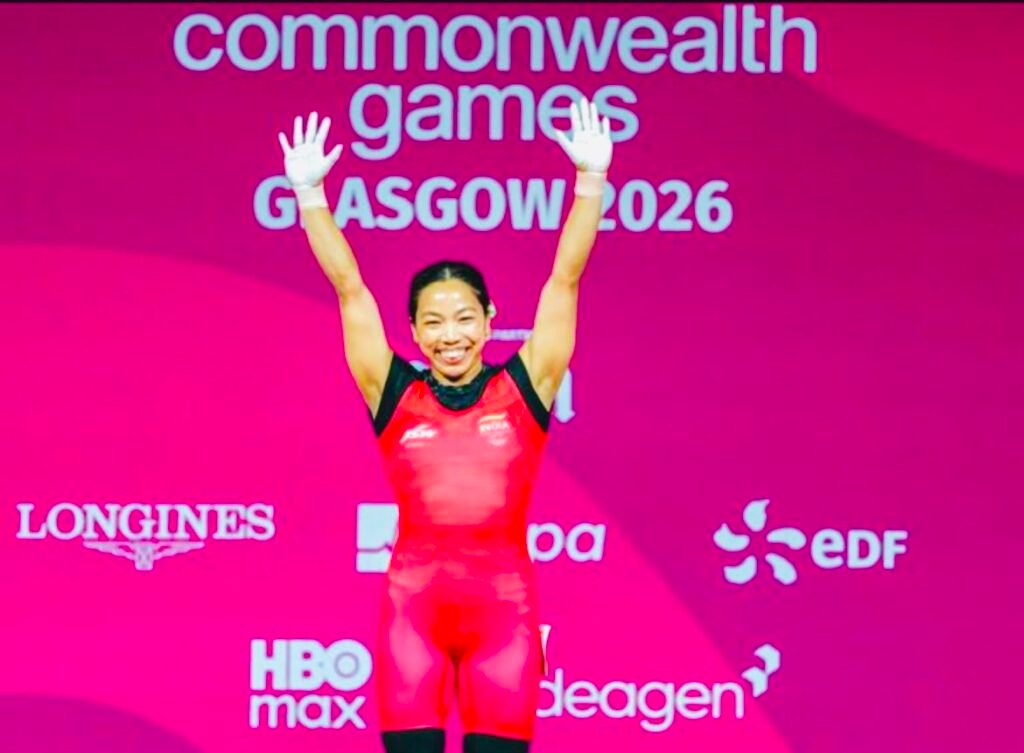
The room erupted in laughter.
For everyone else, pizza is comfort food.
For Mirabai Chanu, it had become victory itself.
Pain Before the Podium
Watching Chanu move so fluently on the platform, it would have been easy to forget the difficult years that preceded Glasgow.
Her career has rarely followed a straight line.
The disappointment of Rio. The glorious redemption of Tokyo. Recurring injury setbacks. Rehabilitation.
Questions over whether her body could continue absorbing elite-level training loads.
Every comeback demanded rebuilding rather than merely returning. There were days when training consisted not of lifting maximum weights, but of relearning movement itself.
Many athletes return after injury.
Very few return to dominate.
That is precisely what separates Mirabai Chanu. She has never allowed adversity to become her identity.
She simply treats it as another weight to lift.
The Little Girl from Manipur
Long before medals transformed her into one of India’s greatest sporting icons, Chanu was simply Saikhom Mirabai, the youngest of six siblings growing up in rural Manipur.
Her family possessed little in terms of material wealth. Her father worked with the Public Works Department, while her mother managed the household. The hills surrounding their home demanded physical labour every single day.
Neighbours often remember how effortlessly young Mirabai carried bundles of firewood that older boys struggled to lift.
Strength arrived naturally.
Opportunity did not.
Travelling long distances for training became routine. Resources were limited. Equipment was basic.
Dreams, however, were limitless.
Inspired by Olympic medallist Kunjarani Devi, another daughter of Manipur, Chanu believed that Indian women could become world-class weightlifters.
Years later, she would surpass even those dreams.
Perfection Built Through Patience
There is a misconception that weightlifting is simply about brute force.
It is not.
Elite weightlifting is rhythm, timing, mobility, balance and explosive acceleration. Milliseconds separate successful lifts from failure.
In Glasgow, Chanu demonstrated why she remains among the most technically accomplished lifters in international competition.
Her opening lift established immediate authority. Every movement appeared economical. The receiving position remained stable.
There was no panic beneath the bar—only precision.
While younger competitors attempted to chase her numbers, Chanu lifted with the confidence of an athlete competing primarily against her own standards.
That tactical maturity is impossible to teach quickly.
It comes only after years spent performing under the spotlight.
India’s First Gold and the Perfect Beginning
The significance of Chanu’s victory extended well beyond individual achievement.
When India’s medal tally finally turned gold, the emotional atmosphere surrounding the contingent shifted immediately.
Every major multi-sport event has a breakthrough performance that changes collective belief.
Glasgow found its moment through Mirabai.
For Indian wrestlers preparing backstage…
For boxers waiting for their opening bouts…
For shooters, athletes and para-athletes beginning their campaigns…
Her performance became reassurance.
India’s gold rush had begun.
The Medal That Belongs to Many
Standing before reporters, Chanu did not speak about records.
She spoke about family.
“It has been very tough to stay away from my family. My mother keeps pushing me.”
That sentence perhaps explains her career better than any statistic.
Elite athletes rarely compete alone.
Behind every champion stands an invisible team—parents who sacrifice, coaches who persist, physiotherapists who rebuild, and training partners who challenge.
Every medal contains far more names than the one engraved upon it.
Then came another sentence that captured the essence of her sporting philosophy.
“This medal is for India.”
Simple. Unrehearsed. Completely genuine.
More Than Gold
Eventually, Glasgow will remember the medal tally.
The records, the numbers and the history books always do.
I suspect I will remember something else.
I will remember a champion who admitted she had remained almost hungry for three days simply to honour her sport.
I will remember tears that arrived only after the work was complete.
I will remember the laughter that followed when she finally spoke about pizza.
It was such an ordinary sentence.
Yet it carried extraordinary meaning.
Because behind that single slice lay years of discipline that few will ever truly understand.
Mirabai Chanu did not simply become India’s first gold medallist at the Glasgow 2026 Commonwealth Games.
She reminded everyone inside the arena that greatness is rarely built on spectacular moments alone.
More often, it is built on the quiet sacrifices nobody applauds—the meals skipped, the pain endured, the family missed, the injuries overcome, and the unwavering belief that tomorrow’s lift will always be better than today’s.
As I walked out of the arena, I realised the loudest memory I would carry from Glasgow was not the clatter of the barbell hitting the platform.
It was a champion smiling through tears, dreaming not of another medal, but of the first slice of pizza she had truly earned.


