

With several traditional medal-winning disciplines absent from the programme, India arrives in Glasgow with fewer opportunities but perhaps a clearer sense of its sporting identity. From Neeraj Chopra’s relentless pursuit of excellence to Mirabai Chanu’s quest for another Commonwealth crown, India’s challenge is no longer about topping the medal table—it is about proving its strength in a leaner, more demanding sporting landscape.
The Commonwealth Games have rarely presented India with a challenge quite like Glasgow 2026.
For decades, the Games have been among India’s happiest hunting grounds, where wrestling, shooting, badminton, table tennis and hockey regularly contributed to the nation’s impressive medal tally. This time, however, the landscape has changed dramatically.
The streamlined programme of just ten sports has removed several of India’s most productive disciplines, forcing the contingent to recalibrate its ambitions. Around 125 Indian athletes will compete across 13 disciplines, including integrated para sports, making this one of the country’s most selective Commonwealth campaigns in recent memory.
The consequences are unmistakable.
India is unlikely to approach the overall medal haul it achieved four years ago in Birmingham. Yet equating fewer medals with diminished performance would be misleading. Glasgow demands efficiency rather than volume. Every podium finish will carry greater strategic value, while every missed opportunity will assume even greater significance.
Athletics now becomes India’s defining battlefield.
Never before has track and field carried such responsibility for India’s Commonwealth ambitions. The remarkable rise of Indian athletics over the past decade has fundamentally reshaped the country’s sporting identity. Instead of relying almost exclusively on combat sports, India now enters the Games with genuine medal prospects across multiple field events.
All Eyes on Neeraj Chopra
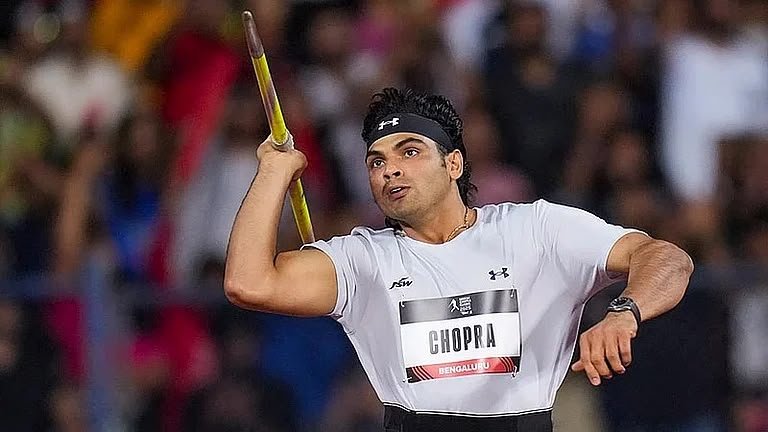
At the centre of those ambitions stands Neeraj Chopra, the undisputed face of Indian athletics.
Already an Olympic champion, world champion and Commonwealth gold medallist, Chopra arrives in Glasgow not merely as India’s biggest medal hope but as the benchmark in men’s javelin. His remarkable consistency has transformed him from India’s brightest prospect into the athlete every rival must overcome.
Unlike previous editions, where he competed under the weight of expectation, Chopra now enters with the confidence that comes from sustained global excellence.
His rivalry with Pakistan’s Arshad Nadeem has evolved into one of world athletics’ defining contests, ensuring that the men’s javelin final will once again command worldwide attention.
The men’s jumps also present significant medal opportunities.
Murali Sreeshankar has developed into one of the world’s most technically accomplished long jumpers. His ability to generate exceptional speed on the runway while consistently producing optimal take-off angles makes him a genuine medal contender whenever he performs to his potential.
Shot put specialist Tajinderpal Singh Toor, provided he is fully fit, remains capable of challenging the Commonwealth’s elite through a combination of experience, explosive power and championship temperament.
India’s middle-distance resurgence also deserves attention.
Gulveer Singh continues to establish himself as one of the country’s most promising endurance runners, while Jyothi Yarraji, despite recent injury concerns, remains a strong contender in the sprint hurdles if she returns to full fitness.
Meanwhile, race walker Priyanka Goswami, javelin thrower Annu Rani, triple jumper Abdulla Aboobacker and a promising new generation of sprinters led by Animesh Kujur further strengthen an athletics squad that possesses unprecedented depth.
More importantly, this is perhaps the first Commonwealth Games in which athletics has moved from being one of India’s medal-winning disciplines to becoming the foundation of its entire campaign.
Mirabai Chanu Remains India’s Most Reliable Medal Prospect
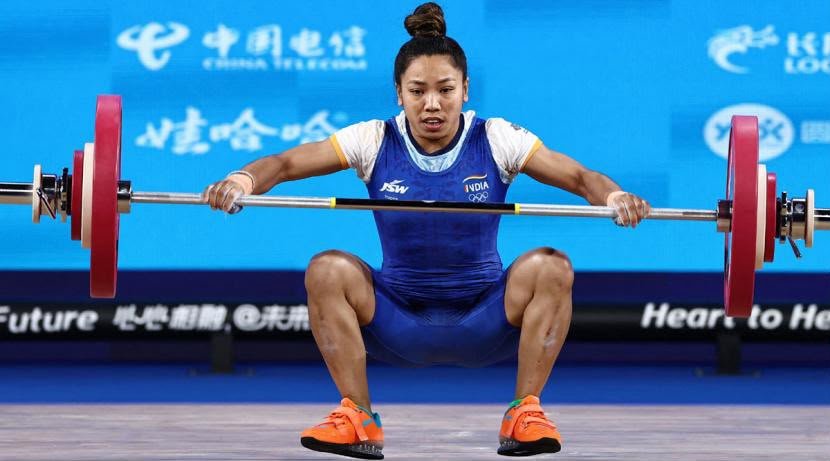
Few Indian athletes embody consistency quite like Saikhom Mirabai Chanu.
Every major championship arrives with questions about her fitness, yet time and again she demonstrates why she remains among the world’s finest weightlifters. Her superiority lies not merely in lifting heavier totals but in her remarkable ability to minimise mistakes under pressure.
Disciplined attempt selection, flawless technique and exceptional composure have become the hallmarks of her success. It is this combination of physical strength and mental resilience that has made Mirabai one of India’s most dependable performers on the international stage.
If she performs to her usual standards, another Commonwealth title is well within reach.
But India’s ambitions in weightlifting extend far beyond its biggest star.
Bindyarani Devi, Harjinder Kaur, Lovepreet Singh, Gyaneshwari Yadav and several emerging lifters provide realistic medal opportunities across multiple weight categories, reflecting the sport’s steady evolution from dependence on individual champions to a squad boasting genuine depth.
Mirabai, who is preparing for her fourth Commonwealth Games, remains quietly confident.
“I have always enjoyed the intensity of this competition. This is my fourth Commonwealth Games, and I am aiming for another gold medal. We have prepared thoroughly and are hopeful that our hard work will pay off. Of course, this is sport and there are always strong competitors, but I am confident,” Mirabai Chanu told TheNews21.
For India’s weightlifters, however, Glasgow is about more than Commonwealth success.
With the Asian Games fast approaching, the competition also serves as a crucial benchmark for assessing form, refining strategy and building momentum against stronger continental opposition.
That larger objective is clear within the Indian camp.
“We have come here well prepared and our group is expecting to win more medals. This tournament is an important stepping stone before the Asian Games, which are now just around the corner. For the past 15 years, Indian weightlifters have struggled to win medals at the Asian Games. We want to break that barrier,” India’s weightlifting coach Vijay Mishra told TheNews21.
The statement reflects a broader shift in Indian sport. Commonwealth success remains valuable, but increasingly it is viewed as part of a longer journey towards sustained excellence on the Olympic and Asian stage.
Boxing Continues to Deliver Medal Certainty
If athletics offers India’s greatest medal potential, boxing arguably provides its most dependable returns.
Olympic medallist Lovlina Borgohain once again spearheads the campaign. Her tactical discipline, efficient footwork and intelligent distance management have established her as one of India’s most reliable performers on the biggest stages.
Alongside her stands an exciting new generation of technically gifted boxers, including Jaismine Lamboria, Preeti Pawar, Sachin Siwach, Priya Ghanghas and Parveen Hooda, each capable of extending India’s rich tradition of Commonwealth podium finishes.
The streamlined format, however, presents fresh challenges.
With fewer competitors in each weight category, every draw assumes greater importance. A difficult opening bout can significantly alter a campaign, placing greater emphasis on tactical preparation, recovery and adaptability throughout the tournament.
For India, boxing remains one of the disciplines where expectation is matched by genuine depth.
Lawn Bowls: Building on Birmingham’s Breakthrough
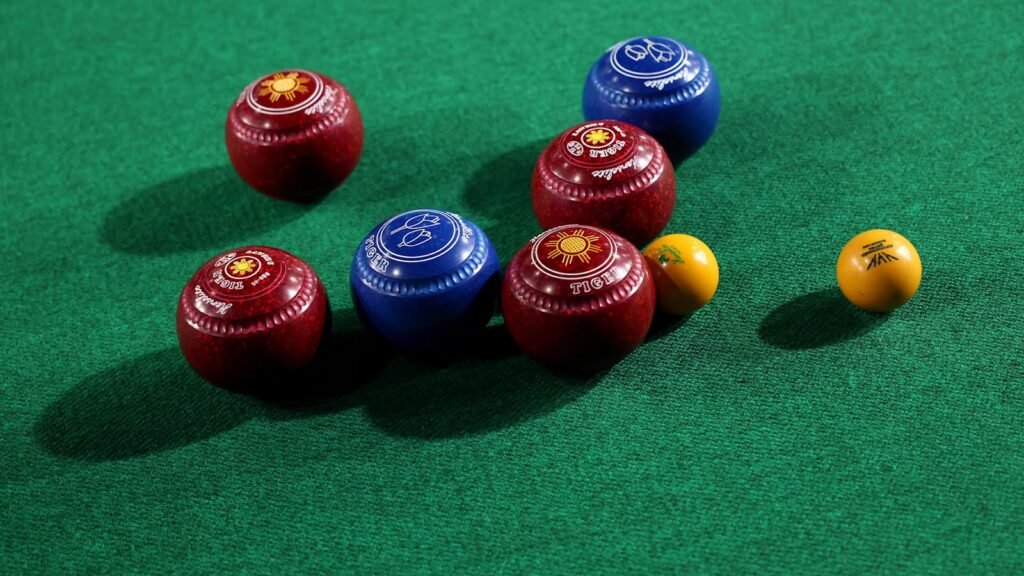
Lawn bowls was once regarded as an unfamiliar sport for Indian audiences.
That perception changed dramatically at the Birmingham Commonwealth Games, where India’s historic success transformed both public awareness and expectations.
Glasgow now offers an opportunity to prove that Birmingham was not an isolated achievement.
India made an encouraging start to its campaign when Putul Sonowal produced one of the early surprises of the competition, defeating defending world outdoor champion Ryan Bester in a first-round tie-breaker. Sonowal will next face Cecil Alexander of the Falkland Islands in the men’s singles.
The result has injected fresh confidence into the Indian squad.
Gold medallist Nayanmoni Saikia, together with an increasingly experienced group of bowlers, arrives believing India can once again compete with the sport’s traditional powerhouses.
Replicating Birmingham’s golden success will undoubtedly be difficult.
Yet perhaps the biggest transformation lies elsewhere.
India no longer steps onto the greens as an outsider. It now competes with the confidence, experience and belief of a nation that has already proved it belongs on the Commonwealth stage.
Judo and Para Sport Offer Additional Medal Opportunities
India’s medal ambitions extend well beyond its headline disciplines.
In judo, Tulika Maan continues to establish herself as a genuine force on the international stage. Her steady rise, combined with the experience of several accomplished judokas across different weight categories, provides India with realistic opportunities to add to its medal tally.
While judo may not attract the same attention as athletics or boxing, it remains one of the disciplines capable of producing valuable podium finishes in a streamlined Commonwealth programme where every medal carries greater significance.
The integration of para sport presents another important avenue for India.
Over the past decade, the country has made remarkable progress in para-athletics, para-swimming and para-powerlifting, producing athletes who now consistently challenge the world’s best. Their growing competitiveness reflects not only individual excellence but also the strengthening of India’s high-performance ecosystem for para sport.
At Glasgow 2026, their performances could play a crucial role in shaping India’s overall medal tally while reinforcing the country’s emergence as a more inclusive sporting nation.
The Real Measure of Success

Glasgow should not be judged against Birmingham.
Any direct comparison would ignore the structural reality of a Games programme that no longer includes several of India’s most successful sports. Wrestling, shooting, badminton and table tennis alone accounted for a substantial share of India’s medals in previous editions, and their absence fundamentally reshapes expectations.
Success, therefore, should not be measured simply by the number of medals India wins.
Instead, the more meaningful questions are these:
Can India’s leading athletes perform according to their world rankings?
Can emerging competitors convert promise into podium finishes?
Can athletics successfully assume the leadership role once occupied by wrestling and shooting?
The answers to these questions will define India’s Commonwealth campaign far more than the final medal tally.
The overall numbers may decline, but the value of each medal will inevitably increase.
A Defining Moment for Indian Sport
Glasgow represents more than another Commonwealth Games for India.
It is a test of how successfully Indian sport has evolved beyond dependence on a handful of traditional disciplines.
The country’s ambitions now rest on a smaller group of world-class performers delivering excellence when it matters most.
If Neeraj Chopra throws with his customary authority, Mirabai Chanu lifts with her trademark precision, Lovlina Borgohain boxes with her characteristic tactical intelligence, and India’s next generation rises alongside them, Glasgow 2026 may ultimately be remembered not for the number of medals India won, but for how convincingly the country adapted to a very different Commonwealth landscape.
For years, India’s Commonwealth success was measured by the size of its medal haul.
This time, the true measure lies elsewhere.
It lies in resilience.
It lies in adaptability.
And above all, it lies in demonstrating that Indian sport has matured into a system capable of delivering excellence even when the opportunities are fewer and the margin for error is smaller.
In Glasgow, India is unlikely to be judged by quantity alone. It will be judged by the quality of its performances—and that may prove to be the most meaningful test of all.


