

London: In the first-ever women’s Test at Lord’s, Indian women’s cricket reached one of its pivotal moments on Sunday when Harmanpreet Kaur’s team defeated England by 270 runs, creating history at the game’s most famous location. In addition to being India’s first women’s Test victory at the Home of Cricket, the victory set new standards for performance, temperament, and tactical brilliance.
India won every stage of the competition over the course of four days. The visitors produced a comprehensive Test match performance, from Smriti Mandhana’s confident strokeplay and Yastika Bhatia’s historic century to Kranti Gaur’s memorable five-wicket haul, Sneh Rana’s incredible performance, and a disciplined bowling effort that destroyed England twice. It was more than just a historic outcome; it was a declaration that India’s women’s team has the mental toughness, strategic maturity, and technical depth needed to succeed in the most challenging format in the sport.
There are victories that add another statistic to a record book, and then there are victories that alter the narrative of a sport. India’s victory in the first-ever women’s Test at Lord’s belongs firmly in the latter category. At the ground universally regarded as cricket’s spiritual home, India did not merely win a Test match—they established authority over conditions, dictated tempo across four days and demonstrated a complete understanding of the demands of red-ball cricket. Every session reinforced the same conclusion: the squad was a team capable of mastering both the romance and the ruthlessness of Test cricket. The margin of victory reflected more than numerical dominance. It represented superiority in planning, execution and temperament.
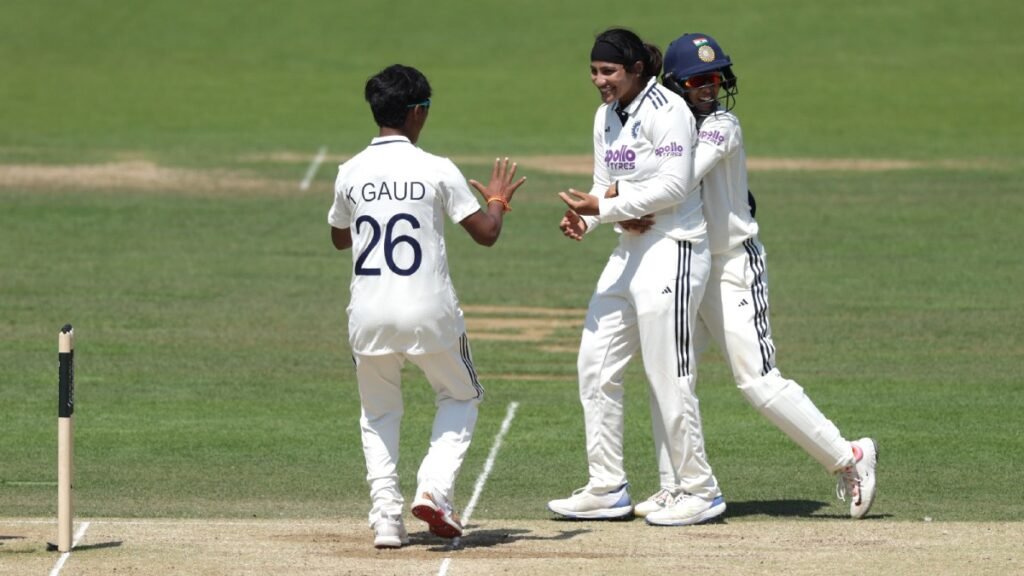
India arrived at Lord’s carrying the responsibility of creating history. They departed having written one of the finest chapters in Indian women’s cricket. The foundation was laid on the opening day when India’s batting unit refused to be hurried by English conditions. Rather than chasing boundaries, the visitors embraced the virtues Lord’s demands—patience, soft hands, disciplined shot selection and relentless occupation of the crease.
Smriti Mandhana once again demonstrated why she has evolved into one of the most technically complete batters in contemporary women’s cricket. Her first-innings 83 was not merely an attractive innings filled with elegant drives through cover; it was a calculated exhibition of risk management. She judged length early, trusted the bounce and forced England’s seamers away from their preferred channels. Whenever England attempted to attack outside the off stump, Mandhana’s balance at the crease allowed her to either leave confidently or punish anything fractionally overpitched. Her innings removed scoreboard pressure before England could exploit the new ball.
Captain Harmanpreet Kaur then shifted the innings into its second phase. Her composed half-century provided exactly what Test cricket values most—a bridge between the top order and the lower middle order. Rather than chasing momentum, she accumulated it. Deepti Sharma’s unbeaten fifty perhaps became the innings’ tactical turning point. Lower-order partnerships frequently determine Test matches, and Deepti ensured India converted a promising position into a competitive first-innings total. By extending the innings beyond England’s comfort zone, India added valuable runs while also increasing the workload on England’s pace bowlers.
A total of 285 may not initially have appeared overwhelming, but on a surface offering movement, it proved significantly above par. The decisive moment of the Test arrived not with the bat but with the ball. Kranti Gaur produced a spell that will remain embedded in Lord’s folklore for years to come. Swing, seam movement, disciplined lengths and unwavering control transformed her from an exciting young fast bowler into a historic figure. Her remarkable five-wicket haul dismantled England’s batting and earned her the distinction of becoming the first woman to enter the Lord’s Test honours board for a five-for. More impressive than the figures themselves was the method behind them.
Rather than searching for miracle deliveries, Gaur repeatedly challenged the corridor outside off-stump, forcing England’s batters into difficult decisions. At Lord’s, where the slope naturally assists seam bowlers who maintain disciplined angles, she used the conditions intelligently instead of relying on sheer pace.
Her consistency denied England any opportunity to establish partnerships. The supporting cast proved equally important. Sayali Satghare maintained relentless pressure from the opposite end, while Sneh Rana’s accuracy prevented England from rebuilding once the ball softened. Instead of allowing the innings to drift, India squeezed every scoring option, forcing England into mistakes born from frustration rather than attacking intent. England were dismissed for just 170 runs.
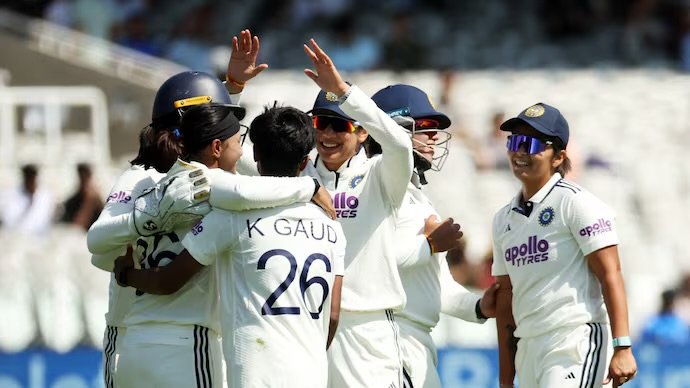
Suddenly, India held not only a commanding lead but complete tactical control. The greatest teams know when they can take a Test match away from the opposition. India sensed that opportunity immediately. Their second innings displayed maturity rather than impatience. Mandhana once again led from the front, proving that consistency across both innings remains the hallmark of elite Test batters. But it was Yastika Bhatia who elevated the match into history. Her magnificent century became the first-ever women’s Test hundred at Lord’s, an achievement carrying significance far beyond personal milestones. Built with exceptional discipline against both seam and spin, the innings showcased a batter entirely comfortable constructing a Test match hundred rather than accelerating towards one.
Every phase reflected intelligent batting. She absorbed pressure during the morning session, rotated strike efficiently through the middle overs and expanded her scoring options only after establishing complete control. By the time India declared, England faced the daunting challenge of surviving a deteriorating fourth-day surface while chasing an almost impossible target.
From that point, the outcome increasingly became a question of when rather than whether. India’s bowlers answered emphatically. Rather than defending the target conservatively, they attacked with fields designed to take wickets. Catchers remained in place around the bat. The seamers consistently threatened both edges before the spinners exploited growing footmarks and variable bounce.
This aggressive mindset separated India’s approach from merely protecting a lead. They hunted victory. England’s batting never established the partnerships required to threaten a draw. Every attempt at resistance encountered disciplined bowling, intelligent field placements and sustained pressure. The visitors controlled the scoring rate so effectively that attacking became England’s only realistic option—a tactical trap that inevitably produced wickets.
Winning at Lord’s has always occupied a unique place in cricket’s imagination. For Indian women’s cricket, however, this triumph carries an even deeper resonance. It was the inaugural women’s Test at the venue. It produced the first women’s Test century at Lord’s. It witnessed the first woman to enter the Lord’s honours board with a five-wicket haul. Most importantly, it concluded with India securing one of the largest overseas Test victories in their history, defeating England by a remarkable 270 runs.
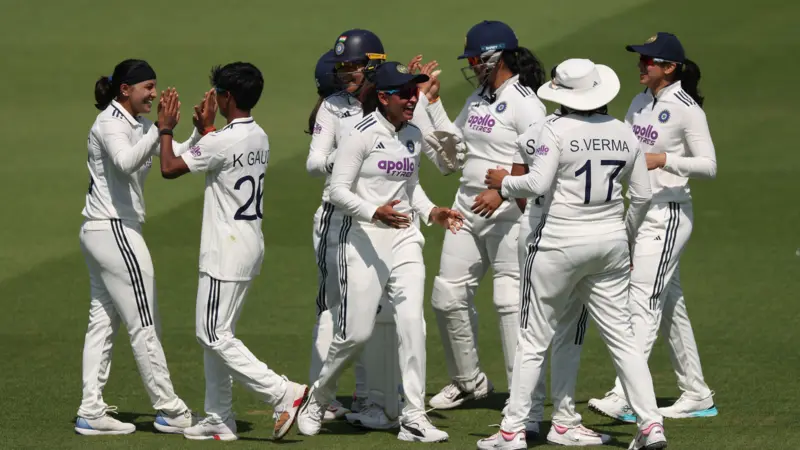
Perhaps the greatest takeaway extends beyond records. For years, women’s cricket has often been evaluated primarily through the lens of white-ball formats. This Test reminded the cricketing world that the longer format remains the ultimate examination of technique, endurance, patience and tactical intelligence.
India excelled in every one of those disciplines. Their batters showed the patience to build innings. Their bowlers maintained discipline over extended spells. Their captain managed sessions instead of merely overseeing them. Their fielders sustained intensity across four demanding days. Collectively, they produced the kind of complete Test performance that wins admiration regardless of era or opposition.
Long after individual statistics fade from memory, this Lord’s Test will be remembered as the moment Indian women’s cricket claimed one of the game’s most revered stages—not simply by participating in history but by owning it.


