

One dismantled England’s batting with unwavering accuracy. The other quietly ended England’s hopes with patience and flawless technique. Kranti Gaur became the first bowler to take five wickets at Lord’s in a women’s Test match, and Yastika Bhatia became the first to score a Test century at Lord’s. Both of their names are in the book of cricket history.
London: The spotlight naturally falls on spectacular performances. A five-wicket haul. A century under pressure. Kranti and Yastika both create records at Lord’s. Yastika became the first woman to score a century in the Women’s Test at Lord’s, while Kranti became a five-wicket taker. A winning performance. However, the true beauty of Test cricket goes deeper. It rewards players who value consistency, patience, and discipline. Provided a powerful reminder of that timeless truth.
Kranti Gaur announced herself on one of cricket’s grandest stages with a remarkable exhibition of pace bowling. At the same time, Yastika Bhatia justified India’s faith in her selection through an innings that combined technical excellence with immense mental strength. Together, they have become two of the defining figures of this historic Test.
As India tightened its grip on the first-ever women’s Test at the Home of Cricket, two performances stood apart—not because they were dramatic, but because they reflected everything that successful red-ball cricket demands.
Kranti Gaur: Pace With Purpose
Fast bowlers often speak about rhythm. Kranti Gaur found hers at Lord’s. England is always her lucky ground, where she took a 6-wicket haul in July 2025 in the Women’s ODI against England. The young seamer did far more than collect wickets. She consistently challenged England’s batters with disciplined lines, intelligent changes in length and an understanding of how the famous Lord’s slope could become an additional weapon.
Rather than searching for magic deliveries everywhere, she built pressure patiently. She attacked the stumps. She forced batters to play. She invited mistakes instead of chasing them. That is precisely how successful Test pace bowling is constructed. Her reward was a magnificent five-wicket haul — an achievement that carries significance far beyond the scorebook. In the first-ever Women’s Test at Lord’s, Kranti became the first woman to earn a place on the iconic Lord’s Bowling Honours Board, a milestone that reflects both personal excellence and the growing stature of women’s Test cricket – 5/37.
Even more impressive was her maturity. This was not bowling fuelled by emotion alone. It was bowling guided by planning, discipline and control. Every spell seemed built around a clear tactical objective, whether attacking the top of the off stump, drawing batters forward with fuller deliveries or exploiting movement away from the right-handers. For a young fast bowler playing only her second Test, it was a performance of extraordinary composure.
Yastika Bhatia Silences the Debate
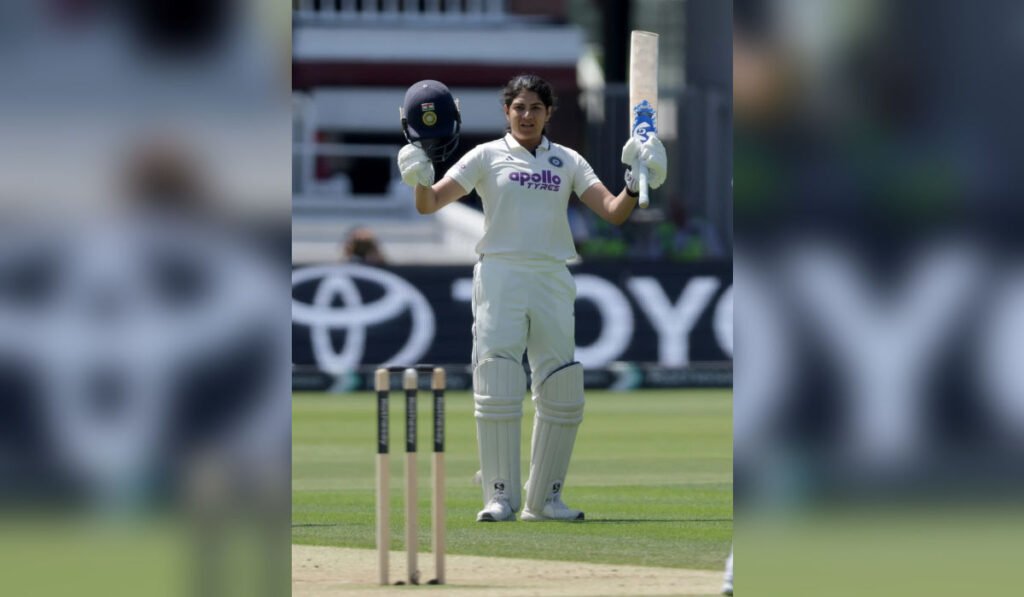
Yastika became the first woman to score a century in a women’s Test match at Lord’s, a historic achievement that reflects both personal brilliance and the growing importance of women’s Test cricket. Before this Test, India’s wicketkeeping selection had generated considerable discussion. Would the team prefer the explosive batting of Richa Ghosh or the specialist red-ball skills of Yastika Bhatia? At Lord’s, Yastika has provided the answer with both gloves and a bat.
It has been her batting that has transformed the conversation. After a modest contribution in the first innings, Yastika produced an innings of remarkable control in the second. Instead of letting England’s bowlers take control, she trusted her defence, left the ball well outside off stump, and only capitalised on genuine scoring opportunities. There was no unnecessary aggression. No impatience. Only complete control.
As the innings progressed, she grew in confidence, converting a steady start into a superb century that further tightened India’s grip on the match. Her partnership-building ability allowed India to extend its lead beyond England’s reach while wearing down an increasingly tired bowling attack.
Her contribution behind the stumps was understated yet immensely valuable as well. Standing back to the seamers on a surface that offered movement, she demanded clean footwork, soft hands and sustained concentration. She rarely looked hurried, gathered the ball confidently and completed the chances that came her way.
Technique Wins Test Matches
Maybe Kranti and Yastika achieved their goals in very different ways – Kranti with the ball and Yastika with her bat – but both performances were based on the same sound technique. Kranti consistently hit difficult lengths rather than looking for extravagant swings. Yastika relied on her defence before expanding her stroke play. Neither player tried to force the game. Instead, they let the game come to them. This approach reflects a growing maturity in Indian women’s cricket.
India’s Red-Ball Evolution
For many years, India’s success was largely dependent on individual brilliance. This team appears to be getting more comfortable working together. Smriti Mandhana provided elegant starts. Harmanpreet Kaur provided stability. Deepti Sharma once again delivered with both bat and ball. Kranti Gaur has emerged as a genuine pace threat, while Yastika Bhatia has demonstrated the importance of specialist wicketkeeping and technical batting in the longer format. Each player has fulfilled a specific role. Together, they have delivered a performance that has gradually dismantled England’s resistance.
A Performance Worthy of Lord’s
The significance of this test extends far beyond the result. Lord’s has finally hosted a Women’s Test. The occasion demanded performances capable of matching the venue’s legacy. Kranti Gaur answered that challenge with a spell that has already earned a place in the history of the ground. Yastika Bhatia responded with an innings that demonstrated why patience, temperament and technical excellence remain priceless qualities in Test cricket.
Some players dominate headlines through power. Others make their impact through precision. At Lord’s, Kranti Gaur and Yastika Bhatia have shown that the longest format still belongs to those prepared to master the smallest details. In a match already destined to occupy a special place in cricket history, their performances have become part of that legacy.


