

The evening air in old Srinagar carries the scent of woodsmoke and the coolness of approaching dusk. Follow the sound of a lone harmonium drifting through a half-open window, and the noise of the street slowly begins to fade. Inside, a few neighbours sit on a faded carpet, their faces illuminated by a single lightbulb. When the singer closes his eyes and plays the first lingering note, the room falls completely silent. For an hour or two, the worries of the day are gently set aside, replaced by a quiet sense of calm.
During reporting across the Valley, one phrase surfaced repeatedly in conversations with listeners, elders and musicians: Taar Lagun. Literally translated as “joining a wire,” it describes the moment when a song creates a direct, unbroken connection between a heavy heart and the Divine.
The Anatomy of Taar Lagun
If you sit down with ordinary listeners, elders or folk musicians anywhere in Kashmir today, you quickly realise that this music is a living tradition, not a historical artefact.
“When you play a Sufi song dedicated to a great saint like Makhdum Sob (Sultan-ul-Arifeen Sheikh Hamza Makhdoom),” explains Ghulam Hassan Rather, a 68-year-old resident of the old town of Srinagar, “something physical shifts in the room. You are not just listening to historical words. A taar (wire) is instantly built. It is an immediate line connected directly to the one whom the song is about.”
Within this tradition, listening to these songs is a search for an anchor. When a person listens to a melody concerning their Peer (spiritual guide) or Wali (saint), their heart tethers to them. Because the saints are regarded as being close to God, they become a spiritual conduit. The song itself becomes a prayer, as though listeners are holding onto the robes of the saint, asking to be lifted out of worldly suffering and guided towards the Divine.
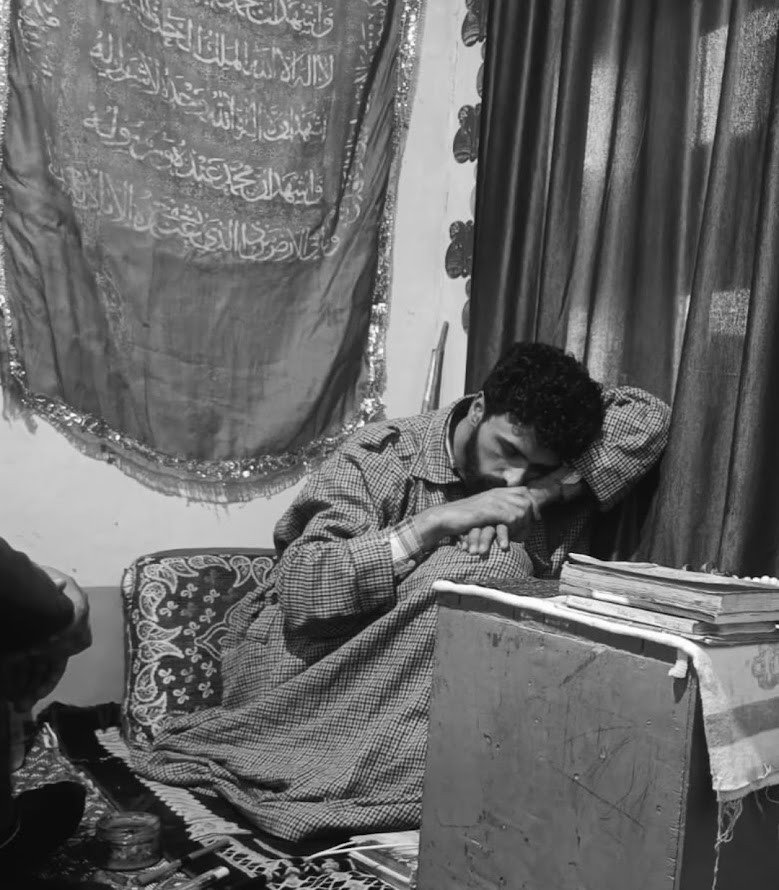
To explain this state of complete spiritual dependence, Ghulam Hassan Rather recites a verse often sung in Kashmir:
Kashmiri:
Dariyaav taraan veer ba gous
Manz sar Khudaya ba geer gous
Bouth laagtam Peer-e-Rehbaro
Hoo ba kariyo yoor waloo
Translation:
While crossing the river, I am stranded.
In the middle, I am struggling.
Lead me safely to the shore, O my guide, my Prophet.
The Currency of Suffering
“Our folk songs carry Seer-e-Asrar—profound secrets and hidden truths about existence,” says Nazir Ahmad, a 57-year-old resident of Athwajan. “They are like locked doors. A young or untouched heart might enjoy the melody, but the deeper meaning remains hidden.”
“It is only when someone has ‘seen something in life’, when they have walked through the fire of heartbreak, profound grief or a major life crisis, that the lock clicks open,” Ahmad continues. “The pain of living becomes the key that allows you to understand the hidden secrets written into the poetry. You hear a verse you’ve heard a thousand times before, but suddenly, because you’ve suffered, you actually understand it.”
The Blended Verse
The architecture of this cosmic connection relies entirely on how Kashmir’s mystics are kept alive—not in textbooks, but in the daily conversations and memories of its people. The poetry of the past remains deeply woven into the Valley’s contemporary spiritual and cultural consciousness.
“When you get to my age, you look at your hands and realise you have very little time left on this earth,” says a 63-year-old grandmother from Srinagar, who requested anonymity.
“You start to look back at your whole life—what you did, what you lost, and what is actually left now. In that quietness, you naturally start to think about God. I don’t look for worldly distractions anymore. I just start singing as if preparing my soul.”
She hums a verse by Habba Khatoon (16th century) that she says she learned from her own mother.
Kashmiri:
Keh draai hel kel keh jaananai,
Chaa mea daanai hoosh
Mea ha ker chei ket poshe daswanai,
Chaa mea daanai hoosh
Translation:
Some wandered here, others wandered elsewhere in search of the Beloved.
I gathered flowers for you; grant me the ecstasy of true wisdom.
This inward journey towards the Divine eventually demands a deeper, more painful stripping away of the worldly self. To truly connect with ultimate reality, the seeker must confront the greatest barrier of all: the human ego.
The Discipline of the Soul
Mohammad Shafi, a 71-year-old retired schoolteacher, treats this musical tradition as a discipline for the soul.
“The hardest thing a human being has to do is face their own ego, their own anger and their own pride,” Shafi says. “When I feel lost or frustrated with life, I repeat these specific verses to quiet my mind. When a singer performs them at a local gathering, the entire room goes completely still. It forces you to look inward and break yourself down, piece by piece, until nothing worldly matters anymore, leaving only the pure spirit intact.”
He recites the lines of Lal Ded (14th-century Kashmiri mystic poet):
Kashmiri:
Kalmey parum tay kalmey sorum,
Kalmey banovum Panuy Paan
Kalmey Moyas Hani hani thurm,
Ad Lal weates Laa Makaam
Translation:
I read the Sacred Word, and I absorbed the Sacred Word. Through the power of the Word, I reshaped my own true self.
Slowly, piece by piece, I let myself dissolve completely into the Word. And that is how Lal reached the Ultimate Realm, far beyond space and time.
Once the ego is dismantled, the boundary between the seeker and the world begins to disappear, transforming the song from a private prayer into a vision of universal unity. In the crowded, narrow alleys of old Srinagar, this continuous lineage of spiritual awakening, preserved through music, has not skipped the younger generation.
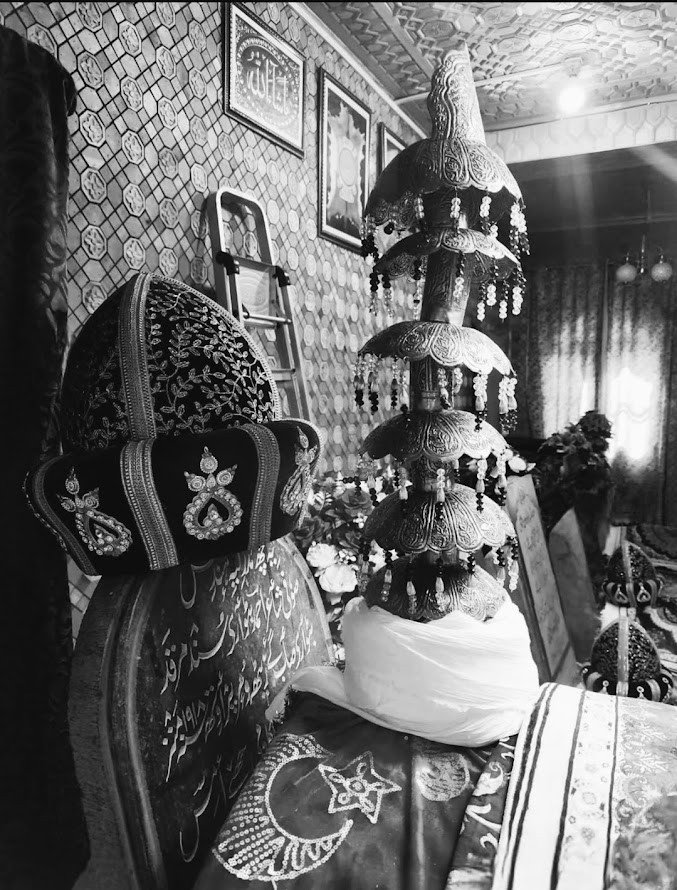
The resting place of Peer Ahmad Soubi Batwari reflects Kashmir’s enduring Sufi traditions, where devotion, poetry and music remain deeply intertwined. Photo: Kazim Altaf.
Basharat Ali, a 29-year-old traditional musician, sits cross-legged on a rug, tuning his harmonium as he prepares to bridge ancient truths with the uncertainties of the present day.
“Look at the world around us. Everyone is angry, everyone is divided, and everyone is fighting over nothing because they only see the surface,” Basharat says, his fingers brushing the keys. “When I perform, I choose songs that remind people that we are all connected by the same divine breath. If you hate someone else, or if you keep malice in your heart, you are only destroying your own spirit. I sing this because it’s the only way I know how to dissolve those divisions and keep myself steady in the divine presence.”
He clears his throat, closes his eyes and begins to sing a couplet by Shamas Faqeer (19th century) that, for him, captures the ultimate expression of this seamless cosmic connection.
Kashmiri:
Wanyo seer e asrar,
Yeno aasakh wobale
Mea wuch har shaye su yaar,
Chana kah zar te khale
Translation:
Speak of the hidden mysteries, otherwise you will bring spiritual ruin upon yourself.
For I have witnessed the Beloved in every single thing, without any doubt or division in my heart.
Epilogue
In Kashmir, these songs have outlived the people who first sang them. They continue to be passed from one generation to the next, not because they are old, but because they continue to answer questions that every generation eventually asks. Through grief, uncertainty and hope, they remain a way of seeking meaning.
For those who sing and those who listen, Taar Lagun is more than a belief. It is the feeling that, for a few moments, the distance between the human and the Divine disappears.
And as long as these verses continue to echo through shrines, homes and gatherings, that connection will continue to endure.


